Table of Contents >> Show >> Hide
- What Is the 100 Dollar Bill, Exactly?
- Why Is Benjamin Franklin on the 100 Dollar Bill?
- How the 100 Dollar Bill Changed Over Time
- What Appears on the Front and Back of a 100 Dollar Bill?
- How to Check Whether a 100 Dollar Bill Is Genuine
- Why the 100 Dollar Bill Matters So Much
- Can You Still Use Old 100 Dollar Bills?
- Common Myths About the 100 Dollar Bill
- Experiences Related to the 100 Dollar Bill
- Conclusion
The 100 dollar bill is the celebrity of American cash. It is the note people double-check under the light, tuck carefully into a wallet, and immediately become suspicious of when a stranger tries to pay for gum with one. It is also the highest denomination of U.S. currency currently issued for public use, which gives it a strange superpower: it feels both ordinary and important at the exact same time. One minute it is helping someone pay a hotel deposit, and the next it is starring in a movie scene, a birthday card, or an awkward debate at the checkout counter over whether the cashier has enough change.
But the 100 dollar bill is more than a flashy piece of paper with Benjamin Franklin’s face on it. It is a carefully engineered piece of American design, history, and anti-counterfeiting technology. It reflects the country’s trust in its currency, the evolution of printing science, and the global role of the U.S. dollar. In other words, this is not just “a hundred bucks.” It is a miniature lesson in economics, politics, security design, and national symbolism, folded into something small enough to vanish into a jeans pocket and large enough to make people suddenly very polite.
What Is the 100 Dollar Bill, Exactly?
The modern 100 dollar bill is a Federal Reserve note and the largest denomination currently issued by the Federal Reserve for everyday public circulation. Higher denominations once existed, including the $500, $1,000, $5,000, and even $10,000 notes, but those were discontinued decades ago after falling out of practical use. That decision helped cement the $100 note as the heavyweight champion of ordinary U.S. cash.
The bill has a practical reputation for a simple reason: it carries serious value without becoming absurdly bulky. Ten one-dollar bills feel casual. Ten $100 bills feel like a plot twist. That portability is part of why the note became so important in commerce, travel, savings habits, and international demand. Whether it is used in a luxury purchase, a cash gift from grandma, or a tucked-away emergency fund, the 100 dollar bill has long represented a sweet spot between convenience and clout.
Why Is Benjamin Franklin on the 100 Dollar Bill?
One of the most common questions about the 100 dollar bill is also one of the most fun: why is Benjamin Franklin on it when he was never president? The answer is that American currency is not reserved only for presidents. Franklin earned his place by being one of the most influential figures in early American history. He was a statesman, diplomat, printer, inventor, and one of the nation’s most effective public thinkers. If early America had an all-purpose MVP, Franklin would have been a strong draft pick.
He was also deeply connected to printing and money itself. Long before his portrait appeared on the note, Franklin was involved in printing colonial currency. He experimented with anti-counterfeiting techniques, including nature-based impressions and intricate printing details that made fake notes harder to produce. That detail is almost too perfect: the man on the $100 bill was once helping make money harder to copy. Franklin would probably appreciate the irony, and then write a witty essay about it.
How the 100 Dollar Bill Changed Over Time
From Classic Greenback to Security Workhorse
Earlier versions of the $100 note had the classic old-school American money look: formal portrait, traditional border work, and far less visual drama. For many years, the reverse featured Independence Hall, and that building remains one of the note’s most enduring symbols. The design was dignified, familiar, and about as flashy as a courthouse staircase. That worked for a long time, but technology eventually forced the bill to get smarter.
The 1996 Redesign
In the mid-1990s, the U.S. government redesigned the $100 note to stay ahead of improving reproduction technology. That redesign introduced features such as an enlarged off-center portrait, a watermark, a security thread, and microprinting. The idea was to keep the note recognizable while making life much harder for counterfeiters. It was a balancing act between tradition and innovation: familiar enough that people would trust it, modern enough that copy machines would regret trying.
The 2013-Present Design
The current-generation $100 bill, first issued in 2013, pushed security much further. It introduced the blue 3-D Security Ribbon and the color-shifting Bell in the Inkwell, two of the note’s most visually distinctive features. It also retained earlier safeguards like the portrait watermark, security thread, and color-shifting numeral “100.” The result is a bill that looks more dynamic than older U.S. notes without turning into a cartoon of itself.
This redesign also expanded patriotic imagery. Phrases from the Declaration of Independence, a quill, and a revised presentation of Independence Hall helped give the bill a stronger symbolic identity. The note is not trying to be art museum wallpaper, but it clearly wants you to notice that America takes both its history and its anti-counterfeiting budget very seriously.
What Appears on the Front and Back of a 100 Dollar Bill?
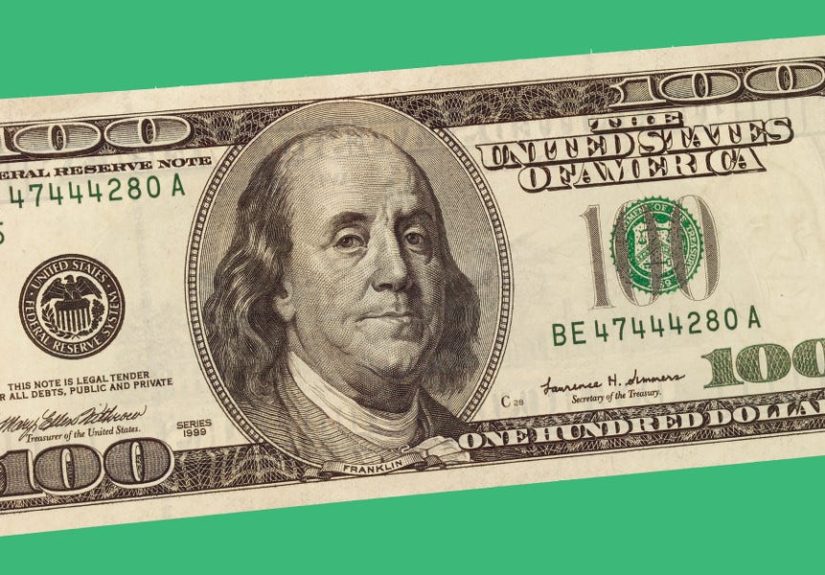
On the front, the central feature is Benjamin Franklin’s portrait. Around him are several design elements that blend symbolism with security: fine-line engraving, large gold “100” printing, the blue ribbon, the copper inkwell with the color-shifting bell, and microprinting embedded in places casual users rarely notice. The front is where most of the bill’s anti-counterfeiting work happens, which makes sense. That is the side people stare at when they are deciding whether a note is real or whether their cousin just paid them with a prop from a crime show.
On the back, the most recognizable image is Independence Hall in Philadelphia. That building matters because it is tied directly to the Declaration of Independence and the U.S. Constitution. In modern redesigns, the depiction emphasizes the rear of the building rather than the traditional front view, a subtle but meaningful visual update. In other words, even the back of the bill got a creative refresh.
How to Check Whether a 100 Dollar Bill Is Genuine
The best way to think about authenticating a $100 bill is not “memorize twenty secret tricks.” It is simpler than that. The official advice boils down to three actions: feel the note, tilt the note, and check it with light. That is a much better routine than the old unofficial method of squinting at it like a detective in a diner.
Feel the Note
Genuine U.S. currency has a distinct texture because of raised printing and the special fabric-like composition of the note. The paper is not ordinary wood-pulp paper. U.S. note paper is made from 75 percent cotton and 25 percent linen, with red and blue fibers embedded throughout. Real money feels slightly rough and crisp in a way that office printer paper simply does not.
Tilt the Note
On a current $100 bill, several features change when you tilt it. The numeral “100” in the lower right corner shifts from copper to green. The Bell in the Inkwell also changes color. Most dramatic of all, the blue 3-D Security Ribbon shows bells and 100s that appear to move as the bill changes angle. This ribbon is woven into the paper rather than printed on top, which is one reason it is such an effective defense.
Check with Light
Hold the note to a light source and two more features become important. First, you should see a faint watermark of Benjamin Franklin to the right of the portrait. Second, you should see the embedded security thread reading “USA 100,” visible from both sides. Under ultraviolet light, that thread glows pink. That is not the kind of detail counterfeiters love. It is the kind of detail counterfeit detectors adore.
Why the 100 Dollar Bill Matters So Much
The $100 note matters because it punches far above its weight in the U.S. currency system. By count, it is one of the most common notes in circulation, and by value, it absolutely dominates. Recent Federal Reserve figures show that $100 bills account for the overwhelming majority of the value of all U.S. notes in circulation. That means the bill is not just popular; it is financially enormous.
Its importance also extends beyond U.S. borders. Research published through the St. Louis Fed has noted that a large share of $100 bills is held outside the United States, reflecting the dollar’s role as a store of value and a trusted medium in many parts of the world. In plain English, people all over the globe see the $100 bill not just as cash, but as portable confidence. That is a rare achievement for something that also spends part of its life being hidden in old birthday cards.
The note remains important in current production planning as well. The Federal Reserve’s 2026 print order includes a substantial range for $100 notes, showing that demand for the denomination remains strong. Even in an age of mobile payments, wire transfers, and card taps that take less time than a blink, the $100 bill is clearly not headed for retirement.
Can You Still Use Old 100 Dollar Bills?
Yes. This is one of the most important practical facts for ordinary users: all U.S. currency remains legal tender, regardless of when it was issued. Older $100 bills have not been recalled or devalued just because newer designs exist. So if you find an older Franklin note tucked inside a book, a drawer, or your uncle’s suspiciously dramatic “secret envelope,” it is still worth its face value.
That policy matters because it preserves trust in American currency. Redesigns are introduced gradually, and older notes continue circulating alongside newer ones. The government has repeatedly emphasized that redesign is about making notes easier to use and harder to counterfeit, not about invalidating older money. Real cash does not become pumpkin spice just because a new version comes out in the fall.
Common Myths About the 100 Dollar Bill
One myth is that the $100 bill is “too rare” to be normal money. It is not. It is common, heavily circulated, and printed in huge volumes. Another myth is that only the newest notes are valid. Also false. Older notes remain legal tender. A third myth is that counterfeit detection requires expensive machines. That is not true either. The official public guidance relies first on touch, tilt, and light, which means ordinary people can do a lot with their own eyes and hands.
Then there is the cultural myth that a hundred-dollar bill means luxury. Sometimes it does. Sometimes it means someone got paid in cash. Sometimes it means a wedding gift. Sometimes it means a person is about to discover that the sandwich shop really, truly does not have change for that. The bill has status, sure, but it also has a wonderfully mundane everyday life.
Experiences Related to the 100 Dollar Bill
Few pieces of money carry emotional baggage quite like the 100 dollar bill. A single one can feel generous, risky, impressive, awkward, or oddly ceremonial depending on the situation. Think about the way people react when they receive one. A $20 is spending money. A $100 often gets a second look, a careful fold, and a quiet mental speech that sounds something like, “Okay, let’s not waste this on nonsense.” It has the strange ability to turn regular adults into budget philosophers in less than two seconds.
For many people, the first memorable experience with a $100 bill happens as a gift. It may come tucked into a birthday card from a grandparent, slipped into a graduation envelope, or handed over before a trip with the classic warning to “keep it somewhere safe.” That moment matters because the bill feels less like currency and more like trust. The note says, in effect, “I think you are old enough to handle this,” which is both flattering and terrifying.
There is also the universal retail experience: trying to use a hundred for a small purchase. This creates a tiny social drama every time. The cashier pauses. The bill is lifted, tilted, inspected, and possibly shown to a manager. The line behind you grows spiritually older. Nobody says anything rude, but everyone silently agrees that you have introduced a subplot into a transaction that should have lasted eleven seconds. The $100 bill can buy convenience while also creating inconvenience. That is a remarkable talent.
Travelers know the note differently. For some, the 100 dollar bill represents security. It is the emergency money folded behind an ID, sealed in luggage, or hidden in a money belt that seemed like a brilliant idea online and deeply uncomfortable in real life. In that context, the note is not about spending power. It is about calm. It is the backup plan you hope never to use and are incredibly grateful to have when plans become creative.
In family life, the $100 bill often becomes symbolic. Parents may hand one to a college student with instructions to save it for “real emergencies,” which naturally raises the question of what qualifies. Flat tire? Probably yes. Concert tickets? Nice try. In those moments, the bill becomes part money, part life lesson. It is a compact lecture on judgment disguised as a crisp rectangle.
Business owners and service workers experience the note in still another way. For them, the hundred can signal both opportunity and caution. A big sale in cash feels great, but a suspicious-looking note can slow everything down fast. The $100 bill demands attention. It is respected because it is valuable and scrutinized because it is valuable. In a sense, that is the bill’s whole life story.
And then there is the private experience almost nobody admits out loud: finding a forgotten hundred. In an old coat. In a drawer. In a book used as a terrible hiding place years earlier. That discovery creates a joy wildly out of proportion to the amount itself. The reason is simple. A found $100 bill feels less like income and more like a gift from a previous version of yourself who, against all odds, made one good decision.
That is why the 100 dollar bill remains culturally powerful. It is not just valuable. It is memorable. People remember where they got one, why they saved one, when they spent one, and whether the cashier held it up to the light like it had personally offended them. The note lives at the intersection of money and emotion, which is exactly why it keeps its mystique.
Conclusion
The 100 dollar bill is one of the most recognizable objects in American life, but it earns that status through more than reputation. It combines historical symbolism, sophisticated printing, anti-counterfeiting technology, and massive real-world economic importance. Benjamin Franklin’s portrait ties the note to early American innovation. Independence Hall connects it to the nation’s founding story. The modern security features show how seriously the United States takes trust in its currency.
Most of all, the note remains relevant because it works on every level. It is useful in everyday transactions, powerful in circulation, trusted around the world, and surprisingly emotional in personal experience. The next time you hold a $100 bill, you are not just holding spending power. You are holding a tiny historical document, a miniature security device, and perhaps the only object in your wallet that can make a cashier, a traveler, a collector, and a conspiracy-minded uncle all stare at it for completely different reasons.
Note: This article is written in original language for web publication and is based on real U.S. government and historical reference material.