Table of Contents >> Show >> Hide
- 29 moving artistic responses to the war in Ukraine
- 1. Banksy’s gymnast on a broken wall
- 2. The seesaw built on an anti-tank obstacle
- 3. The boy who flips the giant in a judo match
- 4. Painted anti-tank hedgehogs in Kyiv
- 5. Danylo Movchan’s Struggle
- 6. Los Angeles street murals painted in solidarity
- 7. London’s public artworks in blue and yellow
- 8. Gianfranco Meggiato’s The Meeting, The Symbol of Peace
- 9. Our Fire Is Stronger Than Your Bombs
- 10. Protective vests at Berlin’s Art Weapon Festival
- 11. Oleksiy Say’s Black Cloud
- 12. Gamlet Zinkivskyi’s works in Kharkiv
- 13. Maxim Kilderov’s painting 55
- 14. Viktor Mikhalev’s “flowers of war”
- 15. Bomb-shelter posters in Venice
- 16. The visual diaries of everyday wartime life
- 17. Heinali’s Aves rubrae
- 18. Wartime photography from contemporary Ukrainian artists
- 19. Natalia Amirova’s watercolor portraits of everyday Ukrainians
- 20. Kristina Otchich-Cherniak’s red line drawings
- 21. Rita Maikova Zaporozhets and the art of displacement
- 22. Nikita Kadan’s prints and installations
- 23. Lika Volk’s socially engaged art practice
- 24. The antiwar zines and compilations made in Lviv
- 25. Liturgy of Anti-Tank Obstacles
- 26. Ana Juan’s Motherland
- 27. David Plunkert’s Putin’s Tracks
- 28. Sasha Skochilenko’s antiwar price-tag intervention
- 29. Instruments and artworks made from war remnants
- Why these works matter beyond the first emotional hit
- What it feels like to encounter this art
- Final thoughts
War produces headlines fast. Art moves slower. It arrives after the sirens, after the first stunned silences, after the part where language starts to feel like a flimsy household tool trying to stop a flood. Since Russia’s full-scale invasion of Ukraine, artists in Ukraine and far beyond it have answered destruction with murals, posters, photographs, installations, performances, forged objects, and visual diaries that refuse to let grief become abstract.
Some of these works are blunt as a hammer. Some whisper. Some rage in public. Some sit quietly in galleries and make you feel as if someone has opened a window inside your chest. Together, they show what art does best when history goes feral: it remembers, witnesses, accuses, mourns, and, every now and then, throws in a tiny spark of defiant beauty just to prove that brutality does not get the final edit.
This is not a ranking of suffering, and it is not a neat little slideshow of sadness. It is a curated look at 29 moving artistic responses connected to the war in Ukraine, from famous murals to lesser-known works and projects that turned rubble, memory, and resistance into something unforgettable.
29 moving artistic responses to the war in Ukraine
1. Banksy’s gymnast on a broken wall
Painted on a ruined building in Borodyanka, Banksy’s gymnast balancing in the wreckage became an instant symbol of impossible grace. The image works because it does not deny devastation; it performs resilience directly on top of it. It is elegance with dust still in its lungs.
2. The seesaw built on an anti-tank obstacle
Another Banksy mural, showing children playing on a metal tank trap, lands like a punch disguised as a playground. It turns a weapon of defense into a child’s toy and asks the ugliest question of wartime childhood: how quickly does survival become normal?
3. The boy who flips the giant in a judo match
That mural of a small boy throwing a larger man to the ground may be simple on the surface, but simplicity is the point. It reads like visual shorthand for an entire war: a smaller nation refusing to be crushed, and doing so with nerve, technique, and astonishing balance.
4. Painted anti-tank hedgehogs in Kyiv
When artists painted antitank hedgehogs in Kyiv, they transformed cold military hardware into civic symbols. Suddenly, a barricade was also a canvas. It was one of the clearest early examples of how Ukraine’s artists turned defense into visual language without making war look glamorous.
5. Danylo Movchan’s Struggle
Created after news that works by beloved folk artist Maria Pryimachenko had been destroyed, Struggle channels folk imagery into a new wartime icon. It feels both ancestral and immediate, like heritage stepping forward, rolling up its sleeves, and refusing to disappear.
6. Los Angeles street murals painted in solidarity
Street artists in Southern California responded with antiwar murals that mixed anger, satire, and grief. These pieces matter because they prove the war’s cultural shock wave did not stop at Europe’s border. A wall in Los Angeles became, for a moment, part of Ukraine’s visual chorus.
7. London’s public artworks in blue and yellow
In London and other cities, solidarity art appeared in storefronts, on walls, and along public streets. The colors of the Ukrainian flag became a global shorthand for shared outrage. Not subtle, no. But subtlety is overrated when tanks are involved.
8. Gianfranco Meggiato’s The Meeting, The Symbol of Peace
Installed in Rome to mark one year since the invasion, this work used physical space to stage peace as an aspiration rather than a slogan. It did not pretend peace was already here. It presented peace as something fragile, desired, and deeply unfinished.
9. Our Fire Is Stronger Than Your Bombs
This poster exhibition featuring Ukrainian illustrators was one of the most direct examples of graphic art meeting moral clarity. Posters are fast, public, and built for impact. In wartime, that makes them perfect vehicles for fury, solidarity, and the refusal to be silenced.
10. Protective vests at Berlin’s Art Weapon Festival
At the Art Weapon Festival, protective vests became part of an exhibition language about survival, vulnerability, and contemporary Ukrainian culture under fire. Clothing meant to stop shrapnel took on the weight of sculpture. Even empty, the vests felt inhabited by danger.
11. Oleksiy Say’s Black Cloud
Say’s enormous installation, designed to evoke the sensory reality of war, is less something you merely view than something you absorb. Thunder, sound, shadow, scale: it pushes beyond symbolism and into atmosphere. It asks audiences not just to understand war, but to feel its pressure.
12. Gamlet Zinkivskyi’s works in Kharkiv
Zinkivskyi stayed in a city under assault and continued making street works that reimagined Kharkiv’s walls. His art does not treat the city as backdrop. The city is collaborator, witness, wounded body, and notebook all at once.
13. Maxim Kilderov’s painting 55
Part of an immersive basement exhibition near Kyiv, 55 symbolizes the days Kilderov spent under Russian occupation. The work carries the claustrophobia of confinement and the stubbornness of memory. It feels less like a picture and more like a duration made visible.
14. Viktor Mikhalev’s “flowers of war”
Forged from decommissioned weapons and ammunition, Mikhalev’s metal flowers are painful little miracles. They do not erase where the material came from. That is exactly why they sting. Beauty is there, yes, but it arrives carrying the shape of violence inside it.
15. Bomb-shelter posters in Venice
Poster installations in Venice brought the aesthetics of wartime shelter into one of the world’s most glamorous art settings. The contrast was devastating. It was a reminder that for some people, art week means prosecco by the canal; for others, it means calculating the nearest basement.
16. The visual diaries of everyday wartime life
Artists and photographers documenting kitchens, stairwells, checkpoints, and ordinary faces in extraordinary circumstances have created some of the war’s most affecting images. These works reject spectacle. They insist that history also happens while someone carries groceries or waits for power to return.
17. Heinali’s Aves rubrae
Presented around the first anniversary of the invasion, this musical and artistic response carried mourning into sound. It proves that not all powerful antiwar works shout. Some hover. Some ache. Some feel like a prayer transmitted through wires and nerves.
18. Wartime photography from contemporary Ukrainian artists
Photographers such as Elena Subach and others featured by major institutions have helped define a new visual vocabulary of the war: not just explosions and smoke, but interrupted domesticity, altered landscapes, and faces that look both exhausted and fiercely awake.
19. Natalia Amirova’s watercolor portraits of everyday Ukrainians
Watercolor can seem too gentle for war, which is exactly why it works here. Amirova’s detailed portraits turn ordinary people into the center of the frame. They do not appear as “victims in general.” They appear as individuals, which is far more unsettling and far more humane.
20. Kristina Otchich-Cherniak’s red line drawings
These drawings, often spattered with blood-hued drops, strip away decorative comfort. The red does not just suggest injury; it stains the act of looking. Minimal line work, maximum emotional damage.
21. Rita Maikova Zaporozhets and the art of displacement
For artists working in exile or partial exile, the canvas becomes a place where geography misbehaves. Home, memory, motherhood, and fear crowd into the same space. The result is often not tidy political art, but emotionally dense work shaped by dislocation.
22. Nikita Kadan’s prints and installations
Kadan’s work has long examined Ukraine’s Soviet legacy and the violence layered into land, architecture, and public memory. In the context of the full-scale invasion, his pieces feel eerily precise, as if history left notes in the margin and he was the one patient enough to read them.
23. Lika Volk’s socially engaged art practice
Volk’s response to the war has included repurposing, public engagement, and conversations about Russian imperial history in Ukraine. Her work reminds us that antiwar art is not only about finished objects. Sometimes the piece is the public reckoning it creates.
24. The antiwar zines and compilations made in Lviv
In Lviv, displaced artists began creating work that documented trauma, memory, and the everyday texture of survival. Zines, compilations, and small-format projects may not arrive with blockbuster branding, but they often preserve the atmosphere of a moment more faithfully than monuments do.
25. Liturgy of Anti-Tank Obstacles
This documentary follows sculptors who shifted from religious work to making anti-tank barriers. Few artistic responses capture wartime transformation more clearly. The title alone does half the heavy lifting: sacred labor, redirected by invasion into defense.
26. Ana Juan’s Motherland
Created for The New Yorker, this cover image answered wartime horror with a maternal symbol of protection. It is not sentimental. It is haunted. The work reminds viewers that in war, the instinct to shelter another person becomes its own kind of monument.
27. David Plunkert’s Putin’s Tracks
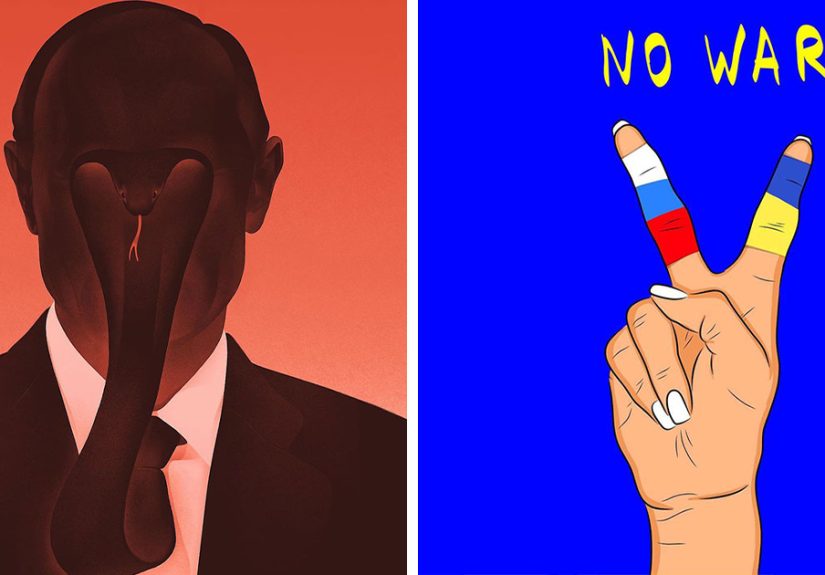
Also appearing on a magazine cover, Plunkert’s image translated invasion into a sharply legible graphic metaphor. Editorial illustration can sometimes feel disposable, but in moments like this it becomes historical shorthand: one image, one glance, one awful recognition.
28. Sasha Skochilenko’s antiwar price-tag intervention
In Russia, antiwar art has often had to become stealthy. Replacing grocery store price tags with antiwar messages was a tiny act with enormous moral force. It was not made for a museum wall. It was made for an aisle, a glance, a conscience.
29. Instruments and artworks made from war remnants
Across exhibitions and performances, artists have turned remnants of war into speakers, sculptural objects, and even instruments. That gesture never stops being startling. It is one thing to survive wreckage. It is another to force wreckage to sing.
Why these works matter beyond the first emotional hit
The strongest art about Ukraine after the invasion does not merely “raise awareness,” that most tired phrase in cultural vocabulary. It does more difficult work. It restores scale. News often toggles between the massive and the numb: casualty counts, aid packages, geopolitics, front lines. Art reintroduces the intimate human middle. A child on a seesaw. A forged flower. A red line drawing. A photograph of a person standing inside an altered ordinary life.
That intimacy matters because cultural destruction has been part of the story, too. When artists respond, they are not adding decorative commentary to history. They are defending identity, memory, and public truth. These works show that the war in Ukraine is not only a fight over territory. It is also a fight over who gets to narrate a nation, preserve a culture, and imagine a future.
Just as important, these pieces resist the flattening effect of endless scrolling. A good antiwar artwork interrupts your passive consumption. It makes you stop. Sometimes it makes you uncomfortable. Sometimes it makes you furious. Occasionally it does something even stranger: it allows beauty to coexist with grief without betraying either one.
What it feels like to encounter this art
Seeing art made in response to the invasion of Ukraine is rarely a clean emotional experience. You do not walk away with a single feeling and a tidy sentence to post under it. You walk away carrying several contradictory reactions at once, and that contradiction is part of the point.
First comes the shock of recognition. Even when the work is symbolic, you know what it is touching. A ruined wall is not just a wall. A red line is not just a line. A flower made from metal is not just a clever piece of craft. The materials and images arrive with context already attached to them, and that context sits heavily in the room. Art like this does not ask for neutral viewing. It asks for presence.
Then comes the unsettling part: beauty. Not cheerful beauty, obviously. Not “everything is fine” beauty. More like the beauty of precision, courage, and refusal. The careful brushstroke. The exact shape of a silhouette. The discipline of an installation built to make strangers feel, however briefly, the atmosphere of fear that others live with daily. That beauty can feel almost unfair at first. Why should something born from war be visually powerful? But that question misunderstands what artists do. They do not beautify violence. They wrest form from chaos so memory has somewhere to live.
There is also an experience of scale that changes from work to work. Large public pieces can make you feel tiny in the face of history. A mural on a damaged building can turn a whole street into a witness. A massive cloud installation can make your body understand dread before your brain finishes naming it. Smaller works do the opposite. A poster, a drawing, or a photograph can pull you inward until the war stops looking like an event and starts looking like a person’s interrupted Tuesday.
Another striking experience is how often this art collapses distance. You may be standing in Berlin, Rome, New York, Los Angeles, or Venice, and yet the work keeps redirecting your attention back to Kyiv, Kharkiv, Odesa, Mariupol, or towns most casual readers had never heard of before the invasion. Good art refuses the comfort of “over there.” It turns geography into moral proximity.
And perhaps the most lasting experience is not despair, though there is plenty of sorrow in these works. It is admiration sharpened by grief. Again and again, these artists show that making something is itself a form of resistance. A mural says: we are still here. A photograph says: this happened. A forged sculpture says: even your scrap metal will testify against you. A poster says: you do not get to monopolize the public wall. Art does not stop missiles. Nobody sensible claims that. But it does stop erasure, and that matters more than cynics like to admit.
By the time you finish moving through these kinds of works, you realize they have quietly changed the way you understand resilience. Not as a motivational slogan. Not as a glossy social-media word stretched over pain like plastic wrap. Resilience here looks messier and more honest. It looks like artists working with damaged buildings, displaced lives, interrupted careers, salvaged materials, and exhausted hearts, and still deciding that the world must be shown what this war feels like from the inside. That decision, repeated across countries and mediums, is why these pieces stay with you.
Final thoughts
The most moving art made after the Russian invasion of Ukraine does not ask us to admire suffering. It asks us to witness endurance, pay attention to cultural survival, and reject the idea that war can be understood only through military maps and diplomatic statements. These pieces mourn the dead, defend the living, and preserve the emotional record of a nation under attack. They are heartbreaking, yes. But they are also proof that even under bombardment, the human urge to create remains stubbornly, gloriously difficult to kill.