Table of Contents >> Show >> Hide
- Why the first day is such a high-stakes day
- The 50 critical day-one mistakes that got people fired
- Category 1: “Policy? I thought that was optional.”
- Category 2: Safety shortcuts that made everyone’s hair stand up
- Category 3: Respect and boundaries (aka: don’t speedrun HR)
- Category 4: Theft, fraud, and “absolutely not” ethics
- Category 5: Confidentiality and data mishaps
- Category 6: Attitude and communication that torched trust
- What these stories have in common (and how to avoid becoming one)
- First-day survival checklist (practical, not preachy)
- If you do get fired on day one: what now?
- Extra: of real-world first-day experiences and lessons
- Conclusion
Your first day at a new job is basically the workplace equivalent of meeting your partner’s parents: you’re trying to be charming, you’re overthinking where to put your hands, and you’re praying you don’t accidentally call someone “Mom.” Most first days are harmlessly awkwardwrong door, wrong parking lot, wrong coffee order. But every so often, a “small” mistake turns into a flashing red siren that screams, “This is not going to work.”
This article breaks down 50 real-world, day-one firing scenariosno names, no doxxing, no internet pile-on. These are the kinds of incidents HR teams, managers, and employees repeatedly talk about when discussing immediate terminations: policy violations, safety shortcuts, confidentiality breaches, harassment, theft, dishonesty, and “I cannot believe you said that out loud” moments. Along the way, you’ll get practical lessons (and a few laughs) so your first day ends with a badge… not a cardboard box.
Why the first day is such a high-stakes day
Day one is when trust is easiest to winand fastest to lose. Employers expect nervousness. They do not expect rule-breaking before lunch. Most companies have a short list of “instant deal-breakers” because they create immediate risk: harassment, violence, theft, serious safety violations, major dishonesty, or intentionally mishandling sensitive data.
Also, in much of the U.S., many roles are “at-will,” meaning employment can end quickly as long as the reason isn’t illegal. That’s why some first-day mistakes can have first-day consequences. Think of your first day as a quiet trust audit: people are checking whether you’re safe, respectful, coachable, and honest.
The 50 critical day-one mistakes that got people fired
Category 1: “Policy? I thought that was optional.”
- They skipped required paperwork and trainingthen refused to do it. Orientation forms weren’t “busywork”; they were compliance. The refusal was the headline, not the paperwork.
- They walked into a restricted area because “I’m new, it’s fine.” Many workplaces have access-controlled rooms for safety, privacy, or security. Curiosity isn’t a badge.
- They ignored the dress code on purpose. Not “I didn’t know,” but “I don’t do dress codes.” Day one is not the day to start a flip-flop revolution.
- They brought an unauthorized guest into the building. A friend, a partner, a kid, a “bro who was in the neighborhood.” Security tends to be hilariously unamused.
- They installed random software on a company computer. If you can’t pronounce the program name and it came from a sketchy pop-up, IT will noticeimmediately.
- They recorded a meeting without permission. Depending on location and context, recording can raise privacy issues. Even when it’s legal, it can still violate company policy.
- They posted company info on social media “just to celebrate.” A selfie with a client list or whiteboard in the background isn’t a flex. It’s a confidentiality incident with good lighting.
- They used the company email for personal subscriptions and side accounts. It reads like poor judgment on day one… and future compliance headaches on day 30.
- They refused to follow a simple security rule. “Don’t prop open the secure door” or “don’t share badges.” Refusal signals future chaos.
- They lied on a form that got verified the same day. Some lies don’t even make it to day twoespecially if credential checks are fast.
- They showed up intoxicated. If your “new job smell” includes vodka, HR will fast-track your exit.
- They took a “quick hit” in the parking lot. Even where some substances are legal, being impaired at workor violating policycan be terminable.
- They brought a prohibited item to work. Some jobs ban weapons, recording devices, or certain tools. Day one is not the day to test the handbook’s boundaries.
Category 2: Safety shortcuts that made everyone’s hair stand up
- They bypassed a safety guard “to save time.” In high-risk environments, skipping steps isn’t “efficient.” It’s how injuries happen.
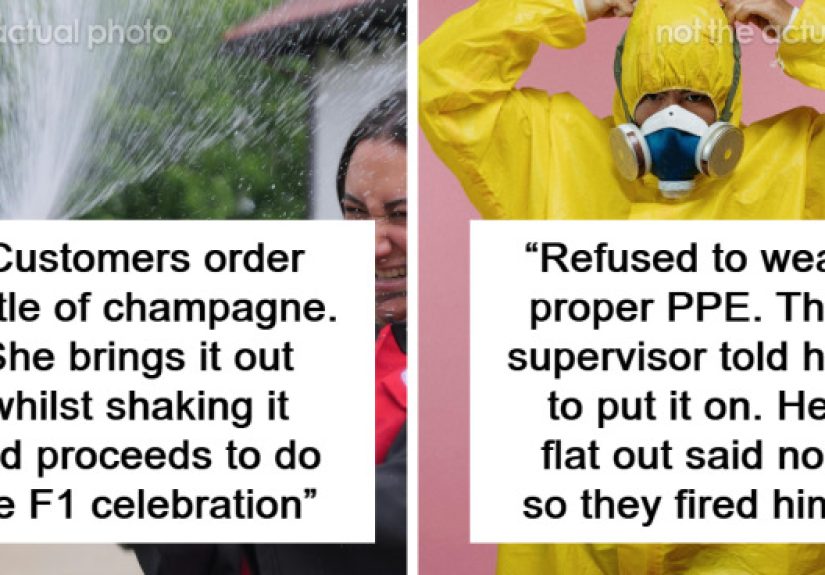
- They refused PPE because it “looks dumb.” Hard hats and goggles don’t exist to ruin your outfit. They exist to keep your body parts where they belong.
- They operated equipment they weren’t trained to use. Forklifts and heavy machinery aren’t “learn-as-you-go” hobbies.
- They treated lockout/tagout like a suggestion. If a supervisor says “do not energize that,” the correct response is “got it,” not “watch this.”
- They ignored a chemical label. Mishandling or mixing chemicals can trigger serious incidentsand immediate removal.
- They turned a safety briefing into a joke… then didn’t follow it. Humor is fine. Disregard is notespecially when others have to carry the risk.
- They hid a near-miss incident. Mistakes happen. Cover-ups destroy trust. Most workplaces can train skills; they can’t “train honesty” into a person who refuses it.
- They filmed unsafe behavior for a “first day” TikTok. Safety teams aren’t impressed by viral content. Also: incident reports are forever.
Category 3: Respect and boundaries (aka: don’t speedrun HR)
- They made a sexual comment in the first hour. If you’re still learning names, it’s too soon for “jokes.”
- They touched a coworker without consent. Even “friendly” touches can cross boundariesand day one is when everyone is watching closely.
- They used a slur or stereotype as “banter.” You don’t get a free pass because you’re new. You get a shorter leash.
- They mocked someone’s appearance, disability, or accent. Cruelty isn’t a personality trait; it’s a termination strategy.
- They flirted aggressively with customers. Customer-facing roles often have strict conduct rules because reputation is on the line.
- They started gossiping like it was an Olympic sport. “So what’s the tea?” is a wild opening line with people you met ten minutes ago.
- They posted a coworker’s photo online without permission. Some workplaces have strict privacy rules. Either way, it’s disrespectful and risky.
- They tried to “prank” the team. Surprise glitter in the HVAC vent is not onboarding. It’s sabotage with sparkle.
Category 4: Theft, fraud, and “absolutely not” ethics
- They stole food, cash, or merchandiseon camera. Many workplaces have cameras. Yes, even by the snack shelf. No, “it was just a test” won’t land.
- They padded hours on their timesheet. It’s hard to recover from “time theft” before you’ve earned your first paycheck.
- They asked a coworker to clock them in. That’s not teamwork; that’s a conspiracy with a timestamp.
- They used a company card for a personal purchase. Even a small charge signals a giant judgment problem.
- They accepted a “gift” that violated policy. Certain industries restrict gifts from vendors, clients, or patients. Day one is not the day to collect freebies.
- They tried to sell something to the team immediately. Recruiting coworkers into a side hustle before you know the Wi-Fi password is bold. Not in a good way.
- They falsified a credential or license. If a role requires certification, faking it is the fastest exitespecially in regulated industries.
Category 5: Confidentiality and data mishaps
- They emailed sensitive files to a personal account “to work later.” Many employers treat this as a serious data-handling violationbecause it is.
- They shared a password with a coworker. Security controls exist for a reason. Sharing logins breaks audit trails and can break your employment.
- They clicked a suspicious link and hid it. Anyone can make a mistake. Hiding it turns a training moment into a trust crisis.
- They left a laptop unlocked in a public place. Some companies can’t risk even one day of careless exposure.
- They looked up customer or patient info “out of curiosity.” Accessing private data without a business reason is often instant-termination territory.
- They took screenshots of internal systems to “study later.” Screenshots can capture sensitive details. Many workplaces ban this outright.
Category 6: Attitude and communication that torched trust
- They told the boss, “That’s not my job.” Boundaries matter, but day one is about learning and helpingnot refusing basic tasks with zero context.
- They argued with the trainer instead of asking questions. Confidence is great. Combative energy is not.
- They bragged about breaking rules at their last job. “I ignored policy all the time” is not the character reference you think it is.
- They disappeared for hours without telling anyone. Even if you’re overwhelmed, vanishing creates coverage, safety, and accountability problems.
- They insulted the company in a public forum. Complaining online while wearing your brand-new badge is… a choice.
- They refused feedback immediately. A simple correction became a standoff. Employers often interpret that as a preview of every future coaching conversation.
- They showed up late, then acted offended that it mattered. Life happens. But day one is when “reliable” is being evaluated in real time.
- They threatened a coworker. Any credible threatverbal or impliedcan trigger immediate termination and serious escalation.
What these stories have in common (and how to avoid becoming one)
Step back from the chaos and you’ll see the same three ingredients repeating like a sad little chorus:
- Trust breakers: lying, stealing, hiding mistakes, violating confidentiality, or disrespecting boundaries.
- Risk multipliers: anything that increases the chance of injury, harassment claims, data breaches, or legal exposure.
- Culture collisions: refusing norms before you understand them (dress code, communication style, teamwork).
If you want a first day that doesn’t end in a dramatic walkout montage, your mission is simple: be safe, be respectful, be honest, and be coachable. You don’t need to be perfect. You just need to avoid behavior that signals you’ll be expensive, dangerous, or disruptive to keep.
First-day survival checklist (practical, not preachy)
Do this in the first hour
- Ask what “success” looks like for today: where to be, who to shadow, what to learn, and what to avoid.
- Confirm basics: schedule, breaks, dress expectations, safety rules, and how the team communicates (email, Slack, radio, tickets, etc.).
- Take notes. It shows respect and reduces repeat questions (which makes everyone love you faster).
Do this in the first week
- When unsure, ask: “Is there a policy for this?” (You’ll sound careful, not clueless.)
- Report mistakes early. A small error admitted quickly is usually fixable; a hidden error grows teeth.
- Keep your phone and social media on a short leash until you understand what’s allowed.
- Be curious, not critical. You can suggest improvements laterafter you understand why things are done a certain way.
If you do get fired on day one: what now?
First, take a breath. A first-day firing feels personal, but it often reflects risk management more than your entire character. If you were terminated for a clear policy violation or behavior that crossed lines, focus on what you can control: own it, learn, and fix the habit before you jump to the next role.
If you believe the termination happened for an illegal reason (for example, discrimination) or because you raised a good-faith concern about unsafe or unlawful practices, write down what happened while it’s fresh. Keep records you already have legitimate access to. Then consider speaking with a qualified employment professional in your state. The point isn’t to start a warit’s to understand your options and protect yourself.
Extra: of real-world first-day experiences and lessons
Ask a room full of managers about “first-day disasters” and you’ll hear the same stories told with the same expression: a mix of disbelief, irritation, and “please learn from this so I don’t have to live through it again.” One common experience is the confidence-to-competence gap. A new hire walks in determined to prove they’re a star, but they confuse boldness with skipping steps. In a warehouse, that looks like jumping onto equipment without training. In an office, it can look like emailing a client before learning the processthen sending the wrong attachment to the wrong person. The lesson is boring but powerful: speed comes after accuracy. On day one, your job is to be safe and learn the system, not to “optimize” the system.
Another recurring experience is the social misread. New people often try to connect quickly, and that’s human. But “connecting” can veer into oversharing, off-color jokes, or gossipespecially if someone treats the break room like a group chat. Many quick terminations aren’t about one awkward comment; they’re about the signal it sends: “This person doesn’t understand boundaries.” Teams can teach tools. They can’t teach basic respect if someone rejects it. A smarter move is to start with safe curiosity: ask people what they work on, how long they’ve been there, what they wish they’d known as a new hire, and what “good” looks like in the role. You’ll build rapport without accidentally building an HR file.
Then there’s the technology face-plant: clicking a suspicious link, downloading a random browser extension, or forwarding a file to a personal email “so I can read it on my phone.” In many industries, this isn’t a slap-on-the-wrist mistakeit’s a major incident because it can expose customers, patients, or company systems. The most experience-based advice is simple: if you mess up, report it immediately. Security and IT teams would rather fix a problem at 9:07 a.m. than discover it at 4:58 p.m. after the log files start screaming. Hiding a mistake turns a “teach and patch” moment into a “we can’t trust you” decision.
There’s also a quieter, more common experience: the first-day personality test. Some people show up and immediately debate everythingdress code, schedule, how the team “should” do the workbefore they’ve even learned the acronyms. That doesn’t read as leadership. It reads as friction. Most successful new hires do the opposite: they observe first, ask thoughtful questions, and wait to offer ideas until they understand constraints (clients, regulations, timelines, safety, approvals). Being coachable on day one is basically career currency. It buys you patience, guidance, and second chances.
Finally, the most underrated first-day experience is the one nobody posts online: the quiet win. The person who shows up on time, follows safety rules, takes notes, asks smart questions, and says, “Thanks for walking me through that,” isn’t viralbut they’re trusted fast. They get better training. They get invited to real projects. They build a reputation as reliable while everyone else is still figuring out where the printer lives. If you want the “experienced professional” version of day one, it’s surprisingly simple: treat every rule like it exists for a reason, treat every person like they deserve respect, and treat every mistake like something to surface earlynot something to hide.
Conclusion
Getting fired on the first day usually isn’t about one innocent slip-up. It’s about a choice that screams “risk”: ignoring safety, breaking trust, crossing boundaries, mishandling information, or showing an attitude that makes coaching impossible. The good news? Most of these disasters are preventable with boring (and therefore powerful) habits: follow policies, ask questions, respect people, and speak up early when you’re unsure. Be the person who makes a solid first impressionnot the story someone tells at lunch for the next five years.