Table of Contents >> Show >> Hide
- The $44 Billion Plot Twist That Broke Everyone’s Brain
- Why Twitter Users Reacted Like the Building Was on Fire
- Here Are 30 Of The Best Reactions From Twitter Users
- What Those Reactions Actually Meant
- Why the $44 Billion Number Made the Story Even Wilder
- Final Thoughts
- Extended Experience: What It Felt Like to Watch the Twitter Deal Unfold in Real Time
- SEO Tags
When news broke that Elon Musk was buying Twitter for $44 billion, the internet did what the internet does best: it immediately turned the entire event into a live comedy special, an ethics seminar, a stock-market panic attack, and a group chat with no adult supervision. In one corner, fans declared that “free speech” had won. In another, critics acted like the app had just been sold to a Bond villain with a meme addiction. And somewhere in the middle, millions of regular users kept scrolling, posting, joking, panicking, andmost of allrefusing to log off.
The deal was massive, weirdly theatrical, and very on-brand for Twitter. This was never just another tech acquisition. Twitter had become a digital town square, political battlefield, newsroom wire, fandom arena, and personal diary with a character limit. So when Musk swooped in with a $54.20-per-share offer and the board agreed to sell, the reaction was never going to be polite, muted, or normal. This was Twitter reacting to the fate of Twitter on Twitter. That alone practically guaranteed chaos.
And chaos, dear reader, was delivered in economy-size packaging.
The $44 Billion Plot Twist That Broke Everyone’s Brain
Part of what made the Elon Musk Twitter deal feel so combustible was the sheer symbolism of it. Musk was not some quiet private-equity buyer working behind mahogany conference-room doors. He was already one of the platform’s biggest celebrities, loudest users, and most unpredictable power posters. He didn’t just want to own Twitter. He wanted to own the platform where he had built part of his public image in real time.
That distinction mattered. For years, Twitter had functioned as a place where politicians shaped narratives, journalists chased breaking stories, brands tried too hard to sound funny, and regular users became accidental comedians one viral post at a time. Musk framed his bid around “free speech,” algorithm transparency, fewer bots, and product ideas like an edit button. Supporters heard liberation. Skeptics heard deregulation with a side of mayhem. Employees heard uncertainty. Advertisers heard risk. Users heard all of that and responded the only way they knew how: with jokes sharp enough to qualify as workplace equipment.
Even before the long legal saga and eventual October 2022 closing, the original acquisition announcement had already exposed something important about the platform: people weren’t simply attached to Twitter as a product. They were attached to it as a culture, a habit, a public square, and occasionally an emotional support disaster zone.
Why Twitter Users Reacted Like the Building Was on Fire
Because Twitter was never just an app
People didn’t react to the Musk takeover like they react to a company buying a smaller software tool. They reacted like somebody had purchased the group chat that controls the mood of media, politics, sports, entertainment, and half of everyone’s side arguments. That is a different level of emotional investment.
Because everyone projected a different future
Supporters imagined a looser, funnier, less moderated platform. Critics imagined a harassment carnival with blue checks and flamethrowers. Employees worried about culture, stability, and trust-and-safety work. Political junkies immediately started debating what the deal could mean for content moderation and banned accounts. Basically, one acquisition somehow managed to function as a Rorschach test for the entire internet.
Because the man buying Twitter was already its main character
Musk’s online persona was part entrepreneur, part provocateur, part meme uncle who definitely should not have admin privileges but somehow does. That meant the public wasn’t just reacting to a business deal. It was reacting to the idea of giving the most chaotic guy in the room the keys to the building and asking him to improve the lighting.
Here Are 30 Of The Best Reactions From Twitter Users
- The “free speech is back, baby” crowd. These users treated the deal like the digital equivalent of fireworks, a parade, and a victory lap rolled into one tweet thread.
- The “Twitter is doomed” mourners. Their posts read like tiny obituaries for the app, as if the bird logo had already been replaced by a smoking crater.
- The “I’m leaving this platform” announcers. Twitter users have threatened to leave Twitter approximately 40,000 times in history, and this became one of the all-time great entries in the genre.
- The “nobody is actually leaving” realists. This group looked at the dramatic exit posts and basically said, “Sure, see you tomorrow.”
- The popcorn spectators. They had no ideological position at all. They were simply here for the mess, the quote-tweets, and the possibility that a billionaire was making the entire site even more ridiculous.
- The edit-button enthusiasts. Musk had floated the idea, and users reacted as if fixing typos might finally bring civilization to heel.
- The anti-edit-button alarmists. They responded as though editable tweets would collapse the historical record, destabilize democracy, and ruin every “this aged badly” joke in circulation.
- The bot hunters. These users immediately turned the conversation toward spam accounts, fake followers, and whether Musk was actually buying a social platform or a warehouse full of automated nonsense.
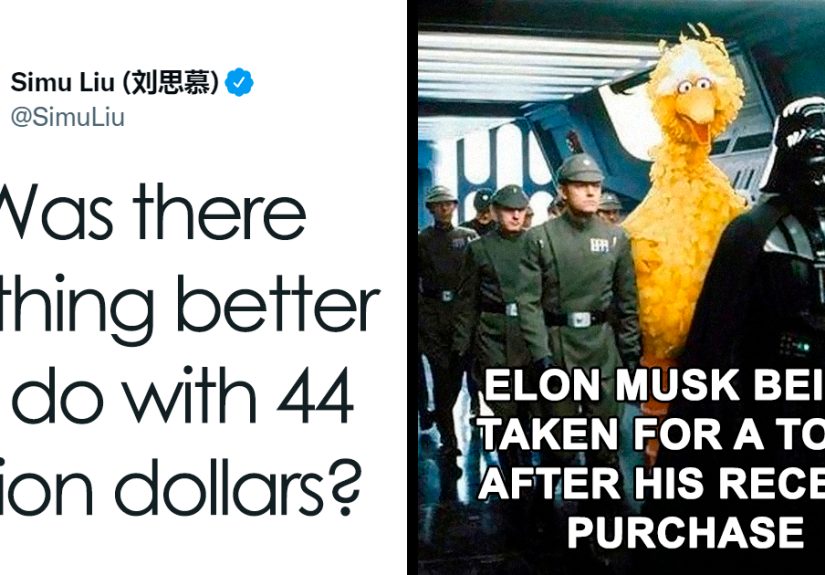
- The “$44 billion for this app?” accountants. They looked at the site’s bugs, discourse, and periodic outages and decided the price tag felt like paying luxury-yacht money for a haunted vending machine.
- The “he bought the app that annoys him most” comedians. Their reading of the situation was simple: this was elite-level hater behavior.
- The “Twitter is now a private company, just like my dignity” jokesters. Not technically useful analysis, but spiritually accurate.
- The Tesla-shareholder worriers. These reactions came with financial side-eye, asking why the CEO of an already giant company needed to take on another headache the size of a moon.
- The “this is what happens when posting becomes a personality” crowd. Their argument was that Musk wasn’t just buying a company; he was buying the stage where he likes to perform.
- The journalists clutching their timelines. Love Twitter or hate it, reporters relied on it for tips, sources, witnesses, and breaking news. Their reactions had major “please don’t break the newsroom fire alarm” energy.
- The creators who feared the vibe would curdle. Artists, writers, commentators, and niche internet weirdos worried the tone of the platform would get meaner, louder, and less usable.
- The moderation skeptics. They didn’t buy the sunshine version of “free speech” and worried that looser rules would mostly benefit trolls, harassers, and serial attention-seekers.
- The harassment survivors saying, “This is not funny for us.” Their posts pushed back on meme-only coverage and reminded everyone that policy changes hit vulnerable users first.
- The conservatives celebrating a reset. Many saw the acquisition as a rejection of the platform’s old moderation style and as a symbolic win in a much larger culture-war fight.
- The liberals doomscrolling in broad daylight. Their reaction was basically, “Oh great, the app was exhausting already.”
- The “Trump comeback?” speculators. Within minutes, timelines filled with predictions, arguments, and panic over whether previously banned political figures could return.
- The crypto optimists. Any Musk story tends to attract a subset of users who hear “new ownership” and immediately start asking whether dog memes are about to become infrastructure.
- The Jack Dorsey truthers. These users read the sale through the lens of Twitter’s cofounder and platform philosophy, treating it like the latest chapter in the app’s long identity crisis.
- The employees posting through the pain. Some reactions carried a very specific corporate despair: “This is somehow happening during my normal workday, and yes, I still have meetings.”
- The “focus week is over forever” crowd. This flavor of reaction captured the surreal experience of having a global billionaire takeover explode in the middle of ordinary office life.
- The “Mastodon, anyone?” scouts. Alternative-platform talk surged whenever the future of Twitter looked unstable, and this moment sent many users window-shopping for exits.
- The meme maximalists. They understood that a story this absurd demanded one thing above all else: elite meme production at industrial scale.
- The legal nerds. These users weren’t even focused on ideology. They were fascinated by filings, financing, board maneuvers, merger terms, and whether the whole thing would actually stick.
- The “this feels like satire” users. Their core reaction was disbelief that one of the world’s richest men was acquiring one of the world’s messiest apps in the most public way possible.
- The “Twitter is reacting to Twitter on Twitter” philosophers. They appreciated the pure recursion of the moment and wanted everyone else to admire the absurd beauty of it.
- The addicts who posted, complained, joked, predicted disaster, and then kept refreshing anyway. Which is to say: most of Twitter.
What Those Reactions Actually Meant
Underneath all the jokes, snark, and panic, the public response revealed a real tension at the center of social media. Users wanted more openness, but also more safety. They wanted fewer arbitrary rules, but also fewer trolls. They wanted better products, but not at the cost of the social norms that made the place tolerable. And they definitely wanted all of that without handing too much power to one very online billionaire.
That’s why the Musk Twitter deal produced such a strange split-screen effect. To supporters, he looked like a disruptor finally shaking up a stale, ideologically rigid platform. To critics, he looked like a wealthy chaos engine who might confuse attention with governance. Both views spread fast because Twitter had trained its users to react at the speed of emotion first and reflection second.
There was also a deeply Twitter-specific irony here: many of the users who hated the deal were also the people who understood the platform best. They knew how quickly small policy shifts could affect public conversation. They understood how dogpiling works, how moderation debates spiral, and how follower counts can turn into political narratives overnight. This wasn’t abstract to them. It was personal, practical, and immediate.
Why the $44 Billion Number Made the Story Even Wilder
The money mattered because it made every reaction feel larger than life. Forty-four billion dollars is not a casual impulse buy. It’s not “I accidentally overspent during a sale” money. It’s “the internet is now a corporate action item” money. That number became a punchline all by itself. Users kept comparing the price tag to everything from public needs to absurd luxuries to the emotional cost of using Twitter for ten consecutive years.
And that sticker shock magnified every argument around the deal. If someone spends that much to buy the platform where politicians, celebrities, journalists, and trolls all compete for oxygen, people assume big changes are coming. Whether they feel hopeful or horrified depends on what they think Twitter is for in the first place.
That, more than anything, explains the scale of the reaction. The acquisition was not just about ownership. It was about who gets to shape the rules, tone, and future of one of the most influential social media platforms in the world.
Final Thoughts
Elon Musk buying Twitter for $44 billion became one of those rare internet moments that worked on every level at once: business story, culture-war flashpoint, workplace drama, meme festival, and cautionary tale about what happens when the richest poster in the room decides posting is no longer enough. The funniest part was never just the tweets themselves. It was the fact that millions of users instantly understood the stakes and translated them into reactions ranging from hysterical to heartfelt.
In the end, the best reactions weren’t memorable because they were merely funny. They were memorable because they captured the strange, contradictory truth about Twitter: people complained about it endlessly, distrusted it routinely, and still understood that changing who controls it could change much more than one app. It could change the tone of public conversation itself.
So yes, the jokes were excellent. The panic was theatrical. The memes were elite. But the frenzy also said something serious. Twitter users knew that the platform mattered, and the moment Musk moved to buy it, they reacted like people watching the weather change over the whole internet.
Extended Experience: What It Felt Like to Watch the Twitter Deal Unfold in Real Time
Watching the Elon Musk Twitter acquisition unfold in real time felt less like following a business transaction and more like being trapped inside a global improv show where every participant had Wi-Fi and zero restraint. One minute, people were debating financing and securities filings like honorary law professors. The next, they were posting memes about billionaires impulse-buying apps because they got mad online. It was the rare story where everyone, from finance people to fandom accounts to extremely tired media workers, seemed to be reacting in the same room at the same time.
That was the unique power of the moment. Normally, news about mergers and acquisitions arrives in polished headlines and then trickles down through analysis. This one exploded instantly on the very platform being sold. Users didn’t have to wait for the reaction cycle. They were the reaction cycle. You could watch excitement, dread, sarcasm, confusion, opportunism, and pure nonsense refresh in front of you every few seconds.
For longtime Twitter users, it also felt oddly personal. Even people who claimed to hate the app reacted as if someone had announced a surprise remodel of their favorite dysfunctional diner. They might complain about the service, the lighting, the menu, and the customers at the next table, but they still knew exactly where the bathroom was and which booth had their name on it. Musk buying Twitter raised a bigger question than “Will the app change?” It raised the question, “Will this still feel like the same place tomorrow?”
That uncertainty explains why the reactions were so layered. Some people were genuinely thrilled by the idea of a shake-up. Some were convinced the platform’s safety and moderation systems could unravel. Others treated the whole thing like performance art with SEC paperwork. Most users were a blend of all three. They laughed because the story was absurd, but they kept refreshing because they sensed it mattered.
There was something almost perfectly Twitter-like about that contradiction. The platform had always been a place where sincerity and irony sat next to each other like reluctant roommates. A tweet could be a joke, a warning, a news alert, a business thesis, and a cry for help all at once. The Musk deal intensified that dynamic. It turned everyone into a commentator, even if their commentary was just a screenshot, a one-line joke, or a digital scream typed before coffee.
In that sense, the experience of watching the deal unfold may have been more revealing than the deal itself. It showed how deeply Twitter had embedded itself in public life. Not because it was always healthy, and certainly not because it was always wise, but because it had become one of the fastest places on Earth for people to perform opinion. When ownership of that stage changed, users responded like actors hearing the theater might get new management before curtain call.
And maybe that’s why the reactions remain so memorable. They weren’t just responses to Elon Musk. They were responses to a collective fear, hope, joke, and habit wrapped into one platform. The deal was huge, but the reaction was the real story: millions of people showing, in real time, that they understood Twitter was never merely software. It was infrastructure for modern attention.