Table of Contents >> Show >> Hide
- Introduction: When the Richest Man in the Room Starts Explaining the Joke
- Whoor Whatis “Anti-Wokestradamus”?
- Elon Musk, X, and the Comedy-as-Culture-War Machine
- What Life of Brian Was Actually Satirizing
- Monty Python Was Anti-Dogma, Not Automatically Anti-Woke
- John Cleese, Eric Idle, and the Split Personality of the Python Legacy
- Why Musk’s Reading Feels So Internet-Native
- The Free Speech Angle: Real Issue, Messy Messenger
- Specific Examples: When Python Cuts in Multiple Directions
- The Bigger Lesson: Don’t Draft Dead Parrots Into Culture Wars
- Experience Section: What This Debate Feels Like From the Audience Seat
- Conclusion: Monty Python Saw Human Folly Coming, Not Your Timeline
Note: This article is an original, web-ready synthesis based on real public reporting, comedy history, and widely documented events. Source links are intentionally not displayed in the article body per publishing requirements.
Introduction: When the Richest Man in the Room Starts Explaining the Joke
There are many ways to enjoy Monty Python. You can laugh at the coconut horses, quote the “dead parrot” sketch until your friends quietly stop inviting you places, or hum “Always Look on the Bright Side of Life” while standing in line at the DMV like a fully evolved absurdist. Then there is Elon Musk’s apparent method: treating Monty Python like a dusty prophecy scroll that proves the culture war was foretold by British comedians in fake beards.
The phrase “Elon Musk Thinks Monty Python Are His Anti-Wokestradamus” captures a very modern internet ritual: a billionaire posts or amplifies an old comedy clip, his supporters declare it proof that comedy “predicted” today’s debates, critics roll their eyes so hard they briefly glimpse the Bronze Age, and everyone spends the next six hours arguing about a joke from 1979 as if it were a constitutional amendment.
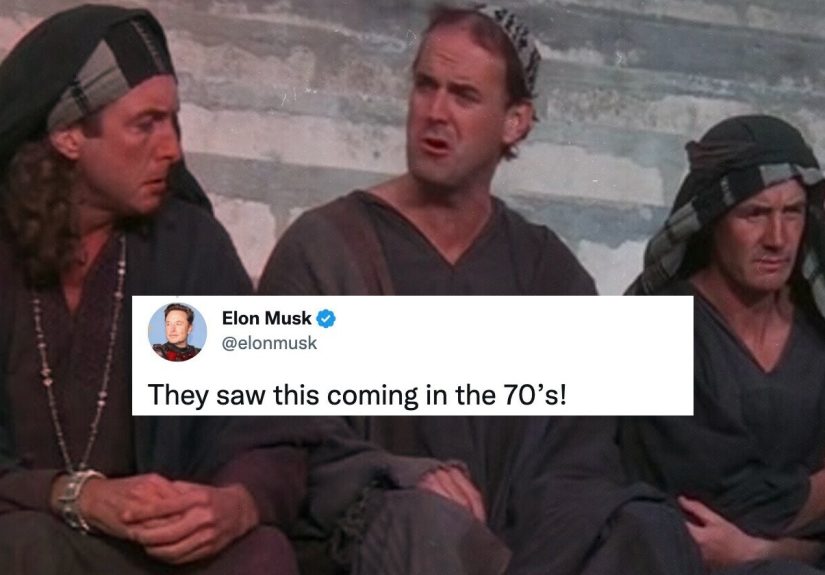
The specific spark came from a scene in Monty Python’s Life of Brian, the 1979 religious satire that offended various moral guardians long before the internet made outrage available in family-size buckets. In the clip, a revolutionary character named Stan says he wants to be called Loretta and wants the right to have babies. Other characters react with confusion, bureaucracy, and the kind of absurd debate that Monty Python specialized in. Decades later, some online commentators framed the scene as a prophetic anti-woke statement. Musk appeared to approve of that reading, suggesting the Pythons had “seen this coming.”
But here is the comic banana peel: Monty Python was rarely a neat fit for anybody’s ideology. The troupe mocked institutions, movements, religions, revolutionaries, conservatives, radicals, bureaucrats, intellectuals, and anyone else who looked too comfortable on a pedestal. Trying to recruit them into a single modern political camp is like trying to make a duck sign a mortgage. You may get a lot of noise, but the paperwork will not hold up.
Whoor Whatis “Anti-Wokestradamus”?
“Anti-Wokestradamus” is not a real historical figure, although give it ten minutes and someone will launch a podcast under that name. The joke blends “anti-woke” culture-war commentary with Nostradamus, the French astrologer whose vague predictions have been retrofitted to every major event short of your uncle’s fantasy football collapse.
In this context, the term means that Musk and some of his fans seemed to treat Monty Python not merely as comedians, but as prophets who predicted today’s debates about identity, language, censorship, free speech, and political correctness. It is a flattering idea if you already agree with Musk’s cultural instincts. It is also a wildly convenient way to flatten comedy into a bumper sticker.
The Problem With Turning Comedy Into Evidence
Comedy often survives because it is slippery. A joke can mock an idea, a social habit, a political faction, or the people arguing about the idea. It can also mock the fact that humans love turning simple questions into procedural meetings chaired by men named Reg who have brought six subcommittees and no snacks.
That is exactly what Life of Brian does. The film is less a pamphlet about one social issue than a carnival of anti-dogma satire. It pokes at religious literalism, revolutionary infighting, crowd psychology, purity tests, and the way humans can take a sincere cause and smother it under slogans. The famous “Loretta” scene is funny not simply because of gender, but because the entire group handles a personal declaration by instantly forming a political argument about rights, feasibility, solidarity, and wording. In other words, the joke is partly about activist bureaucracy eating its own shoelaces.
To read the scene as a single-issue prophecy about modern “wokeness” is possible only if you hold the clip very close to your face and ignore the rest of the movie waving its arms in the background.
Elon Musk, X, and the Comedy-as-Culture-War Machine
Elon Musk’s relationship with comedy has become part of his public brand. He posts memes, replies to jokes, praises edgy satire, and often frames humor as a truth detector. Since buying Twitter in 2022 and later rebranding it as X, he has also positioned himself as a defender of free speech against what he sees as institutional censorship and the “woke mind virus.”
That combinationplatform owner, billionaire celebrity, political commentator, meme distributor, and self-appointed comedy appreciatormakes every joke Musk touches instantly heavier. A random user sharing a decades-old clip might be internet noise. Musk engaging with it turns it into discourse, and discourse is what happens when a joke gets trapped in an elevator with 40 opinion columnists.
Why Monty Python Is Useful to Musk’s Online Persona
Monty Python offers Musk something especially valuable: cultural prestige with a rebellious flavor. The troupe is beloved, quotable, British, clever, and old enough to feel pre-approved by history. Invoking them lets Musk present his anti-woke stance as aligned with classic comedy rather than merely modern grievance. It says, in effect: “I am not just arguing online; I am defending the sacred tradition of silly walks.”
The trouble is that Monty Python’s legacy is not one clean weapon. It is a crate of exploding props. Use one sketch to mock progressive language norms, and another sketch can be used to mock rigid gender roles. Use Life of Brian to criticize activist certainty, and the entire film can be used to criticize religious censorship, mob thinking, and authoritarian leaders. Monty Python is not a sword. It is a rubber chicken that keeps changing hands.
What Life of Brian Was Actually Satirizing
Released in 1979, Monty Python’s Life of Brian tells the story of Brian Cohen, a man born near Jesus who is repeatedly mistaken for a messiah. The film became controversial because many religious groups saw it as blasphemous. Some local authorities banned it. Some countries restricted it. Protesters objected. The filmmakers insisted the movie was not mocking Jesus himself so much as the human tendency to build dogma, hierarchy, and absurd certainty around belief.
That distinction matters. Life of Brian is about people who desperately want simple answers and heroic leaders, then behave foolishly when reality refuses to cooperate. The revolutionaries are not noble geniuses; they are factional, pompous, and comically inefficient. The crowds are not wise; they are easily swept up by slogans. The authorities are not dignified; they are ridiculous. Nobody gets out with their dignity fully ironed.
The “Loretta” Scene in Context
The “Loretta” scene appears during a meeting of the People’s Front of Judea, a revolutionary group that spends nearly as much energy arguing with similar revolutionary groups as it does opposing Rome. Stan announces that he wants to be a woman and wants the right to have babies. The group debates what solidarity requires when biology, language, and political principles collide.
Modern viewers naturally bring modern debates to the scene. That is normal. Old art is constantly reinterpreted. But reinterpretation is not the same as ownership. The scene can be read as mocking gender idealism, procedural activism, male confusion, revolutionary overreach, or the simple Pythonian joy of making everyone in a room say increasingly ridiculous things with great seriousness.
What it probably was not: a carefully coded 1979 manifesto about 2020s American internet politics. Monty Python did many impressive things. Time-traveling through Twitter/X culture-war threads was not, as far as the historical record shows, among them.
Monty Python Was Anti-Dogma, Not Automatically Anti-Woke
The strongest argument against Musk’s “Anti-Wokestradamus” reading is the broader Python method. Their comedy attacked dogma more than any one ideology. They mocked people who were too certain, too pompous, too bureaucratic, too pious, too revolutionary, too traditional, or too proud of their own cleverness. That last category, one suspects, could keep the troupe busy forever.
In Monty Python and the Holy Grail, medieval heroism becomes a parade of mud, cowardice, severed limbs, and constitutional peasants. In The Meaning of Life, religion, medicine, sex education, warfare, capitalism, and mortality all get tossed into the blender. On Monty Python’s Flying Circus, language itself often collapses under the weight of its own silliness.
That is why Python remains so durable. The comedy is not merely “offensive,” which is easy. It is structurally anarchic. It refuses to let any institution stand still long enough to look noble. The target is not just a belief; it is the human craving to turn belief into a costume, a committee, a hierarchy, or a chant.
Why Both Sides Want the Python Badge
People want Monty Python on their side because the troupe still carries the aura of dangerous intelligence. Being able to say “Monty Python agrees with me” feels like having a medieval catapult loaded with Oxford wit. For anti-woke commentators, Python represents a time when comedy seemed less policed. For progressive fans, Python represents irreverence toward authority, organized religion, class systems, empire, and traditional masculinity.
Both readings contain fragments of truth. Neither owns the whole snake. Or python. You understand.
John Cleese, Eric Idle, and the Split Personality of the Python Legacy
Part of the confusion comes from the Pythons themselves. John Cleese has repeatedly criticized political correctness and cancel culture, arguing that fear of offense can damage comedy. His comments make him appealing to anti-woke audiences who believe modern humor has been wrapped in bubble wrap and handed a consent form.
Eric Idle, meanwhile, has often taken a different public tone, criticizing wealthy or famous comedians who complain about being silenced while speaking from enormous platforms. That split complicates any attempt to claim “Monty Python” as a single political identity. The group was made of individuals, not a hive mind wearing matching tweed.
Even during their original run, the Pythons were collaborators with different temperaments. Their comedy worked partly because of friction: Cleese’s explosive authority figures, Idle’s musical slickness, Michael Palin’s cheerful reasonableness, Terry Jones’s historical intelligence, Terry Gilliam’s nightmare animations, and Graham Chapman’s surreal calm. Reducing all that to “they were anti-woke” is like reviewing an orchestra by saying, “The trumpet was loud.”
Why Musk’s Reading Feels So Internet-Native
The internet loves short clips because short clips remove context with surgical precision. A 60-second scene can be detached from a 94-minute movie, pasted into a new argument, captioned with confidence, and treated as proof. This is how old movies become modern political witnesses without being sworn in.
Musk’s X thrives on that format. A clip appears. A caption frames it. A famous account reacts. Supporters amplify it. Critics respond. The algorithm adds confetti. Soon the question is no longer “What did this scene mean in Life of Brian?” but “Which side wins today’s Monty Python discourse?”
Memes Reward Certainty, Comedy Rewards Ambiguity
This is the central mismatch. Memes reward instant recognition. Comedy often rewards uncertainty, surprise, and layered meaning. A meme says, “This proves my point.” A Python sketch says, “What if everyone’s point is secretly wearing a fake mustache?”
That is why Musk’s interpretation is so clickable and so incomplete. It understands the clip as ammunition. Monty Python usually built comedy by making ammunition explode in the hands of the person holding it.
The Free Speech Angle: Real Issue, Messy Messenger
There is a legitimate conversation to have about comedy, offense, and free expression. Classic works do get reclassified, recontextualized, warned about, edited, debated, and sometimes misunderstood. Some comedians argue that audiences have become more literal-minded. Some audiences respond that “it was just a joke” has too often been used as a discount coupon for cruelty. Both points can be true depending on the joke, the target, the speaker, and the room.
Musk’s problem is not that he discusses free speech or comedy. Those are worthwhile topics. The problem is that his version often arrives wrapped in culture-war branding, where “free speech” can start to mean “applause for my side” and “wokeness” can become a fog machine covering every criticism, consequence, or moderation decision he dislikes.
Monty Python, at its best, would likely distrust that kind of certainty. The Pythons loved puncturing grand statements. If a tech billionaire marched in declaring himself the defender of comedy civilization, one imagines a Python sketch would immediately introduce a clerk demanding Form 27B/6 for authorized joke guardianship.
Specific Examples: When Python Cuts in Multiple Directions
Consider Holy Grail. Its “constitutional peasant” scene mocks monarchy and inherited authority with the glee of someone throwing mud at a royal portrait. That is hardly a conservative valentine. Yet the film also mocks revolutionary jargon and academic abstraction. Everyone gets bonked.
Consider Life of Brian. It mocks religious dogma and censorship, which appeals to liberals and libertarians. It also mocks left-wing factionalism and activist infighting, which appeals to conservatives and anti-woke commentators. The movie is not confused. It is comprehensive.
Consider The Meaning of Life. The “Every Sperm Is Sacred” number satirizes religious teaching on reproduction with extravagant musical comedy. Another scene jokes about imposing gender roles on a newborn. If someone wants to turn Python into a purely anti-progressive oracle, these examples sit there politely clearing their throats.
The Bigger Lesson: Don’t Draft Dead Parrots Into Culture Wars
Old comedy deserves interpretation, not conscription. Viewers can notice that a scene feels newly relevant. They can debate whether a joke aged well or badly. They can say, “This reminds me of today.” That is healthy. The problem begins when a complex comedy work is forced to wear a campaign hat and stand behind a podium.
Musk’s “Anti-Wokestradamus” moment is funny because it reveals a broader habit among powerful internet personalities: using cultural artifacts as instant validation. Instead of asking what a scene is doing, they ask how it can be deployed. The joke becomes a flag. The flag becomes a fight. The fight becomes content. Somewhere, the original punchline files a missing-person report.
Experience Section: What This Debate Feels Like From the Audience Seat
Anyone who has watched old comedy with a modern crowd knows the experience can be awkward, fascinating, and unexpectedly revealing. One person laughs at the absurdity. Another winces at a word choice. A third pauses the movie to explain the entire social history of the joke, at which point the popcorn begins praying for a power outage. This is not proof that comedy is dead. It is proof that audiences are alive, changing, and occasionally very bad at letting a scene breathe.
The Musk-Monty Python debate feels familiar because many viewers have had the same argument in miniature. You show a friend a beloved old sketch, expecting laughter. Instead, the friend notices a stereotype, a dated assumption, or a political undertone you never focused on. Suddenly you are not just watching comedy; you are hosting a tiny courtroom drama in your living room. The remote becomes evidence. The couch becomes the jury box. Someone says, “It was a different time,” which is both true and not the magic spell people hope it is.
The best experience, however, comes when viewers resist the urge to flatten the work. Monty Python is funniest when allowed to be messy. The troupe’s sketches often begin with a recognizable situation and then wander into madness like a professor who took a wrong turn and found a fish-slapping contest. That messiness is the point. It gives audiences room to laugh, argue, disagree, and return later with a different reading.
Watching Musk and his supporters frame Python as anti-woke prophecy can feel like watching someone use a Swiss Army knife only to spread mayonnaise. Technically, yes, one tool may serve that purpose. But you are ignoring everything else it can do, including the tiny scissors nobody understands. Python can criticize progressive excess, but it can also mock reactionary panic. It can defend comic freedom while ridiculing people who treat themselves as martyrs because someone disliked their joke. It can laugh at identity debates and laugh at the pompous men who think they have solved identity debates by posting one clip.
For writers, comedians, and viewers, the useful lesson is humility. A joke from 1979 does not automatically settle an argument in 2026. A billionaire’s retweet does not turn satire into scripture. A classic film does not belong exclusively to whoever shouts “free speech” first. Comedy is more alive when it remains open to multiple readings, including readings that annoy us.
The personal experience of revisiting Monty Python today is less like finding a prophecy and more like opening a junk drawer full of brilliant, dangerous, ridiculous tools. Some still work perfectly. Some spark. Some make you wonder why anyone owned them in the first place. But the drawer is worth exploring because it shows comedy doing what comedy does best: refusing to behave.
That, ironically, is where Musk’s interpretation becomes most Python-like by accident. The attempt to turn Monty Python into a clean anti-woke oracle is itself absurd enough to be a sketch. Picture a group of internet warriors gathered around a sacred laptop, chanting, “The Pythons have spoken!” while a bored clerk asks whether they mean the People’s Front of Judea or the Judean People’s Front. The punchline writes itself, then complains about subscription verification.
Conclusion: Monty Python Saw Human Folly Coming, Not Your Timeline
Elon Musk may enjoy believing Monty Python predicted the anti-woke backlash, and it is easy to see why that idea appeals to his online audience. The troupe’s comedy was fearless, sharp, and deeply suspicious of fashionable certainty. But calling them “Anti-Wokestradamus” says more about today’s internet than about Monty Python.
The Pythons did not need to predict modern culture wars. They understood something older and funnier: humans are ridiculous when they become too sure of themselves. That applies to activists, kings, priests, revolutionaries, executives, censors, fans, and billionaires with posting privileges. Especially billionaires with posting privileges.
So yes, Monty Python still matters. Not because they belong to Musk, or to his critics, or to any single ideological tribe. They matter because their comedy keeps slipping out of every cage built for it. The moment someone declares, “Monty Python proves my side is right,” a giant animated foot should descend from the heavens and remind everyone that the joke was never that simple.