Table of Contents >> Show >> Hide
- What Are Insectivorous Plants?
- 1. Venus Flytrap: The Celebrity With Teeth
- 2. American Pitcher Plants: Elegant Bug Elevators Going Down
- 3. Tropical Pitcher Plants: The Hanging Cups of the Jungle
- 4. Sundews: Sparkly, Sticky, and Ruthlessly Patient
- 5. Butterworts: Pretty Leaves With Sticky Intentions
- 6. Bladderworts: Tiny Underwater Traps With Big Ambition
- 7. Cobra Lily: The California Pitcher With a Reptile Costume
- 8. Waterwheel Plant: The Aquatic Cousin of the Venus Flytrap
- 9. Rainbow Plants: Sticky Traps With a Shimmer
- 10. Corkscrew Plants: Underground Hunters
- Why Insectivorous Plants Matter
- How to Grow Insectivorous Plants Responsibly
- Experience-Based Notes: What Observing Insectivorous Plants Teaches You
- Conclusion
Plants are usually the quiet ones at the dinner table. They sit in the sun, sip water, breathe politely, and mind their leafy business. Then come insectivorous plants: the botanical plot twist. These plants still photosynthesize like ordinary greenery, but they also trap and digest insects or other tiny animals to gain nutrients that their habitats do not provide. In other words, they are not eating bugs because they are dramatic. They are eating bugs because their soil is basically a sad, nutrient-poor buffet.
Insectivorous plants, also called carnivorous plants, usually grow in bogs, fens, wet pine savannas, seepage slopes, and other habitats where sunlight and water may be plentiful but nitrogen and phosphorus are limited. Instead of giving up, they evolved ingenious traps: snapping jaws, sticky leaves, slippery pitchers, underwater suction bladders, and even lobster-pot style chambers. The result is one of the strangest and most brilliant survival strategies in the plant kingdom.
This guide explores clear examples of insectivorous plants, how they catch prey, where they grow, and why many of them need protection. If you have ever wondered whether a plant can be both beautiful and mildly terrifying, the answer is yesand it may already be sitting in a bog with perfect posture.
What Are Insectivorous Plants?
Insectivorous plants are plants that capture and digest insects or other small organisms to supplement their nutrition. They do not stop being plants. They still use sunlight, carbon dioxide, and water to make food through photosynthesis. The insects are not their main energy source; they are more like mineral supplements with legs.
Most insect-eating plants live in acidic, wet, low-nutrient environments. In such places, ordinary roots cannot gather enough nitrogen, phosphorus, and other minerals from the soil. Over time, certain plants developed modified leaves that act as traps. These traps help them lure prey, hold it, break it down, and absorb nutrients.
Common Trap Types
There are several major trap styles among insectivorous plants. Pitfall traps use pitcher-shaped leaves filled with fluid. Flypaper traps use sticky hairs or mucus-coated leaves. Snap traps close rapidly when trigger hairs are touched. Suction traps pull in tiny aquatic prey with sudden pressure changes. Lobster-pot traps guide prey inward through one-way passages. Each method is a different answer to the same ecological problem: “How do I get nutrients when the soil refuses to cooperate?”
1. Venus Flytrap: The Celebrity With Teeth
The Venus flytrap, scientifically known as Dionaea muscipula, is probably the most famous insectivorous plant in the world. It is native to the coastal plain of North Carolina and South Carolina, not to every swamp on Earth as cartoons might suggest. Its trap is a modified leaf divided into two hinged lobes. Along the inner surface are sensitive trigger hairs.
When an insect touches the trigger hairs in the right sequence, the trap snaps shut. This clever two-touch system helps the plant avoid wasting energy on raindrops, dust, or other false alarms. Once the trap closes around real prey, the plant seals the edges and releases digestive fluids. After several days, it reopens, leaving behind the hard parts it cannot digest.
Venus flytraps catch ants, beetles, spiders, flies, and other small arthropods. Despite their fierce reputation, they are small plants and are not dangerous to people. The real danger often goes the other way: habitat loss and illegal poaching have harmed wild populations. Responsible growers should buy nursery-propagated plants, never wild-collected ones.
2. American Pitcher Plants: Elegant Bug Elevators Going Down
American pitcher plants belong mainly to the genus Sarracenia. These plants are native to North America, especially the eastern United States and southeastern coastal plain. Instead of snapping shut, they use pitcher-shaped leaves that work like natural pitfall traps.
The pitcher attracts insects with color, scent, and nectar. An insect lands near the rim, enjoys what appears to be a free snack, then slips on the waxy or downward-pointing surface. Once inside, escape becomes difficult. Some species have hairs that point downward, guiding prey deeper into the tube. Digestive fluids and resident microorganisms help break down the prey so the plant can absorb nutrients.
Notable Examples of Sarracenia
Purple pitcher plant (Sarracenia purpurea) has squat, open pitchers that often collect rainwater. It is one of the more widely distributed pitcher plants and can be found in bogs and wetlands in parts of the eastern United States and Canada.
Yellow pitcher plant (Sarracenia flava) produces tall, dramatic pitchers that can look like botanical trumpets. Its bright colors and nectar trails help lure insects into the trap.
White-topped pitcher plant (Sarracenia leucophylla) is famous for its pale, veined upper pitchers. It looks like stained glass decided to become a predator.
Hooded pitcher plant (Sarracenia minor) has translucent spots that confuse insects into flying toward false exits. It is the plant version of a funhouse mirror, except the ending is much less fun for the fly.
3. Tropical Pitcher Plants: The Hanging Cups of the Jungle
Tropical pitcher plants, commonly known as Nepenthes, are native mostly to Southeast Asia, Madagascar, and nearby tropical regions. Many grow as climbing vines and produce hanging pitchers at the ends of tendrils. These pitchers can be elegant, colorful, and surprisingly large.
Like Sarracenia, Nepenthes plants use pitfall traps. Their pitcher rims, called peristomes, can become slippery when wet. Insects attracted by nectar lose their footing and fall into digestive fluid below. Some larger species may trap more than insects, including small vertebrates, though insects remain the usual prey for most cultivated varieties.
Popular cultivated examples include Nepenthes x Miranda, Nepenthes alata, and Nepenthes ventricosa. These plants are favorites among collectors because their pitchers look like ornaments designed by a rainforest with a dark sense of humor.
4. Sundews: Sparkly, Sticky, and Ruthlessly Patient
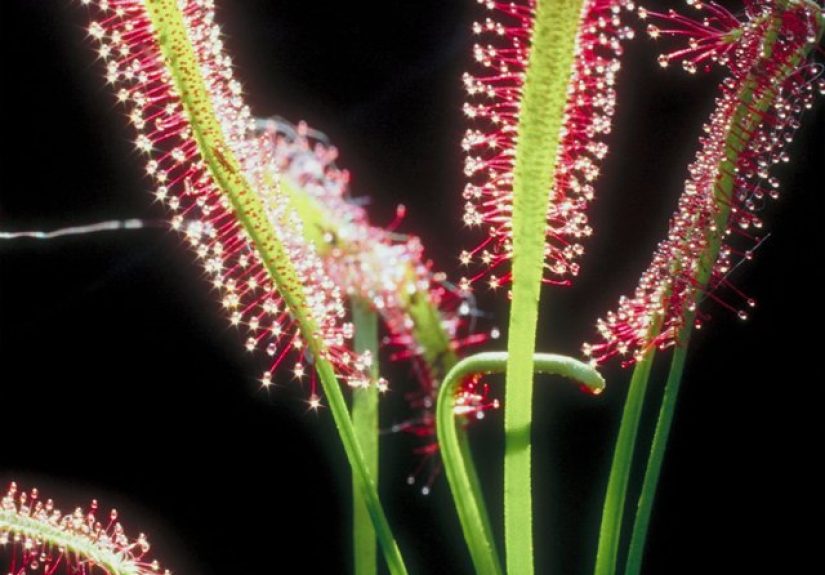
Sundews belong to the genus Drosera, one of the largest and most diverse groups of carnivorous plants. Their leaves are covered with tiny glandular hairs tipped with glistening droplets. Those droplets look like dew, but they are actually sticky mucilage.
An insect lands on the leaf, gets stuck, and struggles. The movement stimulates nearby tentacles to bend inward. In many species, the leaf slowly curls around the prey, increasing contact with digestive glands. It is not fast like a Venus flytrap, but it is highly effective. Sundews are the “no rush, still winning” champions of the carnivorous plant world.
Common Sundew Examples
Roundleaf sundew (Drosera rotundifolia) grows in bogs and wet, acidic habitats. Its round leaves form a low rosette decorated with red sticky hairs.
Spoonleaf sundew (Drosera intermedia) has longer, spoon-shaped leaves and is found in wet places across parts of North America and beyond.
Cape sundew (Drosera capensis) is native to South Africa and is one of the easiest sundews for beginners to grow. It is forgiving, attractive, and very good at catching small flies.
5. Butterworts: Pretty Leaves With Sticky Intentions
Butterworts, or Pinguicula, often look harmless at first glance. Their leaves are smooth, pale green, and sometimes arranged in neat rosettes. Many produce delicate flowers that look more like ornamental houseplants than insect traps. But the leaves are coated with sticky secretions that act like flypaper.
Small gnats, fruit flies, and other tiny insects become stuck on the leaf surface. The plant releases enzymes that digest the prey and absorbs the nutrients through the leaf. Butterworts are especially useful in collections because they can help catch fungus gnats. That does not mean they are a complete pest-control service, but they do bring a certain poetic justice to the windowsill.
Examples include Pinguicula primuliflora, a North American species associated with wet habitats, and many Mexican butterworts, which are popular among collectors for their attractive rosettes and colorful flowers.
6. Bladderworts: Tiny Underwater Traps With Big Ambition
Bladderworts belong to the genus Utricularia. Many species are aquatic or semi-aquatic, and their traps are among the fastest in the plant world. Instead of sticky leaves or pitchers, they use tiny bladder-like structures.
Each bladder is set under negative pressure. When a small aquatic organism touches the trigger hairs near the trap door, the door opens and water rushes in, pulling the prey inside. The door closes almost instantly. This suction-trap system is remarkable because it works at a miniature scale with impressive speed.
Bladderworts often catch tiny crustaceans, mosquito larvae, protozoans, and other small aquatic organisms. Their flowers may be yellow, purple, or white, and can look surprisingly showy considering the plant’s underwater hunting equipment is nearly invisible.
7. Cobra Lily: The California Pitcher With a Reptile Costume
The cobra lily, or California pitcher plant (Darlingtonia californica), grows in parts of northern California and Oregon. Its hooded pitchers resemble a rearing cobra, complete with forked leaf appendages that look like a snake’s tongue. If the plant kingdom hosted a costume contest, this one would make the finals.
Cobra lilies lure insects into the pitcher through an opening beneath the hood. Once inside, prey may become disoriented by translucent patches that look like exits. The insect moves deeper into the trap, eventually falling into fluid where it is broken down. Unlike many other carnivorous plants, cobra lilies are famous for needing cool root conditions, making them more challenging to cultivate than Venus flytraps or Cape sundews.
8. Waterwheel Plant: The Aquatic Cousin of the Venus Flytrap
The waterwheel plant, Aldrovanda vesiculosa, is an aquatic carnivorous plant with small snap traps arranged in whorls around a floating stem. It is related to the Venus flytrap and uses a similar rapid closing mechanism, though on a much smaller scale.
Instead of catching houseflies, waterwheel plants capture tiny aquatic invertebrates. Their traps close when sensitive hairs are stimulated. Because the plant floats freely and lacks true roots, it depends heavily on clean, suitable aquatic habitats. It is rare in the wild and can be difficult to maintain in cultivation.
9. Rainbow Plants: Sticky Traps With a Shimmer
Rainbow plants, or Byblis, are carnivorous plants with slender leaves covered in sparkling glands. They resemble sundews at first glance, but they belong to a different plant family. Their sticky secretions catch small insects, and the plant absorbs nutrients from the prey.
Many Byblis species are native to Australia. They are often grown by advanced hobbyists who enjoy their delicate appearance. The name “rainbow plant” comes from the way light shines through the sticky droplets, creating a glittering effect. It is beautiful, but for a tiny gnat, it is basically a luxury trap.
10. Corkscrew Plants: Underground Hunters
Corkscrew plants belong to the genus Genlisea. They are less famous than Venus flytraps or pitcher plants, but they are fascinating. Their traps are usually underground or underwater and shaped like twisted tubes. Tiny organisms enter the trap and are guided inward by hairs that make turning back difficult.
These plants often prey on microscopic animals and protozoans rather than large insects. Still, they belong in any serious discussion of carnivorous and insectivorous plant adaptations because their trapping structure is so unusual. They prove that nature does not need a big mouth to be clever.
Why Insectivorous Plants Matter
Insectivorous plants are more than biological curiosities. They reveal how evolution solves hard problems. In nutrient-poor habitats, these plants turned leaves into traps, nectar into bait, and digestion into a survival strategy. They also support unique ecosystems. Pitcher plants, for example, may host mosquito larvae, mites, bacteria, and other tiny organisms in their fluid-filled leaves.
Many insectivorous plants are also important conservation symbols. Their habitats are often wetlands, bogs, seepage slopes, and fire-maintained pine savannas. These places are vulnerable to drainage, development, pollution, fire suppression, and illegal collecting. Protecting carnivorous plants means protecting entire ecosystems that shelter many other rare species.
How to Grow Insectivorous Plants Responsibly
Growing insectivorous plants can be rewarding, but they are not ordinary houseplants. Most dislike fertilizer, rich potting soil, and mineral-heavy tap water. A good rule is simple: do not pamper them like a tomato plant. Their roots evolved for poor soil, so rich soil can harm or kill them.
Basic Care Tips
Use rainwater, distilled water, or reverse-osmosis water when possible. Give most species bright light. Grow bog plants such as Venus flytraps, sundews, and many Sarracenia in nutrient-poor media such as sphagnum peat mixed with clean sand or perlite. Avoid standard potting mix because it often contains fertilizer. Do not feed them hamburger, chicken, cheese, or any other kitchen experiment. They are insectivorous plants, not tiny green garbage disposals.
Some temperate species need winter dormancy. Venus flytraps and many American pitcher plants naturally slow down in cooler months. Tropical species such as many Nepenthes may need stable humidity and warm conditions instead. Always identify the plant before copying care advice from another species.
Experience-Based Notes: What Observing Insectivorous Plants Teaches You
Spending time with insectivorous plants changes the way you look at “quiet” nature. At first, the obvious stars get all the attention. A Venus flytrap closes and everyone gasps. A tall pitcher plant glows in the sun and looks like a sculpture. A sundew sparkles like it has been sprinkled with sugar. But after a while, the slower details become the most interesting part of the experience.
One useful lesson is patience. A sundew may take hours to curl around its prey. A pitcher plant may stand still for days, silently collecting insects. Butterworts barely move at all, yet their leaves keep catching tiny gnats. These plants remind observers that action in nature is not always loud. Sometimes the most successful hunter in the room is the one that looks like a decorative coaster.
Another experience many growers notice is that water quality matters more than enthusiasm. Beginners often want to help too much. They add fertilizer, use regular potting soil, or feed the plant pieces of meat. The plant then declines, not because it was neglected, but because it was over-loved. Insectivorous plants teach restraint. Give them clean water, proper light, poor soil, and the occasional insect, then step back. The plant already has a plan.
Observing these plants outdoors, especially in a bog or wetland garden, also highlights the importance of habitat. A pitcher plant is not just an isolated oddity. Around it may be sphagnum moss, orchids, grasses, sedges, frogs, dragonflies, and pollinators. The whole place works as a delicate system. Remove the water, shade it too heavily, suppress natural disturbance where fire is part of the ecosystem, or collect plants illegally, and the system begins to fail.
For home growers, the most satisfying experience often comes from creating a small bog container. A wide pot, proper carnivorous plant media, distilled water, and full sun can support a miniature display of flytraps, sundews, and small pitcher plants. Watching dew form on sundews in the morning or seeing new pitchers rise in spring feels like keeping a tiny wetland on the patio. It is not high-maintenance in the usual sense, but it is specific. These plants do not ask for fancy treatment; they ask for the right treatment.
Children and new plant lovers are often especially drawn to insectivorous plants because they make biology visible. Adaptation, habitat, nutrients, evolution, and conservation become easier to understand when a leaf snaps shut or a pitcher catches an ant. The “wow” factor opens the door, but the science keeps people interested. That is the real magic of insectivorous plants: they are strange enough to grab attention and complex enough to reward deeper study.
The best experience, however, is learning to respect them. These plants are not monsters. They are specialists. They evolved in difficult places and solved nutrient problems with elegance, chemistry, and structural genius. Whether you admire a Venus flytrap, a cobra lily, a bladderwort, or a humble butterwort, you are seeing survival written in leaves. That is far more impressive than any fictional man-eating plant with a theme song.
Conclusion
Examples of insectivorous plants include Venus flytraps, American pitcher plants, tropical pitcher plants, sundews, butterworts, bladderworts, cobra lilies, waterwheel plants, rainbow plants, and corkscrew plants. Each has a different trapping strategy, but all share the same basic purpose: gaining nutrients in habitats where the soil is poor.
These plants are fascinating because they challenge our expectations. They are beautiful, delicate, efficient, and sometimes a little unsettlingin the best possible way. They also remind us that unusual habitats such as bogs, fens, and wet pine savannas deserve protection. When we protect insectivorous plants, we protect some of the most specialized and surprising ecosystems on Earth.