Table of Contents >> Show >> Hide
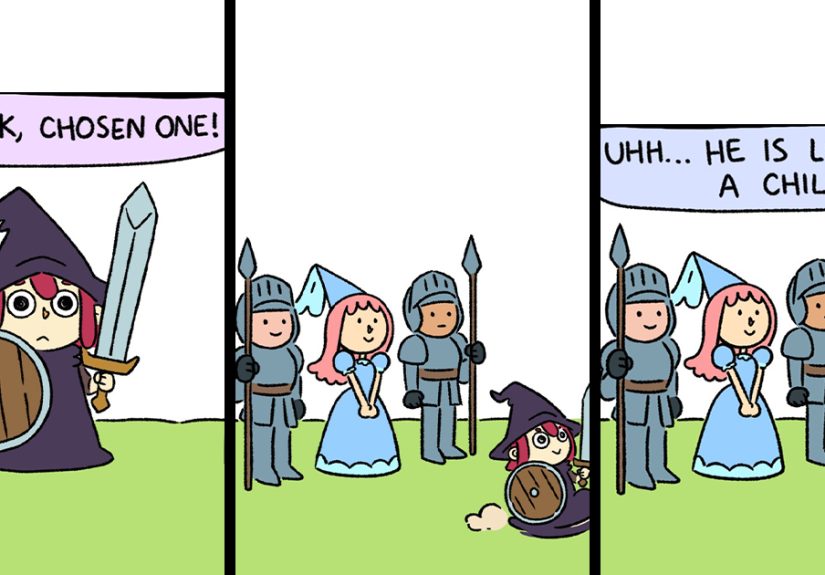
If you have ever saved 99 healing potions “for later” and then finished the game without touching a single one, congratulations: you are exactly the kind of person this comic series was made for. Clueless Hero, created by Luis Lee and Ana Gaby Perez, turns gamer brain into comedy gold. The setup is simple, but that simplicity is the trapdoor under the joke: drop a silent, well-meaning, gloriously confused hero into a game world that runs on RPG logic, and suddenly every normal mechanic looks just a little bit ridiculous.
That is the magic behind the collection often presented as 31 comics about a “clueless hero”. These comics do not just poke fun at video games from a distance. They feel like they were made by people who have spent a suspicious amount of time staring at inventory screens, arguing with NPC dialogue, and pretending that their latest “quick session” will not somehow become a three-hour side-quest spiral. In other words, they understand the culture from the inside.
What makes this brand of gamer humor work so well is that it never tries too hard to prove it is “for gamers.” It simply notices the weird things players already accept as normal. Why do heroes smash pottery with zero social consequences? Why do merchants stand in one spot forever like retail monks? Why do we trust a glowing checkpoint more than our own common sense? Clueless Hero grabs those questions, gives them a side-eye, and turns them into punchlines.
Who Are The Artists Behind Clueless Hero?
Luis Lee and Ana Gaby Perez built a comic that feels like it belongs to both gaming culture and internet comic culture at the same time. That combination matters. A lot. One side gives the series its references: fantasy heroes, boss fights, side quests, save systems, item hoarding, and all the sacred nonsense of game logic. The other side gives it speed, timing, and accessibility. You do not need to read 400 pages of lore to get the joke. One panel in, and your brain goes, “Oh no. I have done that.”
That instant recognition is part of why these artists stand out. Their comic does not rely on obscure references meant only for elite gamers who remember the exact stats of a sword from a 1997 JRPG import. Instead, the humor usually comes from universal gamer behavior: overthinking, under-preparing, trusting bad tutorials, ignoring the main quest, and interpreting every harmless object as possible loot. The hero may be clueless, but the joke is precise.
There is also a clear affection behind the satire. This is not one of those cynical “look at these silly gamers” projects. It is more like, “look at the adorable chaos we all willingly live in.” That difference keeps the comics light, funny, and weirdly warm. The artists know that gaming is full of absurdity, but they also know absurdity is half the fun.
Why These 31 Comics Feel So Relatable
The Silent Hero Is A Comedy Machine
One of the smartest choices in the series is the hero archetype itself. He resembles the classic fantasy adventurer type: brave enough to keep moving, confused enough to make everything harder, and quiet enough that the world can project whatever madness it wants onto him. A silent or nearly silent hero is already a familiar gaming device, especially in adventure and role-playing games. But in comedy, that silence becomes rocket fuel.
Why? Because silence creates a gap, and comedy loves gaps. If the hero does not explain himself, every action becomes funnier. Open a suspicious chest? Funny. Follow the least trustworthy wizard alive? Funnier. Nod politely while carrying a backpack full of fish, bombs, soup ingredients, and a cursed relic? That is peak gamer behavior wearing a fantasy tunic.
The “clueless hero” works because he lets the joke land visually and conceptually at the same time. He is not clueless in a mean-spirited way. He is clueless the way players often are: fully committed, half informed, and somehow still progressing. That makes him less like a parody of a hero and more like an honest portrait of how many players actually move through games.
Game Logic Is Naturally Ridiculous
Video games are full of mechanics we accept without blinking. In real life, if someone told you to roll through breakable crates in an abandoned castle to find arrows and lunch, you would probably seek help. In games, that is called resource management. Clueless Hero understands that the quickest route to a laugh is often not inventing a new joke, but simply holding up a mirror to the logic players already treat as reasonable.
That is why jokes about save points, inventory systems, fetch quests, respawning enemies, suspicious healing items, and emotional attachment to junk land so well. These are not fringe gaming habits. They are practically a second language. The comics tap into that language and translate it into visual humor that feels immediate. You do not have to stop and decode the reference. The reference already lives in your muscle memory.
And then there is the truly glorious territory: the rules that players obey even when those rules are obviously nonsense. “This door is locked, so I must now explore a volcano.” “This side character has a name, so they are probably important.” “This boss has three forms because peace was never an option.” When game design habits become patterns, comedy can turn those patterns into rhythm. These comics understand rhythm very well.
The Best Jokes Are Not About Winning. They Are About Playing
A lot of gaming humor on the internet focuses on extremes: rage, speedrunning, impossible difficulty, or giant industry drama. Clueless Hero often aims somewhere more useful: the ordinary player experience. That is what gives the series staying power. The funniest moments in gaming are not always huge moments. Sometimes they are tiny, embarrassing, deeply human moments.
Like realizing you have been walking around with a broken weapon for way too long. Or discovering the item you sold for pocket change was needed for a legendary upgrade. Or pretending you definitely understood a puzzle while internally becoming one with the loading screen. The comics recognize that humor grows in the gap between how heroic games want us to feel and how chaotic we actually are while playing them.
That is why even people who are not hardcore gamers can still appreciate the humor. The jokes may be built on game mechanics, but the emotional core is universal: confusion, overconfidence, procrastination, denial, and that very special human talent for making simple tasks weirdly complicated.
What The Series Says About Gamer Culture
The collection of 31 comics is not just a stack of one-off gags. Taken together, it becomes a mini portrait of modern gamer culture. There is love for fantasy adventure, affection for old-school RPG patterns, and a gentle roast of the habits players carry from game to game like inherited family curses.
One major theme is shared experience. Gaming is huge now, but certain habits are still instantly recognizable across genres and generations. Nearly everyone has encountered the panic of low health, the temptation to explore where they clearly should not, the hope that one more side mission will somehow solve everything, and the irrational certainty that every barrel deserves investigation. The comics transform those habits into social currency. Laughing at them is a way of saying, “Yes, you too? Same.”
Another theme is meta-awareness. These comics know games are designed objects. That is why jokes about developers, rules, balancing, and genre expectations fit naturally into the series. The world does not just contain monsters and heroes. It also feels shaped by invisible design decisions, which makes the comedy richer. The artists are not simply making fantasy jokes. They are making jokes about how games are built, how players interpret them, and how both sides accidentally create nonsense together.
That kind of layered humor is especially satisfying because it rewards attention without becoming smug. You can laugh at the surface joke, or you can laugh harder because you recognize the deeper critique of gaming habits and design conventions. Either way, the comic wins. Nicely played, artists. Nicely played.
Why The “Clueless Hero” Formula Works So Well
The secret ingredient here is balance. Too much parody, and the comic would feel like a one-note skit stretched past its natural life. Too much lore, and it would become inaccessible. Too much meanness, and the charm would evaporate like your health bar after touching a boss arena floor. But Luis Lee and Ana Gaby Perez avoid all three traps.
Their approach works because the hero is funny without becoming unbearable, the references are recognizable without becoming exclusionary, and the tone stays playful even when it is poking holes in familiar gaming rituals. The result is a comic that feels lightweight in format but sharp in observation.
In a crowded internet full of memes, reaction images, and hot takes moving at the speed of caffeine, a comic like this has real staying power. It is built on patterns that are not going away anytime soon: fantasy adventure tropes, player psychology, quest logic, and the strange little rituals that gamers keep repeating because games keep training us to repeat them. That makes Clueless Hero both timely and oddly evergreen.
31 Comics, One Big Joke About How We All Play
At its best, Clueless Hero reminds us that games are funny even before anybody writes a joke about them. The artists simply know where to look. They find comedy in the pause before a terrible decision, the confidence of an underprepared hero, the logic of imaginary worlds, and the habits players carry like beloved baggage from one title to the next.
So if you are wondering what makes these 31 comics worth attention, the answer is not just that they are funny. It is that they are observant. They understand that the real comedy of gaming lives in repetition, ritual, and player behavior. We all know the fantasy of being the chosen hero. Clueless Hero just adds the missing truth: sometimes the chosen hero is winging it, misreading the quest, hoarding apples, and somehow still saving the world.
Honestly? That may be the most realistic hero in gaming.
Extra Gamer Experiences That Make This Topic Hit Home
What makes a comic series like this stick with readers is not only the joke on the page, but the memory it wakes up in the player. Most gamers have at least one story that sounds like it could have been pulled straight out of Clueless Hero. Maybe it was the first time you confidently marched into a boss room, got immediately flattened, and then spent ten minutes pretending the loss was “part of the strategy.” Maybe it was the moment you realized you had been carrying a rare item for 30 hours and had absolutely no clue what it did. That is the emotional territory these comics understand so well.
I think that is why gamer humor survives across consoles, genres, and generations. The technology changes, the graphics get fancier, and every year some new game promises to redefine immersion, but players remain gloriously predictable. We still check behind waterfalls. We still assume the suspicious cave contains treasure instead of consequences. We still save strong weapons for a “better time” that never arrives. And we still become emotionally attached to the weirdest things, like a starter sword, a goofy side character, or one single healing item we have no logical reason to protect.
There is also a very specific kind of gaming embarrassment that Clueless Hero captures perfectly: realizing the game told you exactly what to do, and you still did the opposite. Not because you are reckless. Not because you are rebellious. Mostly because you saw a shiny object in the distance and your brain went, “Well, that is obviously the priority now.” Twenty minutes later you are in a swamp, underleveled, mildly cursed, and somehow responsible for a side quest involving mushrooms, ghosts, and a blacksmith with trust issues.
Then there are the social experiences. Anyone who has played with friends knows that gaming often turns competent adults into adorable goblins. One person becomes the loot vacuum cleaner. One person ignores the mission to test every physics interaction possible. One person insists they know the route, which is gamer language for “I have led us into disaster before, and I can do it again.” Comics about a clueless hero work because every friend group already has one. Sometimes we are that hero. Sometimes we are the exhausted companion watching that hero poke a glowing object that is definitely going to explode.
Even solo players know the feeling of narrating nonsense to themselves while gaming. “I am just checking this area.” “I definitely meant to fall off that ledge.” “No, no, I wanted to alert every enemy in a two-mile radius.” That inner commentary is part of the fun. Games invite drama, but players create comedy. We miss jumps. We misread maps. We overprepare for easy fights and underprepare for obvious danger. We become legends and clowns in alternating five-minute intervals.
That is why Clueless Hero does more than get a quick laugh. It makes players feel seen. Beneath the fantasy armor, the boss battles, and the dramatic quests, there is a very human truth: gaming is often a long sequence of confusion, optimism, nonsense, and accidental brilliance. Which, now that I think about it, is also a pretty accurate description of life. No wonder the comics work so well.
Conclusion
Clueless Hero succeeds because it understands a simple truth: gamers do not just love winning; they love the weird, messy, hilarious process of getting there. These 31 comics turn silent-hero tropes, RPG logic, player habits, and game-world absurdity into smart, easy-to-love humor. Luis Lee and Ana Gaby Perez are not just making jokes about games. They are capturing the tiny rituals and recurring disasters that make gaming culture feel like a giant inside joke shared across millions of players.
If a comic can make you laugh, nod, and quietly whisper, “Okay, wow, I have absolutely done that,” it is doing something right. Clueless Hero does that again and again. It is cheerful, sharp, and painfully relatable in the best possible way. For gamers, it feels like recognition. For everyone else, it is a reminder that heroes are a lot funnier when they are a little confused.