Table of Contents >> Show >> Hide
- What Is a George III Period Oak Drop Leaf Table?
- Key Features That Define the Form
- Why Oak Matters
- How to Identify a Good Example
- Why Collectors and Designers Still Love Them
- Styling a George III Period Oak Drop Leaf Table Today
- Care and Preservation
- Is a George III Period Oak Drop Leaf Table Worth Buying?
- Experience: Living With a George III Period Oak Drop Leaf Table
- Conclusion
A George III period oak drop leaf table is the kind of furniture that quietly wins a room without begging for attention. It does not scream. It does not sparkle. It does not arrive with chrome legs and a personality disorder. Instead, it shows up with sturdy oak, practical hinged leaves, and the sort of calm confidence that says, “I have survived centuries. I can handle your coffee mug.”
For collectors, designers, and homeowners who love antique English furniture, this table form sits in a sweet spot between beauty and usefulness. It belongs to the George III period, broadly associated with the later Georgian era, when furniture design moved across elegant curves, classical influence, and increasingly refined lines. In other words, this was a time when furniture makers understood something modern life keeps relearning: a table should be handsome, but it should also actually work.
The appeal of a George III period oak drop leaf table comes from that balance. It is architectural without feeling stiff, adaptable without feeling flimsy, and old enough to carry real history without becoming impossible to live with. Whether used as a small dining table, a console in a hallway, or a flexible work surface in a snug room, it remains one of the smartest antique furniture choices around.
What Is a George III Period Oak Drop Leaf Table?
At its core, a drop leaf table is built around a fixed center section with one or two hinged leaves that can be raised when needed and lowered when space is tight. That simple idea made it incredibly useful in houses where rooms had to do more than one job. Breakfast, letter writing, card playing, sewing, and supper could all happen on the same surface. When the action ended, the leaves dropped, and the room got its breathing space back.
A George III period example refers to a table made during the reign of George III, or styled in the taste of that late 18th-century moment. This is where things get interesting. George III furniture can range from pieces with lingering Chippendale energy to more restrained forms that hint at the neoclassical elegance associated with later Georgian taste. Translation: not every table looks identical, and that is part of the fun.
When the table is made of oak, it gains another layer of character. Oak brings visual weight, visible grain, and serious toughness. It also develops the sort of patina collectors love: a surface mellowed by age, handling, light, and time rather than factory distressing that tries a little too hard.
Key Features That Define the Form
1. Hinged leaves
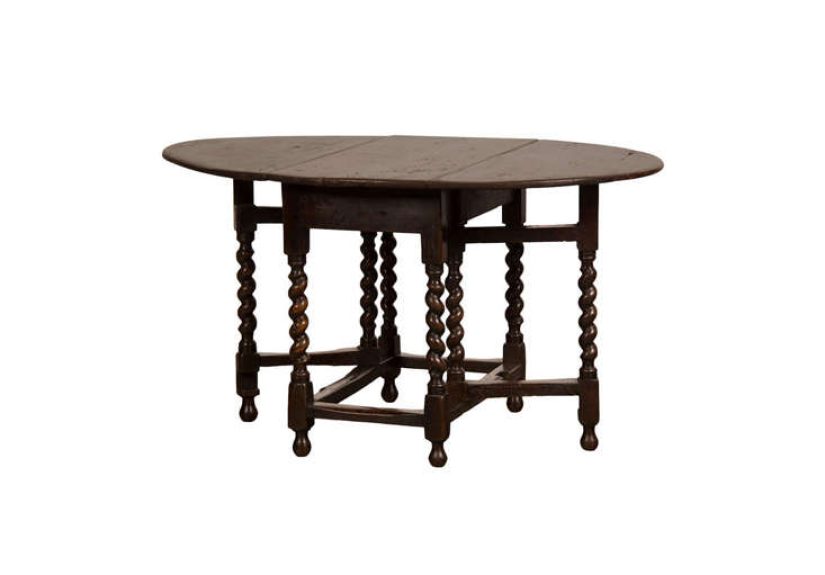
The defining feature is right there in the name. The leaves fold down when not in use and lift up to expand the tabletop. Depending on the design, the top may become oval, rectangular, or softly rounded when fully opened. This flexibility is what made drop leaf tables so useful in historic interiors and still makes them appealing in smaller homes today.
2. Gateleg or support action
Many period drop leaf tables use gatelegs or hinged supports that swing out to hold the leaves up. This is not just clever engineering; it is furniture with manners. The table expands only when invited. Some George III examples feature single-gate action, while others use different support arrangements depending on scale and regional making traditions.
3. Solid plank tops and honest construction
One hallmark of earlier furniture is construction you can actually read. Tops may be formed from wide planks, sometimes with cleated ends. Leaves are hung on iron butt hinges, and the joinery often has the sturdy logic of furniture meant for daily use rather than showroom posing. On authentic period pieces, tiny irregularities are often a good sign. Perfect symmetry is lovely in theory; handwork is lovelier in real life.
4. Legs with personality
George III period oak drop leaf tables can stand on turned tapering legs, pad feet, faceted octagonal legs, or more decorative supports like barley twist turning. Some examples are plain and provincial, while others show off a little. Think of it as the difference between a great wool coat and a great wool coat with very good cuff buttons.
5. A plain or lightly detailed frieze
Many oak examples keep the apron or frieze relatively simple, letting the shape and timber do the talking. That restraint is part of the charm. These are not tables overloaded with carving just to prove they exist.
Why Oak Matters
Mahogany often gets the glamour shots in Georgian furniture history, but oak deserves more applause. A George III period oak drop leaf table has a grounded, almost architectural presence that feels different from mahogany’s polish. Oak is strong, stable, and visually rich. Its grain can read as bold, warm, and deeply textured, especially once age has softened the surface into a darker, more complex tone.
Oak also makes sense for a working table. This is furniture meant to be used, not merely admired from a morally superior distance. An oak table can hold a lamp, a laptop, a bowl of fruit, a stack of books, or an alarming number of unopened mail envelopes without looking offended.
Collectors often appreciate oak for its patina, too. A surface that shows slight cupping, gentle wear, softened edges, and color variation can be more attractive than one that has been stripped into blandness. Antique furniture is supposed to have a memory. If it looks suspiciously brand-new, something may have gone wrong.
How to Identify a Good Example
Buying a George III period oak drop leaf table is part education, part instinct, and part staring at hinges like a detective in a period drama. Start with overall proportion. The best tables feel balanced whether the leaves are up or down. They do not look awkwardly stretched or top-heavy.
Next, examine the construction. Look for a solid center section, well-fitted leaves, old hinges, and sensible joinery. Period pieces often show age in believable ways: wear where hands actually touched the table, darkening around use areas, minor shrinkage, and small repairs that reflect long life rather than recent fakery.
Legs matter, too. Turned tapering legs with pad feet, octagonal supports, or other period-appropriate forms can help date the piece stylistically. A triple-plank top, cleated ends, and a plain frieze are all details often associated with antique examples. Tables with boldly decorative barley twist legs can be especially appealing, though they tend to make a stronger visual statement.
Condition should be judged with a cool head. Scratches, dents, stained patches, hinge wear, and shrinkage cracks are common on old tables. These are not automatic deal breakers. What matters is whether the table remains structurally sound, stable on its legs, and usable without drama. A little evidence of age is charming. A tabletop that behaves like a seesaw is less romantic.
Why Collectors and Designers Still Love Them
The modern affection for the George III period oak drop leaf table is easy to understand. It solves space problems while adding real character. In a small apartment, it can sit nearly flat against a wall and open only when guests arrive. In a country kitchen, it feels perfectly at home next to pottery, linen runners, and slightly smug sourdough. In a more formal room, it can act as a side table with enough history to keep mass-market furniture very quiet.
Designers also love the mix of usefulness and age. Antique tables keep rooms from feeling overly staged. A room with one old oak table instantly gains texture, warmth, and narrative. It suggests that the people who live there collect things with judgment rather than ordering entire personalities from a catalog on a Tuesday night.
Another reason these tables remain desirable is versatility. A George III oak drop leaf table can serve as:
- a breakfast table in a small kitchen,
- a lamp table behind a sofa,
- a writing table in a study,
- an occasional dining table for compact homes,
- or a display table in a hallway or entry.
That sort of flexibility is timeless. Furniture that adapts well tends to stay relevant. Furniture that only works in a 12,000-square-foot villa with imported limestone floors has a narrower market.
Styling a George III Period Oak Drop Leaf Table Today
The good news is that this table plays well with more than one decorating style. In a traditional room, pair it with Windsor chairs, brass candlesticks, framed prints, and natural textiles. In a modern interior, let it stand out against cleaner lines, lighter walls, and fewer accessories. The contrast can be beautiful.
Because oak already has strong visual presence, styling works best when it is simple. A ceramic lamp, a stack of art books, a bowl of pears, or a vase with branches will usually do the trick. You do not need to bury it under objects. Antique tables are not shelves with self-esteem issues.
If the table has especially beautiful turning or a rich old surface, give it room to breathe. Let the wood be the event. A thoughtfully placed antique can do more for a room than a dozen trendy accessories trying to form a committee.
Care and Preservation
A George III period oak drop leaf table has already made it this far, which is impressive. Your job is not to “improve” it into oblivion. Your job is to help it continue living well.
Start with environment. Antique furniture prefers stability. Rapid shifts in humidity can cause wood to expand and contract at different rates, which may lead to cracks, loose joints, or other damage. Keep the table away from intense sun, heating vents, damp areas, and dramatic moisture swings. Excess light can alter surfaces over time, and insects are never invited guests.
For regular cleaning, use a soft cloth and keep things gentle. If grime builds up, use mild methods and dry the surface promptly. Avoid soaking the wood, using harsh sprays, or introducing steam cleaners as if this were a tile floor with ambition. Water rings should be addressed carefully and with restraint. The goal is preservation, not aggressive experimentation worthy of a regrettable internet video.
Waxing or polishing should be done thoughtfully and sparingly. Over-polishing can create buildup, and over-restoration can erase the very patina that makes the table desirable. When in doubt, a good antique conservator is worth the fee. Amateur heroics have ruined many honest old tables.
Is a George III Period Oak Drop Leaf Table Worth Buying?
Yes, especially if you value furniture that earns its footprint. This table offers historical interest, practical flexibility, and a style that does not depend on trends to stay relevant. It can be modest or elegant, plain or richly turned, provincial or polished, but the best examples always feel useful.
That is the real magic. A George III period oak drop leaf table is not just decorative. It represents a long tradition of smart design: furniture made for real rooms, real tasks, and real lives. In an age full of disposable pieces, that feels refreshingly radical.
If you find a strong example with good proportions, honest surface, stable construction, and character you genuinely enjoy, it is more than a purchase. It is an inheritance borrowed in reverse. You become one more caretaker in the life of a table that has already seen a lot and still has plenty left to give.
Experience: Living With a George III Period Oak Drop Leaf Table
The first time I spent real time with a George III period oak drop leaf table, I understood why people become slightly unreasonable about old furniture. From a distance, it looked modest enough: warm brown oak, leaves folded down, sturdy legs, no unnecessary theatrics. But the closer I got, the more it felt like meeting someone whose handshake tells you everything. The surface had that soft, uneven glow only age can produce. Not glossy. Not raw. Just beautifully settled.
What surprised me most was how modern it felt in daily use. With the leaves down, it sat neatly against the wall and behaved like a console table, holding a lamp, a bowl, and the usual household clutter that arrives without invitation. Then company came over, the leaves lifted, the supports swung into place, and suddenly the table changed roles with the ease of a practiced actor. Dinner for two became coffee for four, and later, a place to spread out books and notes. It never felt fragile. It felt ready.
There is also something strangely grounding about using a table that has clearly worked for a living. Tiny marks on the top stopped me from worrying about perfection. Instead of treating it like a museum piece trapped in polite silence, I found myself treating it with respect but not fear. That balance is rare. New furniture often makes you nervous for the wrong reasons. Antique furniture, when it is sound, tends to remind you that use is part of its story.
I also noticed how much it changed the room around it. Everything nearby looked more intentional. A simple chair felt more interesting. A plain ceramic mug looked almost styled. Even afternoon light seemed to settle differently on the oak grain, picking up the subtle ridges and color shifts in the wood. It became one of those pieces that quietly organizes visual chaos. Not because it is loud, but because it has gravity.
Another memorable part of the experience was the movement itself. Raising the leaves, checking the supports, and feeling the weight of the top made the table feel mechanical in the best way. You could sense the old logic behind its design. This was furniture made by people who understood materials and expected objects to adapt to life. That tactile experience is hard to replicate with modern flat-pack pieces that treat hardware like a threat.
Over time, the table became less of an antique and more of a companion. It held flowers one week and unpaid bills the next. It served as a writing desk, a lunch table, a landing pad for groceries, and a place to set down a cup of tea at the end of a long day. That may sound overly sentimental for a table, but anyone who loves old furniture knows the truth: the best pieces earn affection through use, not display.
Living with a George III period oak drop leaf table taught me that great furniture is not about showing off. It is about service, beauty, and endurance. It is about a piece being useful on ordinary Tuesday afternoons, not just impressive when guests come over. And maybe that is why this table form still feels so right. It does not ask for attention. It simply keeps proving, over and over again, that good design ages better than fashion ever will.
Conclusion
A George III period oak drop leaf table remains one of the smartest antique buys for anyone who wants furniture with both soul and function. It brings history, texture, flexibility, and craftsmanship into a space without becoming stiff or overly formal. Whether you are collecting antique English furniture, decorating a compact dining area, or simply looking for a table with more character than most modern options can dream of, this classic form deserves serious consideration.