Table of Contents >> Show >> Hide
- Fusion 101: Why Temperature Is Everything
- Meet the Contenders: ITER vs. the Google-Backed Reactor
- Why This Reactor Must Run 8 Times Hotter Than ITER
- The Promise of Hydrogen–Boron Fusion
- Engineering at a Billion Degrees
- Money, Milestones, and the Race to Commercial Fusion
- What It Could Mean for Clean Energy
- Reality Check: Risks, Hurdles, and Healthy Skepticism
- Following the Fusion Race: Experience from the Front Row (500-Word Perspective)
If you think your laptop runs hot when you have 47 Chrome tabs open, wait until you hear about the fusion
reactor backed by Google that wants to hit one billion degrees Celsius. That’s not a typo.
This experimental machine has to run roughly eight times hotter than ITER, the world’s largest
tokamak, just to make its favorite type of fusion work.
Why would anyone design a reactor that has to get hotter than science fiction? Because if it succeeds, this
Google-backed fusion project could deliver electricity with almost no long-lived radioactive waste, no meltdown
risk, and fuel you can dig out of seawater and plain old boron ore. It’s a huge bet on a different flavor of
nuclear fusionand it explains why the temperatures involved make ITER look almost “chilly” by comparison.
Fusion 101: Why Temperature Is Everything
Fusion is what powers the Sun. Take very light nuclei, smash them together under incredible
temperature and pressure, and they fuse into heavier nuclei, releasing energy along the way.
On Earth, we can’t reproduce the Sun’s crushing gravity, so we compensate by cranking up the temperature until
the fuel turns into a super-hot plasma.
The easiest fuel combo for fusion reactors is a mix of deuterium and tritium (D–T), two heavy forms of hydrogen.
In devices like ITER, this fuel needs to reach around
150 million degrees Celsiusabout ten times hotter than the core of the Sunfor the reaction
rate to become useful.
At those temperatures, atoms are stripped of their electrons and become plasma, a swirling soup of charged
particles that must be held in place by magnetic fields. Nothing solid can survive that heat; the plasma never
touches the reactor walls directly. Instead, magnetic fields act like an invisible bottle, keeping the plasma
suspended and under controlat least, that’s the goal.
Meet the Contenders: ITER vs. the Google-Backed Reactor
ITER: The Giant Tokamak in France
ITER (International Thermonuclear Experimental Reactor) is a massive, international project under construction
in southern France. Dozens of countries are involved, and the whole point of ITER is to prove that a D–T fusion
machine can produce more power than it consumes. When complete, it’s expected to host plasmas at
150 million °C using powerful magnets, neutral-beam injectors, and radio-frequency heating
systems.
ITER is a tokamak: a doughnut-shaped vessel surrounded by magnets. It’s the standard bearer of mainstream fusion
research and focuses on D–T fuelwhich is “easier” to ignite but produces a lot of energetic neutrons that can
activate reactor materials and create radioactive waste over time.
The Google-Backed Challenger: TAE Technologies
The reactor that has to run eight times hotter belongs to
TAE Technologies, a California-based fusion company backed by Google, Chevron, and other major
investors. Over more than two decades, TAE has raised well over a billion dollars to develop a radically
different approach to fusion, centered on a fuel mix of hydrogen and boron-11 (p–B¹¹).
TAE doesn’t use a classic tokamak design. Instead, its reactors use a “field-reversed configuration” (FRC), a
compact magnetic bottle in which two spinning plasma rings collide and merge into a stable, cigar-shaped plasma.
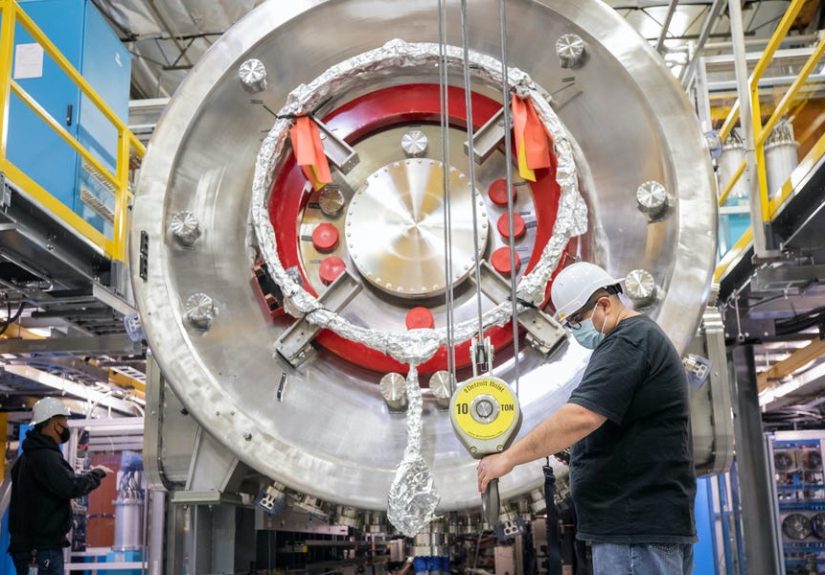
Their current flagship, the Norman device, has already demonstrated stable plasmas above
75 million °C, beating its original goals by a wide margin and attracting a fresh
$250 million funding round in the process.
That’s impressivebut it’s still only a first step. For its future commercial machines, TAE is targeting
one billion degrees Celsius. At that point, their preferred hydrogen-boron fuel starts to look
genuinely competitive.
Why This Reactor Must Run 8 Times Hotter Than ITER
Here’s the key: not all fusion fuels are created equal. D–T fuel, used in ITER, has the lowest barrier to
ignition. Its reaction cross-section (a measure of how likely fusion is to occur) peaks at relatively “modest”
temperatures of tens of keV, corresponding to hundreds of millions of degrees.
Hydrogen-boron fusion, on the other hand, is a classic example of aneutronic fusion. When you
fuse a proton with boron-11 (p–B¹¹), the reaction produces three energetic alpha particles (helium nuclei) and
almost no neutrons. That’s incredibly attractive: fewer neutrons mean less activation of the reactor structure,
less long-lived radioactive waste, and the potential to convert energy directly into electricity using
high-voltage systems instead of giant steam turbines.
The downside? The Coulomb barrierthe electric repulsion between the positively charged fuel nucleiis much
higher. As a result, the optimum reaction rate for p–B¹¹ happens at ion energies nearly
ten times higher than for D–T, corresponding to plasma temperatures in the neighborhood of
billions of degrees Celsius, not “just” hundreds of millions.
That’s why this Google-backed reactor has to run roughly eight times hotter than ITER. It isn’t because the
engineers like pain; it’s because they’re chasing a fundamentally cleaner and more elegant kind of fusion.
The Promise of Hydrogen–Boron Fusion
So what’s the big deal about hydrogen–boron? In theory, a p–B¹¹ reactor offers a list of perks that sounds like
an energy wish list:
- Almost no high-energy neutrons, meaning far less structural damage and long-lived
radioactivity. - Abundant fuel: hydrogen from water and boron from widely available minerals.
- Compact plants with the potential for direct conversion of fusion products into
electricity, skipping the steam turbine step. - No runaway chain reaction, so no Chernobyl-style meltdown scenarios.
Researchers have studied p–B¹¹ for decades, on paper and in experiments, and there’s broad agreement on the
underlying physics: it’s possible, but brutally difficult. Overcoming energy losses from radiation (especially
bremsstrahlung) and keeping the plasma hot and well confined are major challenges. Still, recent theory and
simulation work suggests that new plasma configurations and “avalanche” effects might help tip the balance in
favor of ignition under the right conditions.
Engineering at a Billion Degrees
How do you even think about building a machine that will host plasma at one billion degrees Celsius? The trick
is that the hardware never sees that temperature directly. All the drama happens inside the magnetic fields.
Still, the engineering is extreme.
TAE’s FRC approach uses powerful particle beams and radio-frequency systems to heat and stabilize the plasma,
while magnets confine it in a long, slender shape. Neutral-beam technologyoriginally developed to heat plasmas
in fusion experimentsis now so central to their plans that TAE recently formed a joint venture with the UK
Atomic Energy Authority to commercialize high-performance neutral-beam systems for medical and industrial
applications.
Inside the reactor, the game is all about balance:
- Keep the plasma hot enough that fusion reactions outpace energy losses.
- Confine it long enough that the reactions have time to occur.
- Prevent instabilitieswiggles, kinks, and turbulencefrom tearing everything apart.
TAE’s experiments have already shown that their plasma can be held stable under increasingly harsh conditions,
and each new generation of machines is designed to push the temperature higher while maintaining control. In
parallel, the company and its partners are using advanced computing and AI-driven control strategies to tune the
plasma in real time, something that’s becoming increasingly common across the fusion industry.
Money, Milestones, and the Race to Commercial Fusion
TAE is far from the only private fusion company chasing the dream, but it’s one of the most heavily funded and
longest-running. Across multiple rounds, the company has raised around $1.3 billion, with
Google, Chevron, and other major players reportedly on board. Investors are betting that a viable p–B¹¹ fusion
plant could be a game-changer for grid-scale, low-carbon power.
Recent milestones include:
- Stable plasma conditions at tens of millions of degrees Celsius in the Norman reactor.
- Plans for next-generation machines (often referred to as Copernicus and beyond) that step toward ignition
conditions. - Side businesses (like neutral-beam technology) that can bring in revenue while the long, hard work of fusion
development continues.
Timelines are still ambitious. TAE has suggested that a prototype plant using hydrogen fuel could arrive in the
early 2030s, with p–B¹¹ following later once billion-degree plasmas are routine. Whether those dates hold or
slip, the company’s progress signals that fusion is no longer just a government-lab storyprivate capital and
tech giants are now firmly in the mix.
What It Could Mean for Clean Energy
If a Google-backed fusion reactor can reliably hit a billion degrees and sustain p–B¹¹ fusion at scale, the
payoff could be enormous:
- Firm, low-carbon power that isn’t dependent on sunlight, wind, or weather.
- Small footprint plants that could be built close to demand centers, reducing transmission
losses. - Minimal long-lived waste, easing the political and regulatory hurdles that plague traditional
nuclear power. - New grid architectures designed around clean, high-capacity baseload power.
It’s no accident that AI companies and large data-center operators are watching fusion closely. Training large
AI models and running advanced cloud services require staggering amounts of electricity. A compact source of
virtually carbon-free powerif it becomes realwould reshape how we think about the energy footprint of digital
infrastructure.
Reality Check: Risks, Hurdles, and Healthy Skepticism
Of course, fusion has a long history of over-optimistic timelines. Many scientists and analysts remain cautious,
especially when it comes to aneutronic concepts like p–B¹¹. The physics is more demanding, the engineering is
harder, and the distance between a hot, well-behaved experimental plasma and a power-plant-ready reactor is
measured in more than press releases.
Key open questions include:
- Can bremsstrahlung and other radiation losses be kept low enough at billion-degree temperatures?
- Will confinement and stability hold at the extreme conditions p–B¹¹ requires?
- Can the overall system deliver net electrical power at a cost that competes with renewables plus storage?
Some critics argue that we should focus on more conventional D–T systems, pointing out that we haven’t yet
demonstrated an affordable, grid-connected D–T plant, let alone a more exotic aneutronic reactor. Others counter
that if we want fusion to be not just feasible but truly transformational, it’s worth exploring paths
that reduce radioactive waste and make power plants simpler and safer in the long term.
The bottom line: “Google-backed and a billion degrees” doesn’t guarantee successbut it does signal that serious
money and serious engineering talent believe the problem is at least worth trying to solve.
Following the Fusion Race: Experience from the Front Row (500-Word Perspective)
You don’t have to be a plasma physicist to feel like you’re living through a turning point in energy history.
Over the last few years, headlines about fusion have gone from “someday, maybe” to “wait, that’s actually
happening?” One week it’s a national lab achieving net energy gain in a D–T shot; another week it’s a private
company like TAE announcing a new temperature record or a fresh funding round. If you follow this space even
casually, the story of a Google-backed reactor that wants to run eight times hotter than ITER feels less like
science fiction and more like a high-stakes tech race.
Imagine being an engineer or data scientist walking into TAE’s facility for the first time. Instead of a sleek
Silicon Valley app launch, your daily “product” is a vacuum chamber wrapped in magnets, high-voltage power
supplies, cryogenics, and diagnostics with names that sound like they belong on a spaceship. When the system
spins up, you’re not pushing a new software buildyou’re creating miniature star-like conditions on demand, then
using waves, beams, and magnetic fields to keep that plasma from misbehaving for as long as possible.
The day-to-day experience of working on a billion-degree reactor is surprisingly iterative. Teams tweak control
algorithms by fractions of a percent, retune neutral-beam parameters, adjust magnetic field shapes, and compare
each experimental shot with models that took days to compute. When things go wrong, it’s not subtle: plasmas
crash, sensors light up, alarms sound, and everyone heads back to the whiteboard. When things go right, “success”
might mean keeping the plasma stable for a few milliseconds longer or nudging the temperature a little higher
without triggering new instabilities.
For people following from the outsidestudents, clean-energy geeks, or just curious onlookersthe emotional ride
is similar to watching early spaceflight. There are big public milestones and long quiet stretches in between.
You see renderings of future commercial plants side-by-side with photos of real experimental hardware that’s
already running. You read about ITER’s gradual construction in France, with its colossal tokamak building rising
out of the countryside, and then compare that to TAE’s more compact, industrial-park-friendly reactors quietly
chasing billion-degree plasmas in California.
The contrast is part of what makes this story compelling. On one side, ITER represents decades of international
collaboration, a “traditional” big-science approach with government funding, committees, and long review cycles.
On the other, the Google-backed path pushes toward aneutronic p–B¹¹ fusion with a startup mentality: move
fast, learn from each machine, spin off side technologies like neutral-beam systems for medical use, and let
private capital share the risk and reward. Both routes are betting that by the time today’s teenagers are
middle-aged, fusion will have moved from experimental facilities into real power plants.
Perhaps the most striking experience comes when you picture fusion’s impact on everyday life. Instead of worrying
whether the grid can handle a wave of new EVs, data centers, and heat pumps, we’d be asking different questions:
Where should we site the next fusion plant? How can cities use cheap, clean baseload power to redesign transit,
industry, and housing? How do we make sure communities historically left out of energy booms actually benefit
from what might be the biggest energy transition since the discovery of oil?
Until then, the billion-degree reactor remains a work in progressan audacious experiment driven by a mix of
physics ambition, AI-enhanced control systems, and tech-giant money. Watching it unfold in parallel with ITER
gives us a rare front-row view of two very different visions for the same dream: turning the power of the stars
into something that quietly hums along in the background every time you flip a light switch.