Table of Contents >> Show >> Hide
- What This Challenge Really Is
- Why Artists Love This Kind of Exercise
- Why a Self-Portrait Makes the Challenge Even Better
- How To Draw a Self-Portrait With Your Eyes Closed
- Tips That Make the Challenge More Fun and More Successful
- What Usually Happens on the Page
- Common Mistakes To Avoid
- Why This Challenge Works So Well Online
- How To Turn the Challenge Into Better Content
- 500 More Words on the Experience of Drawing Yourself With Your Eyes Closed
- Conclusion
- SEO Tags
If someone told you to draw a self-portrait with your eyes closed, your first thought might be, “Ah yes, a perfect opportunity to humble myself in public.” Fair. But this playful art challenge is more than a recipe for wildly misplaced eyebrows and ears that look like ravioli. It is also a surprisingly smart drawing exercise.
At its heart, this challenge borrows from the classic blind contour method: you focus on the subject instead of the page, let your hand move slowly, and accept that perfection has officially left the building. When the subject is your own face, the result is part art experiment, part identity check-in, and part comedy special. That blend is exactly why the idea works so well for a “Hey Pandas” style prompt. It is creative, low-pressure, easy to join, and almost impossible to do without laughing at least once.
Even better, an eyes-closed self-portrait is good for more than cheap thrills. It nudges you to observe more carefully, loosen up your expectations, and stop drawing the cartoon version of a face that lives in your brain. In other words, it gets you out of “I know what a nose looks like” mode and into “wait, why is my nose doing that from this angle?” mode.
What This Challenge Really Is
“Draw a self-portrait with your eyes closed” sounds dramatic, but the real magic is not total darkness. The goal is to stop checking the page while you draw. Most people do this with a mirror in front of them. Instead of glancing down every two seconds to rescue the drawing, you keep your attention on your reflection and let your pencil travel as your eyes travel.
That means you are not drawing from memory. You are drawing from observation. There is a huge difference. Memory likes shortcuts. Observation is nosy. Memory says, “A face goes here, eyes go there, let’s call it a day.” Observation says, “Interesting. One eyelid sits slightly lower, the mouth tilts, the hairline has opinions, and the glasses are not as symmetrical as advertised.”
That is why this kind of blind contour self-portrait often looks strange but still feels oddly alive. It may be messy, but it usually captures movement, mood, and personality in a way that polished beginner drawings often miss.
Why Artists Love This Kind of Exercise
It forces you to slow down
When you cannot keep checking the page, you naturally spend more time looking. That slower pace matters. It helps you notice edges, angles, and shapes instead of rushing to fill in a generic face. In a world where everyone wants to finish everything in the time it takes to reheat coffee, that is refreshing.
It breaks perfectionism fast
No one starts an eyes-closed self-portrait thinking, “This will be the realistic masterpiece that defines my legacy.” Good. That is liberating. Because the pressure drops, people often become bolder, looser, and more curious. A challenge like this gives you permission to make ugly lines in service of better seeing.
It makes drawing feel more playful
Some drawing exercises feel like homework in a beret. This one feels different. It is weird. It is funny. It creates instant surprises. When you finally look down, the reveal is half the fun. That emotional payoff is a big reason group settings love it. People compare results, laugh, and suddenly the room gets less self-conscious.
It helps you see beyond the “symbol face”
Many beginners draw symbols instead of what is actually there: almond eyes, a triangle nose, a smiley mouth, done. An eyes-closed self-portrait interrupts that habit. You start following the real contour of your cheek, brow, jaw, and lips. The result may still be lopsided, but it is a more honest kind of lopsided.
Why a Self-Portrait Makes the Challenge Even Better
Self-portraiture has always been bigger than “Here is my face.” Artists use self-portraits to reveal themselves, reinvent themselves, hide parts of themselves, exaggerate a mood, or test how identity changes depending on style and medium. A mirror-based drawing challenge taps into that tradition in a very accessible way.
When you draw yourself with your eyes closed, you are not just studying features. You are also deciding what counts as “you.” Do you focus on the outline of your curls? The sharp angle of your glasses? The sleepy expression you swear you do not always have? Those decisions matter. Even a goofy, one-line portrait becomes a tiny record of how you saw yourself in that moment.
That is what makes this more interesting than a random doodle challenge. It is funny, yes, but it also sits at the crossroads of observation, identity, and expression. Not bad for a drawing that might accidentally connect your eyebrow to your collarbone.
How To Draw a Self-Portrait With Your Eyes Closed
What you need
- A pencil, pen, or marker
- A sheet of paper
- A mirror or phone camera set to selfie mode
- Two to five minutes
- A brave spirit and a forgiving attitude
Step-by-step
- Set up your mirror or front-facing camera so you can clearly see your face.
- Put your pencil on the paper before you begin.
- Pick a starting point, like your chin, eyebrow, or hairline.
- Keep your eyes on your reflection, not the paper.
- Move your hand slowly as your eyes trace the contours of your face.
- Try not to lift your pencil if you want the full blind contour effect.
- Keep going for two to five minutes.
- Only look down when you are done.
That is it. No shading. No erasing. No sneaky little peek “just to check something.” If you peek, the art police will not show up, but the spirit of the exercise takes a hit.
Tips That Make the Challenge More Fun and More Successful
Use a timer
A timer keeps you from quitting the second your hand starts drifting into uncharted territory. Three minutes is a sweet spot: long enough to notice details, short enough that your confidence does not stage a dramatic exit.
Start with one feature
If your whole face feels overwhelming, begin with one area. Follow the line of your eyebrow, around the bridge of your nose, then down to your mouth. You do not have to “cover everything” for the drawing to feel complete.
Draw slowly, not heroically
This is not a speedrun. The slower you move, the more connected your hand stays to what your eyes are actually noticing. Fast drawing usually means memory takes over, and memory is a notorious liar.
Let mistakes stay
Your line will wander. Great. Let it. A doubled jawline, a floating ear, or one eye that appears to be considering a separate career path is part of the charm. In fact, those oddities are often what make the portrait feel expressive.
Try more than one round
The first attempt is usually chaotic. The second one gets more intentional. By the third, you may notice that you are actually seeing better. Not prettier, necessarily. Better.
What Usually Happens on the Page
There are a few common outcomes in this challenge, and all of them are normal.
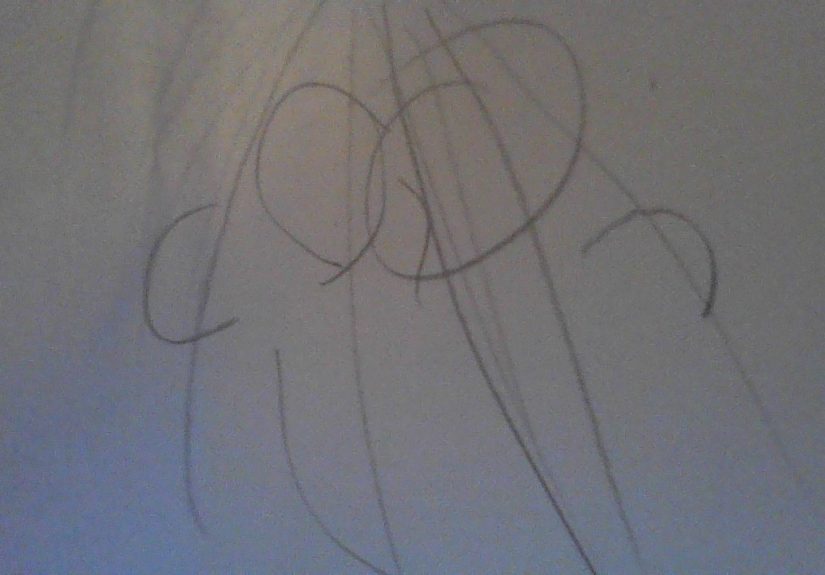
The noodle-face result: a dense tangle of lines that seems impossible to decode until you suddenly notice, “Wait, that is my nose.”
The surprisingly recognizable result: messy but undeniably you. These are the fun ones because they feel like a magic trick performed by a confused pencil.
The emotional result: a portrait that is technically off but somehow nails your mood. Maybe you looked tired, amused, serious, or slightly unhinged after too much coffee. The line often catches that.
The abstract result: less “portrait” and more “modern art professor nodding thoughtfully.” Also valid.
The key is not to rank these outcomes like an Olympic event. The challenge works because it turns observation into experience, not because it guarantees a frame-worthy drawing.
Common Mistakes To Avoid
Looking down too often
This is the classic trap. The second you start checking the page every few seconds, you switch from observing to correcting. That defeats the purpose.
Trying to make it pretty
Beauty is not the assignment. Honesty is closer. Playfulness is even closer.
Rushing through the face like you are late for something
Fast lines can be expressive, but frantic lines often mean you are not really looking. Slow down enough to notice the turn of the jaw, the shape of the nostrils, and the way your upper lip is not just one generic curve.
Quitting after one awkward try
The first round is often the funniest and the least useful. Do another. Your eye-hand coordination warms up, and your fear of looking silly cools down.
Why This Challenge Works So Well Online
A prompt like “Hey Pandas, Draw A Self-Portrait With Your Eyes Closed” is internet gold because it is inclusive. You do not need expensive tools. You do not need advanced skill. You do not even need confidence. You just need a face and a willingness to let that face become a delightful problem.
It also creates the kind of content people love to share: personal, imperfect, and instantly relatable. Unlike polished artwork that can intimidate viewers, blind self-portraits invite participation. They say, “Come mess this up with us.” That is a far friendlier door into creativity.
And there is something refreshing about a challenge where the best response is not always the most technically skilled one. Sometimes the most memorable portrait is the one with the crooked grin, the giant glasses, and the accidental extra cheek that somehow still captures the person perfectly.
How To Turn the Challenge Into Better Content
If you are posting your results online, presentation matters. A quick before-and-after format works well: show your reference face, then the drawing, then your reaction. That structure is easy to follow and fun to scroll.
You can also make the challenge more engaging by adding a theme. Try “morning face only,” “draw yourself while laughing,” or “one-line self-portrait with no lifting the pen.” If you are doing it with friends, compare results and vote on categories like “Most Accurate,” “Most Chaotic,” and “Most Likely To Haunt a Refrigerator Door in a Charming Way.”
For blogs and social posts, the best angle is not whether the drawing is “good.” It is the experience. People connect with the vulnerability, the humor, and the reveal. That is the emotional fuel that makes a simple art prompt feel worth clicking.
500 More Words on the Experience of Drawing Yourself With Your Eyes Closed
The experience of drawing yourself with your eyes closed, or at least without looking at the page, is oddly emotional for something that can produce a face shaped like a melted croissant. At first, most people feel a little silly. You sit down with a mirror, put the pencil on the paper, and immediately become hyper-aware of your own features. Suddenly your face is not just your face. It is a collection of edges, dips, bumps, curves, shadows, and tiny asymmetries you normally ignore.
Then comes the tension. Your hand wants reassurance. Your brain wants control. Everything in you says, “Just peek. A tiny peek. A tasteful peek.” Resisting that urge is part of the challenge. You keep going anyway, tracing the brow, the bridge of the nose, the bend of the lips, the line of the chin. You begin to notice that looking is actually hard work. Real looking, patient looking, has a way of slowing time down.
And then something funny happens. Somewhere between the first panic and the final reveal, the exercise gets relaxing. Not spa-day relaxing. More like “my brain has stopped yelling at me for five straight minutes” relaxing. You focus on one line at a time. You stop judging. You stop correcting. You just follow. That is rare, and it feels good.
When you finally look down, the result is usually ridiculous in the best possible way. One eye may be halfway to your temple. Your mouth may have wandered off course. Your hair might look like it filed for independence. But the surprise is that the portrait often feels more alive than expected. It has energy. It has rhythm. Sometimes it even captures a mood better than a careful drawing would.
For some people, the best part is the laughter. In classrooms, families, and online challenges, blind self-portraits break the ice fast. Nobody gets to be too polished. Nobody gets to pretend they effortlessly emerged from the womb with gallery-ready line work. Everyone is humbled together, and that shared awkwardness is weirdly bonding.
For others, the real impact comes later. After doing a few rounds, you start seeing differently. You notice how often you normally draw from assumption instead of observation. You also notice how much personality can live inside a single line. A hesitant line feels different from a bold one. A wandering line can still be expressive. A flawed portrait can still feel truthful.
That is why this challenge sticks. It is not just a joke prompt, though it is definitely funny. It is a reminder that creativity gets better when you loosen your grip a little. Sometimes the best way to draw yourself is to stop trying so hard to control the outcome. Close your eyes to perfection, open them to observation, and let the wonderfully weird version of you show up on the page.
Conclusion
“Hey Pandas, Draw A Self-Portrait With Your Eyes Closed” is exactly the kind of challenge that sounds chaotic, looks hilarious, and ends up teaching something real. It strips away polish, exposes habits, and makes observation feel fresh again. More importantly, it reminds people that art does not have to be perfect to be memorable.
So grab a mirror, keep your eyes off the page, and let your pencil do its wonderfully confused best. Your portrait may not flatter you. It may not even obey anatomy. But it will almost certainly be more honest, more entertaining, and more human than another overcontrolled sketch. And honestly, that is a pretty great trade.