Table of Contents >> Show >> Hide
- The quick rule that works for most gatherings
- Why ground beef math is weird (but in a predictable way)
- Portion guide by meal type (the part you came for)
- Burgers: how many ounces per patty should you plan?
- Taco bars and nacho parties: plan by “tacos per person,” not wishful thinking
- Chili, spaghetti sauce, and casseroles: the “bowl factor” matters
- Meatballs: appetizer vs. dinner changes everything
- How to calculate pounds of ground beef (without drama)
- Three real-world examples (copy these like a pro)
- Smart buffers: when to add 10% vs. 20%
- Buying tips: how to shop without overthinking it
- Food safety (quick but important)
- Wrap-up: the calm, confident way to plan ground beef
- Experience Notes From the Real World (Because Parties Don’t Happen in a Vacuum)
Hosting is basically a math test you didn’t study for. You’re trying to remember where you put the serving spoon,
someone’s asking if you have gluten-free buns, and your brain is stuck on one question: How much ground beef do I actually need?
Buy too little, and your party becomes a live re-enactment of “The Great Taco Shortage of 2026.”
Buy too much, and you’ll be eating “creative leftovers” until you start naming the meatballs.
Let’s get you to the sweet spot: enough food, minimal waste, maximum bragging rights.
The quick rule that works for most gatherings
If you want one simple starting point, use this:
- Plan 1/3 pound (about 5–6 oz) of raw ground beef per adult for most meals where beef is the main protein.
- Plan 1/4 pound (4 oz) per kid (or count kids under 10 as “half an adult” in your math).
- Add 10–20% extra if you have big appetites, teens, fewer side dishes, or you want leftovers on purpose.
That rule will keep you safe for burgers, tacos, sloppy joes, and a lot of buffet-style setups.
But if you want to be accurate (and not accidentally buy ground beef for a small village), use the meal-specific guide below.
Why ground beef math is weird (but in a predictable way)
1) Raw beef shrinks when cooked
Ground beef loses weight as fat renders and moisture evaporates. A common planning assumption is roughly
about 25% shrinkage. Translation: 4 oz raw often becomes about 3 oz cooked.
(Your skillet isn’t stealing it. That’s just science doing science things.)
2) Your “per person” number depends on the dish
A burger is a single, obvious portion. Tacos are delicious chaos. Chili is a bowl that can turn into a second bowl
if the weather is even slightly chilly. Different meals, different portions.
3) Sides are your secret weapon
Serving chips, salads, fruit, beans, potato dishes, or desserts? You can buy a little less beef.
Serving “a plate and vibes”? Buy more.
Portion guide by meal type (the part you came for)
Use the table below as a practical “how much to buy” guide. Amounts are listed as raw ground beef per person,
because that’s how you’ll purchase it.
| Meal type | Raw ground beef per adult | Raw ground beef per kid | Notes |
|---|---|---|---|
| Burgers (standard single patty) | 1/4–1/3 lb (4–6 oz) | 3–4 oz | Choose based on patty size. Add extra for seconds. |
| Sliders / smash burgers | 4–6 oz total | 3–4 oz total | Usually 2–3 small patties per person. |
| Taco bar / nachos | 1/4–1/3 lb (4–6 oz) | 3–4 oz | Assumes toppings + shells + sides. Increase for “taco athletes.” |
| Chili / meat sauce / casseroles | 1/4–1/3 lb (4–6 oz) | 3–4 oz | More if it’s the main dish with few sides. |
| Meatballs (as the main protein) | 1/4 lb (4 oz) | 3 oz | Depends on meatball size and whether served with pasta/rolls. |
| Meatballs (as an appetizer) | 2–3 oz | 1–2 oz | Assumes other apps are also served. |
If you’re thinking, “These ranges are wide,” you’re rightbecause people are unpredictable. Some guests eat like birds.
Some guests are basically friendly golden retrievers with a plate.
Burgers: how many ounces per patty should you plan?
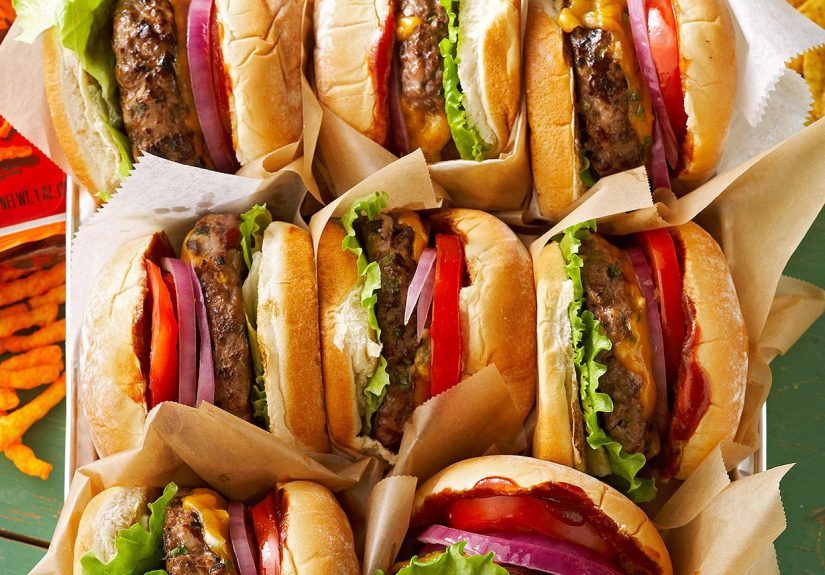
Burger planning is easiest when you decide patty size first. Here are common choices:
Standard backyard burger: 4 oz (1/4 lb) raw per patty
- Best for: mixed-age crowds, lots of sides, kids, potlucks
- Shopping math: 4 patties per pound (since 16 oz / 4 oz = 4)
- Planning tip: assume 1 patty per person, then add 10–20% for seconds
Hearty burger: 5–6 oz raw per patty (about 1/3 lb)
- Best for: adults, fewer sides, “this is the main event” cookouts
- Shopping math: about 3 patties per pound
- Planning tip: if you’re offering hot dogs or another protein, stick closer to 1/4 lb
Big restaurant-style burger: 8 oz raw per patty (1/2 lb)
- Best for: very hungry crowds, “one burger is dinner” situations
- Shopping math: 2 patties per pound
- Reality check: most groups don’t need this unless you know your people
Sliders and smash burgers: small patties, multiple per person
Sliders can fool you because each patty is small… until someone eats three without blinking.
A common approach:
- Sliders: plan 2–3 sliders per adult (often 2–3 oz raw each, depending on bun size)
- Smash burgers: plan 2–3 thin patties per adult (often around 2–3 oz raw each)
- Total beef per adult: typically still lands around 4–6 oz raw
Taco bars and nacho parties: plan by “tacos per person,” not wishful thinking
Taco bars are fun because guests build their own plates. Taco bars are also dangerous because guests build their own plates.
The best way to plan is in two steps:
Step 1: Estimate tacos per person
- Light eaters: 2 tacos
- Most adults: 3 tacos
- Hungry adults/teens: 4 tacos
- Kids: 1–2 tacos (depending on age)
Step 2: Estimate meat per taco
A practical amount is about 2 oz cooked meat per taco if the taco is “meat-forward,”
or a little less if you’re loading it up with beans, rice, lettuce, salsa, and cheese.
Since cooked weight is smaller than raw, that often works out to about 2.5 oz raw per taco.
Put together, most taco bars end up around:
- Adults: 4–6 oz raw ground beef per person (more if you expect 4 tacos each)
- Kids: 3–4 oz raw per person
If you’re offering multiple proteins (like chicken or beans), you can reduce ground beef by about 25–40%,
depending on how popular the alternatives are.
Chili, spaghetti sauce, and casseroles: the “bowl factor” matters
For saucy dishes, guests don’t see an obvious portion like a burger patty. They see a bowl. And bowls are persuasive.
Plan on the higher end if:
- it’s cold outside
- the dish is the main meal (not one option among many)
- people are active (sports day, long event, lots of walking)
Solid planning numbers:
- Chili as the main dish: 1/3 lb (5–6 oz raw) per adult
- Chili as one item on a buffet: 1/4 lb (4 oz raw) per adult
- Meat sauce for pasta: 1/4–1/3 lb per adult (depends on how “meaty” you make it)
Bonus tip: beans, pasta, rice, or potatoes can stretch ground beef without making anyone feel shorted.
(This is not “cheapening out.” This is “being smart and delicious.”)
Meatballs: appetizer vs. dinner changes everything
Meatballs are sneaky because size varies wildly. A “cocktail meatball” is one bite.
A “nonna meatball” is basically a softball with feelings.
As an appetizer
- Plan: 3–5 small meatballs per adult if you have other appetizers
- Beef estimate: 2–3 oz raw per adult
As the main protein (with pasta or rolls)
- Plan: 4–6 meatballs per adult (depending on size)
- Beef estimate: about 4 oz raw per adult
How to calculate pounds of ground beef (without drama)
Here’s the simple formula:
- Pick a raw portion per person (in ounces) based on the meal.
- Multiply by number of guests.
- Add a buffer (10–20%).
- Convert ounces to pounds by dividing by 16.
- Round up to the nearest pound (because stores don’t sell “2.37 pounds” unless you’re at a butcher counter).
Three real-world examples (copy these like a pro)
Example 1: Burger cookout for 16 people (12 adults + 4 kids)
- Adults: 12 × 5 oz = 60 oz
- Kids: 4 × 4 oz = 16 oz
- Total: 76 oz
- Add 15% buffer: 76 × 1.15 ≈ 87.4 oz
- Convert to pounds: 87.4 ÷ 16 ≈ 5.46 lb
- Buy: 6 lb of ground beef
This setup works well for 1 patty per person with a little extra for seconds and “Oops, I made one too thin.”
Example 2: Taco bar for 20 adults
You expect about 3 tacos per person and a toppings-heavy spread. Plan 5 oz raw per adult.
- Total: 20 × 5 oz = 100 oz
- Add 10% buffer: 110 oz
- Convert to pounds: 110 ÷ 16 ≈ 6.9 lb
- Buy: 7 lb of ground beef
If you also serve beans as a true filling option (not just “a spoonful for decoration”), you could drop to about 6 lb.
Example 3: Chili for 30 people (mixed ages) at an event
Chili as the main dish: plan 5 oz raw per adult-equivalent. Let’s call it 25 adult-equivalents after counting kids as half.
- Total: 25 × 5 oz = 125 oz
- Add 20% buffer: 150 oz
- Convert to pounds: 150 ÷ 16 ≈ 9.4 lb
- Buy: 10 lb of ground beef
Smart buffers: when to add 10% vs. 20%
Add about 10% if…
- you have lots of sides
- you’re serving multiple proteins
- it’s a shorter event (not an all-day hangout)
Add about 20% if…
- you have big eaters or lots of teens
- the meal is the main attraction (few sides)
- you love leftovers (future-you deserves nice things)
Buying tips: how to shop without overthinking it
- Round up to the nearest pound. Being a tiny bit over beats being “one pound short” in front of guests.
- Consider the lean-to-fat ratio. Higher-fat blends can shrink more. Leaner blends shrink a bit less, but can dry out if overcooked.
- Split purchases into smaller packages. It chills faster, cooks faster, and is easier to manage in batches.
- If you’re close, buy one extra pound. Ground beef is one of the easiest leftovers to repurpose (tacos today, pasta tomorrow, breakfast hash later).
Food safety (quick but important)
Ground beef is delicious, but it needs safe handling:
- Keep it cold until cooking time (refrigerate promptly after buying).
- Cook thoroughly and use a thermometer for accuracy.
- Serve hot foods hot and don’t let cooked meat sit out for long stretches.
- Store leftovers promptly and reheat well before serving again.
Wrap-up: the calm, confident way to plan ground beef
The easiest hosting win is deciding what you’re serving and choosing a portion that makes sense for that dish.
In most real gatherings, 4–6 oz raw ground beef per person gets you where you need to gothen add a buffer
based on your crowd and your side dishes.
Remember: you’re not feeding a spreadsheet. You’re feeding people. Aim for “plenty,” not “panic.”
Experience Notes From the Real World (Because Parties Don’t Happen in a Vacuum)
I’ve learned the “ground beef per person” lesson the same way many hosts do: by being extremely confident,
doing a bunch of mental math in the grocery aisle, and then realizingtoo latethat confidence is not a measurement unit.
The first time I hosted a burger night for a mixed group, I planned a neat 1/4-pound patty per person.
On paper? Perfect. In reality? Half the guests treated the grill like a tasting menu.
Someone wanted a second burger “just to try the other cheese,” another guest quietly made a double-stacked burger,
and two people asked if there were any extras “for later.” The food was great. The math was… optimistic.
Now I always add a buffer when burgers are the main event, especially if the hangout lasts more than a couple of hours.
When people have time to talk, laugh, and wander back to the table, seconds happen.
Taco bars taught me a different lesson: the “taco count” is more important than the “guest count.”
I once assumed three tacos per person because that’s what everyone says. But I also served chips, guac, rice, beans,
and a big salad. The result? Lots of guests stopped at two tacos because the toppings and sides did their job.
Another time, I had fewer sidesmostly tortillas, meat, and toppingsand suddenly three tacos became four.
The difference wasn’t appetite; it was the menu. If you’re planning a taco bar, decide whether toppings are “supporting actors”
or “co-stars.” Beans and rice can truly reduce how much beef you need, but only if guests actually have enough of them to choose from.
Chili is where weather becomes a secret ingredient. A cool day turns chili into a comfort food magnet.
People don’t just eat chili; they settle in with it. I hosted a game-day chili potluck once and planned conservatively,
thinking there would be a lot of snacks. There were snacks… and people still went back for second bowls.
The fix is simple: if it’s chilly outside or the event is long, treat chili portions like “main meal” portions and buy on the higher end.
My biggest practical tip is to plan leftovers on purpose. Not a mountain of leftoversjust enough to feel smart.
An extra pound of ground beef rarely goes to waste. It turns into taco-stuffed baked potatoes, a quick spaghetti sauce,
breakfast burritos, or a freezer batch of meatballs. Leftovers also reduce host stress because you’re no longer aiming for “exactly enough,”
which is the culinary equivalent of walking a tightrope while holding a tray of drinks.
And here’s the most important experience-based truth: guests remember the vibe more than the exact ounces.
If you plan 4–6 ounces per person, add a reasonable buffer, and serve a couple of filling sides,
you’ll be in that sweet spot where everyone eats well and you still like hosting afterward.