Table of Contents >> Show >> Hide
- The Contest Where One Second Became a Playground
- Meet Metronalmost, the Metronome That Refuses to Behave
- How the Almost-But-Never Logic Works
- The Hardware: Simple Parts, Maximum Mischief
- Why Metronalmost Is Perfectly Wrong for the One Hertz Challenge
- The Human Side: Why Bad Rhythm Feels So Weird
- What Makers Can Learn from Metronalmost
- Why “Last Place” Might Be the Best Branding
- Experience Notes: Living With a Machine That Almost Keeps Time
- Conclusion: A Brilliant Little Failure
- SEO Tags
Note: This article is written for web publication in standard American English, based on verified public information about Hackaday’s 2025 One Hertz Challenge and Mike Coats’ Metronalmost project.
The Contest Where One Second Became a Playground
The 2025 One Hertz Challenge sounds almost suspiciously simple: build something that does something once per second. Blink an LED. Click a relay. Drop a bead. Wave a flag. Make a tiny robot sigh at exactly 1 Hz. The rules are so clean they feel like a trap, and for makers, engineers, hackers, and people who own too many jumper wires, that is exactly where the fun begins.
A hertz is one cycle per second, which makes 1 Hz the tiny heartbeat of timing projects. It is slow enough to see, hear, count, and obsess over. It is also precise enough to reveal whether your code, oscillator, servo, relay, or cardboard contraption is behaving like a disciplined timekeeper or a raccoon wearing a lab coat.
Hackaday’s challenge invited makers to explore that humble one-second rhythm in creative ways. Some projects aimed for accuracy. Some leaned into absurdity. Some celebrated old-school electronics such as the classic 555 timer. Then came Metronalmost, a project that looked at the assignment, nodded respectfully, and sprinted in the opposite direction while carrying a servo motor and a joke.
Meet Metronalmost, the Metronome That Refuses to Behave
Metronalmost is the work of Mike Coats, and its mission is beautifully rebellious: it is a metronome that beats almost, but never exactly, at 60 beats per minute. In other words, it hovers around the target that the One Hertz Challenge celebrates, yet intentionally dodges the exact center. It is not broken. It is not inaccurate by accident. It is wrong on purpose, which is the finest kind of wrong in a maker contest.
The joke lands because a traditional metronome is a symbol of discipline. Musicians use it to practice timing, rhythm, consistency, and patience. Metronalmost takes that trusted role and replaces it with a mischievous little machine that says, “I will help you keep time, but only if time first signs a liability waiver.”
Instead of offering a clean one-second tick, Metronalmost produces a rhythm that is close enough to feel meaningful and far enough away to become deeply irritating. It does not simply drift randomly without structure. It is carefully designed to be almost right, which is much funnier than being obviously wrong. A clock that ticks every seven seconds is just useless. A metronome that nearly ticks once per second is psychological seasoning.
How the Almost-But-Never Logic Works
At the heart of Metronalmost is a clever timing model built around randomness, probability, and deliberate exclusion. A normal, or Gaussian, distribution tends to cluster values around the middle. That makes sense for a metronome parody: most ticks should gather near the one-second mark so the device feels like it is trying. But if it ever lands exactly on one second, it fails at failing.
So the project adds a notch in the middle of the distribution. That notch removes the exact target area from the possible output. The timing can fall slightly below one second or slightly above one second, but not precisely on the forbidden holy grail of 1 Hz. It is like building a dartboard with the bullseye cut out, then proudly announcing that nobody can hit the center. Technically correct, emotionally annoying.
According to the project logs, the mapping function takes a uniform random value and reshapes it into a centrally weighted value with a discontinuity at the midpoint. For example, values near the middle jump around the exact center rather than passing smoothly through it. When applied across a timing range from 0.5 seconds to 1.5 seconds, the result is a metronome that stays close to the One Hertz Challenge goal while refusing to shake hands with it.
Why That Is Smarter Than It Sounds
The project is funny, but it is also a neat demonstration of statistical design. Many beginner timing projects focus on reducing error. Metronalmost focuses on designing a very specific kind of error. It does not ask, “How do we get closer to perfect?” It asks, “How do we orbit perfection forever without touching it?” That makes the project more than a gag. It becomes a miniature lesson in probability, control, perception, and engineering intent.
The Hardware: Simple Parts, Maximum Mischief
Metronalmost does not need a laboratory full of atomic clocks to be memorable. Its component list is wonderfully approachable: a NodeMCU ESP-12E DevKit, a TowerPro MG946R servo, jumper wiring, a right-angle pin header, and a micro-USB cable with an on/off switch. That is a very maker-friendly recipe. No rare unobtainium. No mysterious sealed module purchased from a guy named “ClockWizard_1974.” Just common electronics doing uncommon emotional damage.
The servo is the star performer. A hobby servo is ideal for this kind of visible tick because it can move to controlled positions, giving the project a physical beat rather than a silent number printed to a serial monitor. A blinking LED can show timing, but a moving metronome arm gives timing personality. It looks alive enough to blame.
The ESP8266-based board handles the logic and timing, while MicroPython makes the project readable and playful. The logs describe testing the servo range with PWM, then building the final behavior around the almost-1 Hz rhythm. This is a good example of how small embedded systems can transform a simple idea into a memorable object. The electronics are not overcomplicated, but the concept makes them shine.
The Faux-Woodgrain Case Deserves Applause
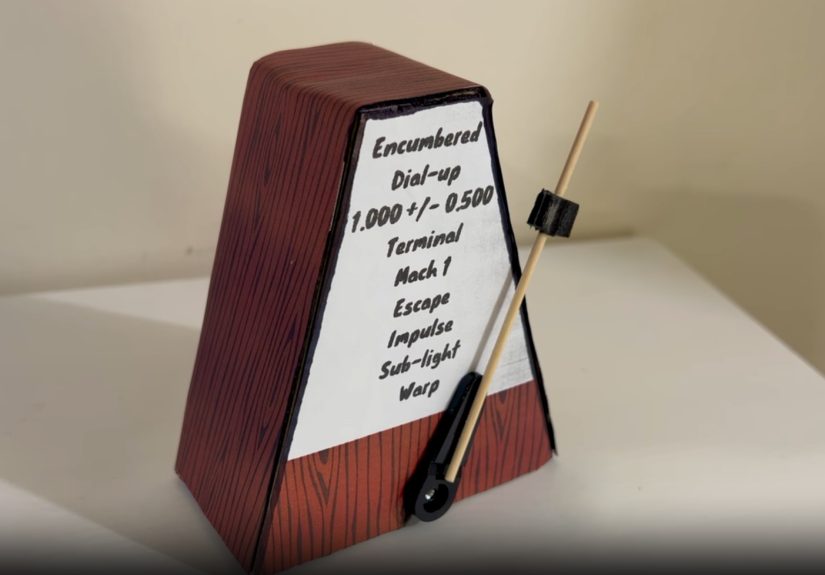
Then there is the enclosure. Metronalmost wears a faux-woodgrain papercraft case, which is exactly the right costume for a fake metronome with real attitude. The cheap-and-cheerful styling matters because it reinforces the joke. It says, “I am a classy musical instrument,” while the behavior says, “I have replaced elegance with carefully modeled chaos.”
The project also plays with tempo labels. Real metronomes use markings such as Largo, Adagio, Allegro, and Presto. Metronalmost swaps seriousness for silliness, with tempo names that belong in a science-fiction elevator. The result is a visual punchline wrapped around an engineering punchline. That is good hardware storytelling.
Why Metronalmost Is Perfectly Wrong for the One Hertz Challenge
The One Hertz Challenge rewards projects that engage with a once-per-second event. Metronalmost engages by refusing. It is like entering a pie-baking contest with a machine that makes beautifully measured anti-pie. But that is why it belongs in the conversation. Great maker competitions often become memorable when someone interprets the rule in a strange, lateral, technically defensible way.
Metronalmost is gunning for last place because it is designed to miss the stated target. But the project’s “failure” is intentional, documented, and engineered. That makes it more interesting than a sloppy clock. A bad timing circuit can miss 1 Hz because of poor calibration. Metronalmost misses 1 Hz because missing 1 Hz is the entire thesis. It is not incompetence. It is performance art with PWM.
Even better, the long-term behavior has a twist. In discussion around the project, Coats noted that over longer time scales the output can average close to 60 BPM, while remaining terrible in the short term. That contrast is delicious. A listener standing in the room experiences uncertainty and irritation. A patient statistician watching long enough might see the average settle down. Metronalmost is therefore both annoying and mathematically polite, which is a rare personality combination outside of certain group chats.
The Human Side: Why Bad Rhythm Feels So Weird
Humans are rhythm-hungry creatures. We walk in rhythm, clap in rhythm, dance in rhythm, and silently judge windshield wipers that are almost synchronized with turn signals. When a beat is predictable, the brain can anticipate the next event. When a beat is close to predictable but never quite dependable, the brain keeps preparing and correcting. That tiny mismatch can feel oddly stressful.
This is why Metronalmost is more than a mechanical joke. It exploits expectation. The tick is near enough to create a pattern, but unstable enough to deny comfort. If the ticks were totally random, the listener might give up and ignore them. If the ticks were perfectly steady, the listener would relax. Metronalmost lives in the cursed middle: predictable enough to lure your attention, unpredictable enough to keep poking it with a tiny screwdriver.
That also makes the project relatable to anyone who has worked with timing systems. Real-world timing is rarely perfect. Crystals drift. Software delays jitter. Servos lag. Power supplies sag. Interrupts interrupt, as they were clearly born to do. The difference is that most engineers try to reduce these problems. Metronalmost invites them to dinner, gives them name tags, and asks them to perform.
What Makers Can Learn from Metronalmost
The first lesson is that constraints are creative fuel. “Do something once per second” is a tiny box, but makers immediately find ways to make the box weird. Some builders chase precision. Others chase spectacle. Metronalmost chases the negative space around the rule. That is a valuable reminder: in creative engineering, the most interesting answer is not always the most obedient one.
The second lesson is that documentation matters. The Metronalmost project is entertaining because the reasoning is visible. The logs explain the hardware, the mathematical model, the enclosure, and the intended irritation. Without that documentation, it would just be a wobbly metronome. With documentation, it becomes a complete story: goal, rebellion, method, build, result.
The third lesson is that humor can make technical ideas easier to understand. Gaussian distributions, cumulative distribution functions, PWM, and servo behavior can sound intimidating in isolation. Wrap them in a metronome that is actively trying to lose a contest, and suddenly the math has a personality. You may not remember every detail of the mapping function, but you will remember the idea of cutting the center out of the probability curve so the machine can never land on the exact target.
Specific Example: The Almost-Perfect Error
Imagine a normal metronome set to 60 BPM. Every tick should arrive one second after the last. Now imagine a mischievous version that chooses each interval from a range, but avoids exactly 1.000 seconds. One tick might arrive at 0.94 seconds, the next at 1.08 seconds, the next at 0.99 seconds, and the next at 1.04 seconds. The average can feel close, yet the moment-to-moment experience remains unstable. That is the magic trick: Metronalmost attacks the listener’s short-term expectation while keeping one foot near statistical respectability.
Why “Last Place” Might Be the Best Branding
In normal competitions, last place is a disappointment. In the One Hertz Challenge, Metronalmost turns last place into a brand strategy. It is openly incompatible with the core goal, but in a way that celebrates the challenge rather than dismissing it. The project understands the assignment so well that it can make fun of the assignment intelligently.
That is why the title “Metronalmost Is Gunning For Last Place” works. It signals playful rebellion. It tells readers that this is not another blinking LED tutorial. It is a project with a point of view. In a maker world full of serious precision instruments, a deliberately infuriating metronome stands out like a kazoo in a string quartet.
For SEO readers searching terms such as “2025 One Hertz Challenge,” “Metronalmost,” “1 Hz metronome,” “Hackaday challenge,” or “servo metronome project,” the appeal is clear. This project brings together embedded electronics, probability modeling, musical timing, and absurd humor. That combination makes it clickable, memorable, and unusually easy to explain at a party where at least three people are wearing conference badges.
Experience Notes: Living With a Machine That Almost Keeps Time
Spending time with a concept like Metronalmost is a surprisingly vivid mental exercise. At first, you think the joke is simple: it is a metronome that refuses to tick exactly once per second. Cute. Nerdy. A little smug. But the longer you imagine it running on a desk, the more you realize the true experience is not visual. It is psychological. The machine gets under your skin because it offers the promise of order and then keeps gently stealing it back.
Picture the device sitting beside a laptop while someone is trying to write code. Tick. Almost a second. Tock. A little late. Tick. Too soon. Your brain begins to chase it. You do not want to listen, but you cannot fully ignore it. The rhythm is close enough to become a question. Was that one early? Was that one late? Is it settling down? Is it mocking me personally? The answer, of course, is yes. Metronalmost is not a tool for practice. It is a tiny wooden-looking goblin for attention management.
In a workshop, the project would probably become a conversation magnet. People would walk past, hear the irregular tick, stop, frown, and ask whether something is broken. That is when the builder gets to enjoy the best sentence in hobby electronics: “No, it is doing that on purpose.” Few phrases are more satisfying. They turn a suspected flaw into a design decision, and a design decision into a story.
The experience also highlights an underrated part of making: the emotional texture of a device. Two projects can use similar parts and produce completely different feelings. A precise 1 Hz LED flasher feels calm and technical. A relay clicking once per second feels industrial and confident. A servo-driven metronome that almost behaves feels comic, tense, and slightly haunted. That emotional layer is not separate from the engineering; it is created by the engineering.
There is also a practical takeaway for builders. If a project is meant to be shared online, it helps to create something that can be understood quickly and remembered easily. Metronalmost has that rare elevator-pitch clarity: “It is a metronome designed to never tick exactly once per second.” That sentence does a lot of work. It explains the contest, the object, the joke, and the technical challenge all at once. Add the probability notch, the servo movement, and the faux-woodgrain case, and the project becomes more than a build. It becomes a character.
That is the real charm of Metronalmost. It does not need to win the One Hertz Challenge to succeed. Its success is in being unforgettable. It proves that a maker project can be educational without being solemn, precise without being obedient, and silly without being shallow. It is gunning for last place, yes, but it may have already won the category that matters most on the internet: the project people actually remember after closing the tab.
Conclusion: A Brilliant Little Failure
Metronalmost is the kind of project that makes maker culture fun. It takes a simple contest rule, studies it carefully, and then builds a machine that dances around the rule with theatrical disrespect. The result is a servo-powered, probability-shaped, faux-woodgrain troublemaker that almost keeps time but refuses to become respectable.
For the 2025 One Hertz Challenge, many entries naturally focused on precision, reliability, and clever once-per-second mechanisms. Metronalmost brought something different: a deliberate near-miss. It shows that engineering is not only about building perfect tools. Sometimes it is about building the perfect joke, then making the joke mathematically defensible.
So yes, Metronalmost may be gunning for last place. But in creativity, documentation, and sheer memorable weirdness, it is punching far above its weight. It is not exactly a metronome. It is not exactly wrong. It is almost everything it should be, and that is exactly the point.