Table of Contents >> Show >> Hide
- What Is an Improper Fraction?
- What Is a Mixed Number?
- How to Convert Improper Fractions Into Mixed Numbers: 9 Steps
- Step 1: Identify the numerator and denominator
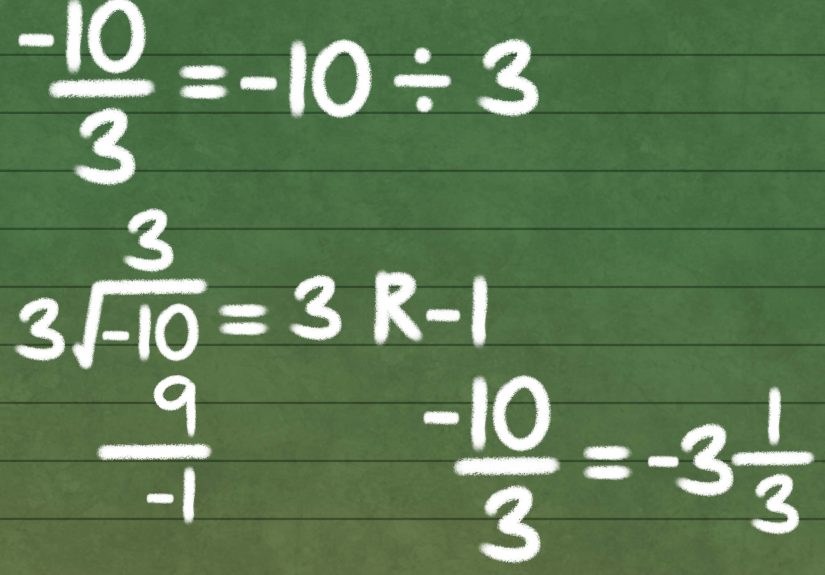
- Step 2: Divide the numerator by the denominator
- Step 3: Use the quotient as the whole number
- Step 4: Find the remainder
- Step 5: Put the remainder over the original denominator
- Step 6: Combine the whole number and the fraction
- Step 7: Check your answer by converting back
- Step 8: Simplify the fraction part if needed
- Step 9: Practice with real examples
- Why the Method Works
- Common Mistakes to Avoid
- Improper Fractions vs. Mixed Numbers: Which Form Should You Use?
- Quick Practice Problems
- Real-Life Uses for Converting Improper Fractions
- Extra Experience: What Actually Helps Students Learn This Skill
- Conclusion
- SEO Tags
Improper fractions may sound like they forgot their manners at the dinner table, but there is nothing “bad” about them. An improper fraction is simply a fraction where the numerator is greater than or equal to the denominator, such as 7/4, 13/5, or 22/6. A mixed number, on the other hand, combines a whole number with a proper fraction, such as 1 3/4 or 2 3/5.
Learning how to convert improper fractions into mixed numbers is one of those math skills that feels mysterious for about five minutesthen suddenly clicks. The secret is division. That is it. No wizard robe, no secret handshake, no calculator required. You divide the numerator by the denominator, turn the quotient into the whole number, use the remainder as the new numerator, and keep the same denominator.
In this guide, we will walk through the process in 9 clear steps, using practical examples, common mistakes, and simple explanations. Whether you are a student, parent, teacher, homeschooler, or someone who just got ambushed by fractions after years of peaceful adulthood, this article will help you convert improper fractions to mixed numbers with confidence.
What Is an Improper Fraction?
An improper fraction is a fraction in which the top number, called the numerator, is greater than or equal to the bottom number, called the denominator. For example, 9/4 is improper because 9 is greater than 4. The fraction 6/6 is also considered improper because the numerator and denominator are equal, meaning it represents exactly one whole.
Improper fractions are useful because they show a quantity in equal parts. If you have 11 slices of pizza and each whole pizza has 4 slices, the fraction 11/4 tells you that you have eleven fourths. It is accurate, but not always easy to picture. A mixed number makes the same value easier to understand: 11/4 equals 2 3/4 pizzas. Now your brain can relax and imagine two whole pizzas plus three extra slices.
What Is a Mixed Number?
A mixed number is made of two parts: a whole number and a proper fraction. For example, 3 1/2 means 3 wholes plus 1/2 of another whole. Mixed numbers are common in everyday life because they are easy to visualize. We say “2 1/2 cups of flour,” “1 3/4 miles,” or “4 1/2 hours,” not usually “5/2 cups,” “7/4 miles,” or “9/2 hours,” unless we are trying to sound like a math textbook that has not had coffee yet.
Both forms are correct. Improper fractions are often better for calculations, especially multiplication and division. Mixed numbers are often better for reading, measuring, and explaining real-world amounts. Being able to move between the two forms is a powerful fraction skill.
How to Convert Improper Fractions Into Mixed Numbers: 9 Steps
Step 1: Identify the numerator and denominator
Start by looking at the improper fraction. The numerator is the number on top, and the denominator is the number on the bottom. In the fraction 17/5, the numerator is 17 and the denominator is 5.
The numerator tells you how many parts you have. The denominator tells you how many equal parts make one whole. So 17/5 means you have 17 fifth-size pieces, and every 5 pieces make 1 whole.
Step 2: Divide the numerator by the denominator
Now divide the numerator by the denominator. For 17/5, ask: How many times does 5 fit into 17?
5 goes into 17 three times because 5 × 3 = 15. It cannot go in four times because 5 × 4 = 20, which is too large. So the quotient is 3.
Step 3: Use the quotient as the whole number
The quotient becomes the whole number part of your mixed number. Since 17 ÷ 5 gives a quotient of 3, your mixed number begins with 3.
At this point, you know that 17/5 contains 3 complete wholes. But we still need to handle the leftover pieces. Fractions, like snack crumbs, rarely disappear just because we are tired.
Step 4: Find the remainder
To find the remainder, multiply the denominator by the whole number, then subtract that product from the numerator.
For 17/5:
- 5 × 3 = 15
- 17 − 15 = 2
The remainder is 2. This means that after making 3 wholes, there are 2 fifth-size pieces left over.
Step 5: Put the remainder over the original denominator
The remainder becomes the numerator of the fraction part. The denominator stays the same. This is important: do not change the denominator unless you are simplifying later.
Since the remainder is 2 and the original denominator is 5, the fractional part is 2/5.
Step 6: Combine the whole number and the fraction
Now put the whole number and fraction together:
17/5 = 3 2/5
That is the mixed number. It means 3 wholes and 2 fifths. Same value, friendlier outfit.
Step 7: Check your answer by converting back
A great way to check your work is to convert the mixed number back into an improper fraction. Multiply the whole number by the denominator, then add the numerator.
For 3 2/5:
- 3 × 5 = 15
- 15 + 2 = 17
- Place 17 over the original denominator: 17/5
Since you got the original improper fraction, your answer is correct.
Step 8: Simplify the fraction part if needed
Sometimes the fraction part of a mixed number can be simplified. For example, convert 18/6 into a mixed number:
- 18 ÷ 6 = 3 with a remainder of 0
- So 18/6 = 3
There is no fraction part because nothing is left over.
Now try 22/6:
- 22 ÷ 6 = 3 remainder 4
- So 22/6 = 3 4/6
But 4/6 can be simplified to 2/3 because both 4 and 6 can be divided by 2. So the final answer is:
22/6 = 3 2/3
Step 9: Practice with real examples
The best way to master improper fractions and mixed numbers is to practice. Here are a few examples:
Example 1: Convert 13/4
- 13 ÷ 4 = 3 remainder 1
- The whole number is 3
- The remainder is 1
- The denominator stays 4
13/4 = 3 1/4
Example 2: Convert 29/8
- 29 ÷ 8 = 3 remainder 5
- The whole number is 3
- The fraction part is 5/8
29/8 = 3 5/8
Example 3: Convert 45/10
- 45 ÷ 10 = 4 remainder 5
- So 45/10 = 4 5/10
- Simplify 5/10 to 1/2
45/10 = 4 1/2
Why the Method Works
The conversion works because fractions are built from equal parts. If the denominator is 5, then every 5 fifths make one whole. When you divide the numerator by the denominator, you are counting how many complete wholes can be made from all the parts.
Take 17/5 again. You have 17 pieces, and each whole needs 5 pieces. You can make 3 full wholes because 5 + 5 + 5 = 15. After using 15 pieces, 2 pieces remain. That gives you 3 wholes and 2/5 left over.
In other words, converting improper fractions into mixed numbers is not a random trick. It is just division with meaning.
Common Mistakes to Avoid
Mistake 1: Changing the denominator
The denominator should stay the same during the first conversion. If you convert 19/6, the denominator in the mixed number is still 6. The answer is 3 1/6, not 3 1/3 or 3 1/19.
Mistake 2: Using the remainder as the denominator
The remainder becomes the new numerator, not the denominator. For 23/7, the answer is 3 2/7 because 23 ÷ 7 = 3 remainder 2. Writing 3 7/2 would flip the meaning and create a very different number.
Mistake 3: Forgetting to simplify
If your mixed number has a fraction that can be reduced, simplify it. For example, 16/12 converts to 1 4/12, but 4/12 simplifies to 1/3. The final answer is 1 1/3.
Mistake 4: Dividing the denominator by the numerator
Always divide the numerator by the denominator, not the other way around. For 14/3, you calculate 14 ÷ 3, not 3 ÷ 14. The fraction is telling you that you have 14 thirds, so you need to find how many groups of 3 fit into 14.
Improper Fractions vs. Mixed Numbers: Which Form Should You Use?
Use a mixed number when you want to communicate a real-world amount clearly. If a recipe calls for 2 1/4 cups of milk, that is easier to understand than 9/4 cups. If you ran 3 1/2 miles, most people can picture that more quickly than 7/2 miles.
Use an improper fraction when you are doing calculations. Multiplying, dividing, adding, and subtracting fractions can become easier when everything is written as improper fractions first. That is why many teachers ask students to convert mixed numbers into improper fractions before solving larger problems.
The smartest approach is not to choose one form forever. Learn both. Mixed numbers are great for meaning. Improper fractions are great for math mechanics. Together, they are like the buddy-cop movie of fraction skills.
Quick Practice Problems
Try converting these improper fractions into mixed numbers before looking at the answers:
- 11/3
- 25/6
- 31/4
- 50/8
- 72/9
Answers
- 11/3 = 3 2/3
- 25/6 = 4 1/6
- 31/4 = 7 3/4
- 50/8 = 6 2/8 = 6 1/4
- 72/9 = 8
Real-Life Uses for Converting Improper Fractions
Improper fractions appear more often than people realize. In cooking, you might double a recipe and end up with 9/4 cups of flour. That is correct mathematically, but 2 1/4 cups is easier to measure. In construction, a measurement like 17/8 inches is more readable as 2 1/8 inches. In time, 75/60 hours becomes 1 15/60 hours, which simplifies to 1 1/4 hours.
Converting improper fractions into mixed numbers helps turn abstract numbers into practical quantities. It is the difference between “I have 19/4 sandwiches” and “I have 4 3/4 sandwiches.” One sounds like a math worksheet. The other sounds like lunch got slightly out of control.
Extra Experience: What Actually Helps Students Learn This Skill
One of the most helpful experiences with teaching improper fractions is watching students move from memorizing steps to understanding what the numbers mean. At first, many learners treat the method like a recipe: divide, write, remainder, denominator. That works for a while, but it becomes much stronger when students can explain why the method works.
A good classroom trick is to use objects before using symbols. Give students counters, blocks, paper circles, or even pretend pizza slices. If the fraction is 14/4, students can physically group 14 pieces into sets of 4. They will see three complete groups with 2 pieces left. That visual becomes 3 2/4, which simplifies to 3 1/2. Suddenly, the mixed number is not just an answerit is a picture.
Another useful experience is connecting the skill to division with remainders. Many students already know that 17 ÷ 5 = 3 remainder 2. The only new idea is that the remainder becomes part of a fraction. Instead of stopping at “remainder 2,” students write the leftover 2 over the original denominator. This connection makes improper fractions feel less like a brand-new topic and more like a familiar skill wearing a fraction hat.
Number lines also help. When students place 1, 2, 3, and 4 on a number line and then divide each space into equal parts, they can see that 13/4 lands at 3 1/4. This is especially helpful for learners who wonder whether mixed numbers and improper fractions are truly equal. The number line proves that both names point to the same location.
Parents can reinforce the concept at home with everyday examples. Cooking is perfect. If a child measures 7 half-cups of oats, ask how many whole cups that makes. Since every 2 half-cups make 1 whole cup, 7/2 cups becomes 3 1/2 cups. Measuring tape, board games, sports statistics, and money discussions can also make fractions feel less like homework and more like a useful language.
The biggest challenge is usually rushing. Students often make small errors because they skip the remainder, change the denominator, or forget to simplify. Encourage them to write each step neatly. A clean setup prevents most mistakes. For example, when converting 34/5, write “34 ÷ 5 = 6 R4” first. Then turn that into 6 4/5. Simple, organized, and much less likely to cause dramatic sighing at the kitchen table.
Finally, confidence grows through repetition. Not endless worksheets until everyone loses the will to divide, but short, focused practice. Five problems a day can be more effective than fifty problems once a month. Mix easy problems with a few that require simplifying. Include one whole-number result, such as 20/5 = 4, so students remember that not every improper fraction becomes a mixed number with a fraction part.
With practice, converting improper fractions into mixed numbers becomes quick and almost automatic. More importantly, students begin to understand that fractions are not random symbols. They are quantities, measurements, groups, leftovers, and wholes. Once that clicks, the math becomes far less intimidatingand maybe even a little satisfying.
Conclusion
Converting improper fractions into mixed numbers is a simple skill built on division. First, divide the numerator by the denominator. Next, use the quotient as the whole number. Then, place the remainder over the original denominator. Finally, simplify the fraction part if needed.
The core formula is easy to remember: numerator ÷ denominator = whole number with a remainder. The remainder becomes the new numerator, and the denominator stays the same. So 17/5 becomes 3 2/5, 29/8 becomes 3 5/8, and 45/10 becomes 4 1/2 after simplifying.
Improper fractions and mixed numbers are two different ways to show the same value. Improper fractions are useful for calculations, while mixed numbers are often easier to read and understand in real life. Once you know how to switch between them, fractions become clearer, friendlier, and much less likely to make you stare dramatically out a window.