Table of Contents >> Show >> Hide
- When declining an interview is the right move
- Decline vs. reschedule vs. withdraw: which one are you doing?
- The 60-second checklist before you say no
- How to decline a job interview politely: 5 rules that work every time
- Subject lines for declining an interview (steal these)
- How to decline a job interview with a letter sample
- Letter Sample 1: Simple and professional (works for most situations)
- Letter Sample 2: Declining because you accepted another offer
- Letter Sample 3: Declining, but keeping the door open
- Letter Sample 4: Declining due to timing (with a “maybe later” option)
- Letter Sample 5: You already schedulednow you need to cancel politely
- Letter Sample 6: Declining and referring someone else (only if appropriate)
- Phone/voicemail script (for last-minute declines)
- How much reason should you give when declining an interview?
- Common mistakes that make a polite decline feel… less polite
- Quick FAQ
- Conclusion: a clean “no” is better than a messy “maybe”
- Experiences and real-world scenarios candidates commonly face (extra ~)
- Scenario 1: “I already accepted another offer… but this company is cooler.”
- Scenario 2: “The recruiter won’t share salary, and I suspect I’m about to waste my own time.”
- Scenario 3: “I said yes, scheduled it, and now I have to cancel.”
- Scenario 4: “I want to keep the door openwithout sounding like I’m collecting interview invites.”
Getting invited to a job interview can feel like being handed a golden ticketuntil you realize the “factory”
is a 90-minute commute, the pay range is a whisper, or you’ve already accepted another role and your calendar
is now booked through the heat death of the universe.
The good news: declining a job interview doesn’t make you unprofessional. Dragging it out, ghosting, or writing
a 12-paragraph breakup essay? That can get awkward fast. This guide will show you how to decline an interview
politely, keep relationships intact, and do it in a way that doesn’t haunt your future job searches.
When declining an interview is the right move
Let’s normalize a healthy career boundary: you’re allowed to say no. Here are common (and totally valid) reasons to
turn down an interview invitation:
- You accepted another offer (congratsgo celebrate with something overpriced and delicious).
- The role isn’t a fit (duties, level, industry, schedule, travel, or values don’t align).
- Compensation is off (and you’d rather not audition for a role you won’t take).
- Timing changed (family needs, relocation, health, current job constraints).
- You learned new info (company direction, layoffs, or red flags you can’t ignore).
Declining early helps the employer move forward with other candidatesand helps you avoid wasting time prepping for
an interview you already know you don’t want. It’s a win-win with fewer awkward emails.
Decline vs. reschedule vs. withdraw: which one are you doing?
These sound similar, but choosing the right approach makes your message clearer (and reduces back-and-forth).
| Situation | Best move | What to say |
|---|---|---|
| You’re still interested but can’t make the time | Reschedule | Apologize, offer alternate times, confirm interest |
| You’re not interested anymore | Decline | Thank them, decline clearly, keep it brief |
| You want to exit the hiring process entirely | Withdraw | State you’re withdrawing your application/candidacy |
The 60-second checklist before you say no
Before you hit send, do a quick reality check. Declining is easier than un-declining.
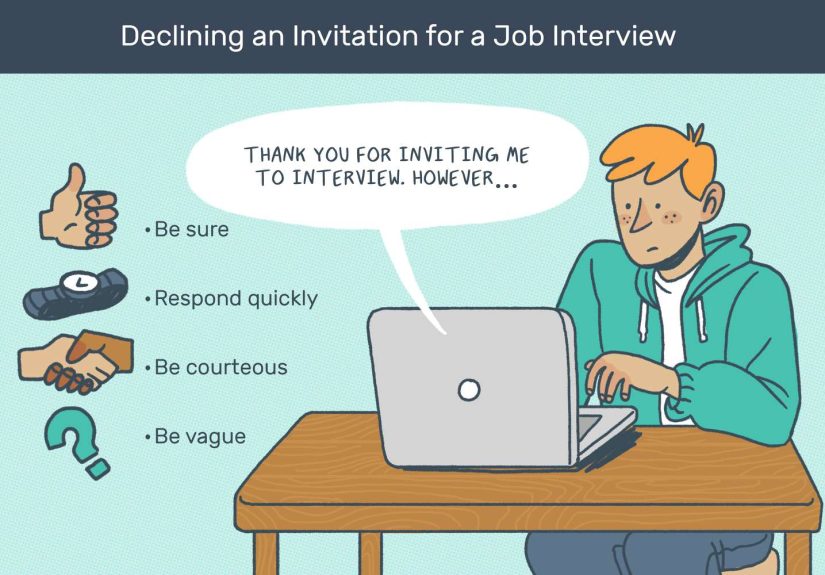
- Are you 100% sure? If not, ask for a day to consider or request missing details (pay range, location, schedule).
- Is it really a “no” or just bad timing? If you’d be interested later, suggest a future window.
- Who invited you? A recruiter email is different from a hiring manager’s direct invitereply accordingly.
- Have you already scheduled the interview? If yes, apologize for canceling and be extra prompt.
- Do you want to keep the door open? If yes, preserve goodwill with a warm, simple close.
How to decline a job interview politely: 5 rules that work every time
1) Respond promptly (today is better than “eventually”)
The fastest way to look professional is to be timely. If you’re declining, don’t wait until the morning of the
interview. If you must decline last-minute, consider a phone call plus a short follow-up email.
2) Start with gratitude
A simple “thank you for the invitation” is enough. You don’t need to write a sonnet about how honored you feel
(unless you really want to, but your future self may cringe).
3) Be clearand brief
You’re declining an interview invitation, not writing a memoir. One or two sentences for context is plenty.
You can keep your reason general.
4) Keep the relationship intact
If you might consider the company later, say so. A respectful decline can turn into a future opportunity, referral,
or a recruiter who remembers you as “the person who handled it like a pro.”
5) Match the channel to the timing
Email is standard. If the interview is within 24 hours, a call (or voicemail) is kinder to the other person’s schedule.
You can still send an email afterward so they have it in writing.
Subject lines for declining an interview (steal these)
- Interview Invitation – [Your Name]
- Re: Interview for [Job Title] – [Your Name]
- Update on [Job Title] Interview Request
- Regarding the [Company] Interview Invitation
- Interview Scheduling – [Your Name]
- Withdrawing from Consideration – [Job Title]
- Thank You – [Job Title] Interview
- Re: [Job Title] Interview (Unable to Proceed)
How to decline a job interview with a letter sample
Below are plug-and-play templates you can personalize. Keep the tone professional, friendly, and short.
Replace the brackets with your details.
Letter Sample 1: Simple and professional (works for most situations)
Letter Sample 2: Declining because you accepted another offer
Letter Sample 3: Declining, but keeping the door open
Letter Sample 4: Declining due to timing (with a “maybe later” option)
Letter Sample 5: You already schedulednow you need to cancel politely
Letter Sample 6: Declining and referring someone else (only if appropriate)
Phone/voicemail script (for last-minute declines)
If the interview is imminent, a quick call can save the other person from rearranging their day around a meeting that won’t happen.
How much reason should you give when declining an interview?
Short version: you can keep it vague. You’re not required to explain personal details, your salary history, your family situation,
or the plot of your entire career arc.
A helpful rule: give a reason only if it (1) is simple, (2) won’t invite debate, and (3) doesn’t create risk for you.
“I accepted another role,” “I’m no longer available,” or “I’m pursuing other opportunities” are usually plenty.
Common mistakes that make a polite decline feel… less polite
- Ghosting (the professional equivalent of leaving someone on read for three weeks).
- Over-explaining (“Let me tell you 14 reasons your company culture scares me…”).
- Sounding uncertain when you mean “no” (“Maybe, possibly, if Mercury is in retrograde…”).
- Being overly blunt (“This job is beneath me” is never the vibe).
- Burning bridges unnecessarily (even if you’re temptedsave it for your group chat).
Quick FAQ
Is it okay to decline an interview by email?
Yes. Email is the standard method in most hiring processes. If you’re declining very close to the interview time,
a call can be more considerate, with an email follow-up for clarity.
Should I apologize when declining a job interview?
If you already scheduled and are canceling, a brief apology makes sense. If you’re declining an initial invitation,
you can skip the apology and simply thank them and decline.
Can I decline but ask to be considered for other roles?
Absolutely. If you like the company but not this role, say so. Keep it specific: “I’d welcome future opportunities
in [department/level]” is clearer than “Call me for anything!”
Should I mention salary as the reason?
Only if you want to. If compensation is the issue and you’d reconsider for the right range, it can be reasonable to ask about the
salary band before declining. If you’re already sure you’re out, you can keep the reason general.
Conclusion: a clean “no” is better than a messy “maybe”
Declining a job interview is really just professional communication with good manners: respond quickly, say thank you, be clear,
and keep it brief. You don’t need to over-justify your decision. A respectful message protects your reputation, keeps relationships
intact, and lets everyone move on fasterlike ripping off the bandage, but with better punctuation.
Experiences and real-world scenarios candidates commonly face (extra ~)
To make this advice feel more “real life” (and less “career guide floating in the clouds”), here are scenarios that candidates
frequently describe when they need to decline an interview invitationplus what tends to work best.
Scenario 1: “I already accepted another offer… but this company is cooler.”
This happens all the time: you accept Offer A, then Interview Invite B arrives and suddenly your brain is like,
“But what if B is my dream job and A is just… fine?” The key is speed and clarity. If you’ve signed and committed, declining B early
is usually the cleanest moveespecially if you don’t want to risk damaging your start at A. Candidates who handle this well typically
send a short note: gratitude, clear withdrawal, and a warm close.
What doesn’t work: “I accepted another offer but I’m still kind of interested, can you interview me anyway and maybe outbid them?”
That can be okay in certain senior roles, but most of the time it reads as indecisive and creates a bidding-war vibe before you’ve even
met the team. If you truly want B, a better approach is to ask for the salary range and timeline before you accept A next time.
Scenario 2: “The recruiter won’t share salary, and I suspect I’m about to waste my own time.”
Candidates often decline interviews because the compensation range is unclearor because the role description screams “three jobs in a trench coat.”
The most effective pattern here is to request key details once, politely. If you don’t get what you need, you can decline without turning it into a debate.
A calm, professional line like, “I don’t think this role aligns with what I’m pursuing right now,” protects your boundaries without accusing anyone of
hiding the ball.
Some candidates worry they’re being “difficult” by asking. In reality, asking about compensation, location, schedule expectations, or travel is normal.
The trick is tone: curious, not confrontational. If the process still feels murky after your question, declining is a reasonable choice.
Scenario 3: “I said yes, scheduled it, and now I have to cancel.”
This one feels the most stressful because it involves logistics and another person’s calendar. Candidates who manage it well do two things:
(1) they cancel as soon as they know, and (2) they keep the message short. The apology should be one sentencenot an emotional confession.
If you can call (especially within 24 hours of the interview), it’s a considerate touch. Then you send the email so everyone has the final details in writing.
What tends to backfire is waiting because you feel guilty. Ironically, the delay often creates more inconvenience. Promptness is kindness.
Scenario 4: “I want to keep the door openwithout sounding like I’m collecting interview invites.”
Candidates sometimes decline because now isn’t the right timemaybe they’re staying put for six months, moving soon, or finishing a certification.
The best “keep the door open” declines are specific and modest. Instead of “Let’s definitely talk later!” (which can sound like a vague brush-off),
candidates often say something like: “I’m not able to move forward right now, but I’d welcome reconnecting in the spring if the team is hiring.”
You’re giving the recruiter a real window, not a polite fiction.
Across these scenarios, one theme wins: you don’t need a perfect reason. You need a clear message, respectful tone, and good timing.
If you do that, declining an interview can actually strengthen your professional reputationbecause you communicated like someone who
respects other people’s time (and your own).