Table of Contents >> Show >> Hide
- Why Text Spills Into Other Cells in Excel
- The Fastest Way: Use Wrap Text
- Add a Manual Line Break Inside One Cell
- Adjust Row Height So Wrapped Text Is Visible
- Adjust Column Width Without Splitting the Text
- Use Shrink to Fit for Short Labels
- Do Not Rely Too Much on Merged Cells
- Keep Formula Results in One Cell
- Prevent Text From Being Split Into Multiple Cells
- Best Formatting Settings for Long Text Cells
- Troubleshooting: Why Is My Text Still Not Staying in One Cell?
- Practical Examples
- My Real-World Experience With Keeping Text in One Excel Cell
- Conclusion
Excel is wonderful until your sentence decides it wants to move into the next cell like an overly friendly neighbor. You type a product description, address, customer note, or project comment, and suddenly the text stretches across half the worksheet. The good news? You do not need to wrestle your spreadsheet into submission. You just need to know how Excel handles long text.
This guide explains how to keep text in one cell in Excel using Wrap Text, manual line breaks, AutoFit, Shrink to Fit, formulas, formatting settings, and a few practical layout tricks. Whether you are building a report, cleaning up a customer list, preparing an invoice, or trying to make a spreadsheet look less like a garage sale of words, these methods will help you keep every piece of text neatly contained.
Why Text Spills Into Other Cells in Excel
By default, Excel lets long text visually overflow into empty cells to the right. The important word is “visually.” The text is still stored in the original cell, but because the nearby cells are empty, Excel displays the overflow across them. If the next cell contains data, Excel cuts off the visible text instead of covering the neighboring value.
For example, if cell A2 contains “Quarterly marketing campaign performance summary,” and B2 is empty, the sentence may appear to stretch into B2, C2, or beyond. But if B2 contains a number, A2 will look chopped. This is not a data loss problem. It is a display problem. Your mission is to control how Excel displays the text without moving it into several cells.
The Fastest Way: Use Wrap Text
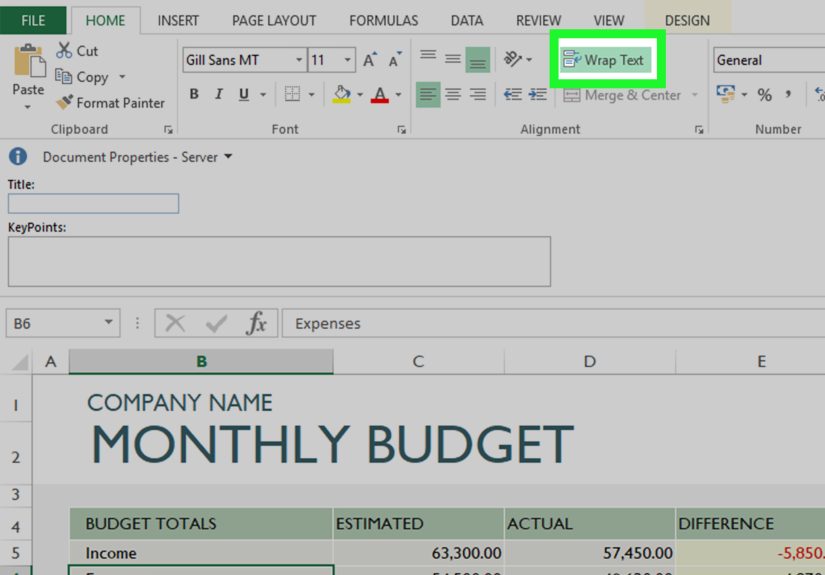
The most common and reliable way to keep text in one cell in Excel is to use Wrap Text. This feature displays long content on multiple lines inside the same cell. The column stays the same width, while the row height expands so the full text can be seen.
How to Wrap Text in Excel
- Select the cell or range of cells that contains long text.
- Go to the Home tab.
- Find the Alignment group.
- Click Wrap Text.
That is it. Excel will keep the content inside the selected cell and break it into multiple lines based on the column width. If you make the column wider, the text uses fewer lines. If you make it narrower, the text wraps into more lines. Excel is flexible like that, which is more than we can say for most office printers.
Keyboard Shortcut for Wrap Text
On Windows, select the cell and press:
This shortcut activates Wrap Text from the ribbon. It is especially useful when formatting multiple rows of product descriptions, survey responses, comments, or notes.
Add a Manual Line Break Inside One Cell
Wrap Text lets Excel decide where the line breaks should happen. But sometimes you want full control. Maybe you are typing an address, a checklist, a shipping label, or a short paragraph that needs clean breaks. In that case, insert a manual line break inside the cell.
How to Start a New Line in the Same Excel Cell
- Double-click the cell, or select it and press F2.
- Place your cursor where you want the new line to begin.
- Press Alt + Enter on Windows.
- On Mac, use Control + Option + Return in many Excel versions.
For example, instead of typing an address like this:
You can keep it in one cell but display it like this:
The cell still contains one value. It simply includes line breaks. This is perfect for mailing labels, contact records, invoices, internal notes, and anything else that deserves more dignity than one endless horizontal sentence.
Adjust Row Height So Wrapped Text Is Visible
Sometimes users turn on Wrap Text and still cannot see everything. This usually happens because the row height is fixed. Excel may need a little nudge.
How to AutoFit Row Height
- Select the row or rows that contain wrapped text.
- Go to Home > Cells > Format.
- Choose AutoFit Row Height.
You can also move your mouse to the line between two row numbers and double-click. Excel will resize the row to fit the visible content. If your spreadsheet suddenly looks like it took a deep breath and stood up straight, that means it worked.
Adjust Column Width Without Splitting the Text
Another simple way to keep text readable in one cell is to adjust the column width. This does not change the cell content. It only changes how much horizontal room the text has.
How to AutoFit Column Width
- Select the column.
- Go to Home > Cells > Format.
- Click AutoFit Column Width.
You can also double-click the right edge of the column header. Excel will expand the column to fit the longest visible entry. This is useful for names, email addresses, SKUs, short descriptions, and labels. However, for very long paragraphs, AutoFit can create a column wider than a movie theater screen. In those cases, Wrap Text is usually better.
Use Shrink to Fit for Short Labels
Shrink to Fit reduces the font size so the text fits within the current cell width. This can be useful for headings, labels, codes, and compact dashboards. It is not ideal for long paragraphs because the text can become too tiny to read without borrowing a microscope from a biology lab.
How to Use Shrink to Fit
- Select the cell or range.
- Right-click and choose Format Cells.
- Open the Alignment tab.
- Under Text control, check Shrink to fit.
- Click OK.
Use this option when layout consistency matters more than large text size. For example, it works nicely for table headers such as “Previous Quarter Revenue” or “Customer Renewal Status.” For detailed notes, Wrap Text is usually easier on the eyes.
Do Not Rely Too Much on Merged Cells
Merged cells can make a sheet look clean, but they often create problems with sorting, filtering, copying, formulas, and AutoFit. When multiple cells are merged, Excel keeps only the content from the upper-left cell in left-to-right worksheets. That means merging cells is not a safe way to combine multiple text values unless you already know what will be preserved.
Also, AutoFit may not behave normally with merged cells. If you wrap text in a merged cell, you may need to manually adjust the row height or column width. Merged cells are like decorative throw pillows: fine in moderation, annoying when they are everywhere.
A Better Alternative: Center Across Selection
If you only want a heading to appear centered across several columns, use Center Across Selection instead of merging cells.
- Select the cells across which you want the heading to appear.
- Right-click and choose Format Cells.
- Go to the Alignment tab.
- Set Horizontal to Center Across Selection.
- Click OK.
This keeps cells separate while giving the visual appearance of centered text. It is cleaner for professional workbooks, especially when sorting and filtering matter.
Keep Formula Results in One Cell
Sometimes the issue is not typed text. It is a formula that combines several values into one cell. Excel can handle this beautifully if you use the right formula and formatting.
Combine Text With Ampersands
The ampersand operator joins text values. For example:
If A2 contains a product name and B2 contains a product code, this formula displays both values in one cell.
Use TEXTJOIN for Cleaner Combined Text
The TEXTJOIN function is excellent for combining multiple text values with a delimiter. For example:
This joins the values from A2 through D2, separates them with commas, and ignores blank cells. It is a tidy way to build one-cell summaries from several columns.
Add Formula Line Breaks With CHAR(10)
If you want formula results to appear on separate lines inside one cell, use CHAR(10) with Wrap Text enabled.
Or use TEXTJOIN:
After entering the formula, turn on Wrap Text. Without Wrap Text, Excel may store the line breaks but not display them the way you expect.
Prevent Text From Being Split Into Multiple Cells
If text is actually being separated into multiple cells, the cause may be a paste operation, a CSV import, or the Text to Columns feature. For example, comma-separated data may split into several columns when opened or imported.
Check Paste Behavior
When pasting from another source, Excel may interpret tabs, commas, or line breaks as separators. If your content keeps spreading across columns, try pasting into the formula bar instead of directly into the grid. Select the destination cell, click in the formula bar, paste the text, and press Enter. This often keeps the full content in one cell.
Use Quotes in CSV Files
If you are preparing a CSV file and want a phrase with commas to remain in one cell, place the full value inside quotation marks. For example:
This helps Excel understand that the commas are part of the text, not column separators.
Best Formatting Settings for Long Text Cells
When creating a worksheet that includes long text, use a formatting system instead of fixing each cell one by one. A few smart defaults can save you from spreadsheet chaos later.
Recommended Settings
- Turn on Wrap Text for comment, description, and note columns.
- Set a reasonable column width, such as 25 to 50 characters wide.
- Use Top Align so long text starts at the top of the cell.
- Use AutoFit Row Height after entering or importing text.
- Avoid merged cells in data tables.
- Use manual line breaks only when you need exact visual structure.
For example, a customer support log might have columns for Date, Customer Name, Issue Type, Notes, Status, and Follow-Up. The Notes column should use Wrap Text and top alignment. That way, long comments stay readable without invading the rest of the sheet like they own the place.
Troubleshooting: Why Is My Text Still Not Staying in One Cell?
Wrap Text Is On, But Text Is Hidden
Use AutoFit Row Height. The row may be too short to show all wrapped lines.
The Text Looks Cut Off
Check whether the next cell contains data. Excel only shows overflow into empty cells. If the neighboring cell is occupied, the text will appear clipped unless you wrap it or widen the column.
Alt + Enter Does Not Work
Make sure you are editing inside the cell first. Double-click the cell or press F2, place the cursor where you want the break, then press Alt + Enter. On Mac, try Control + Option + Return depending on your Excel version.
Formula Line Breaks Are Not Showing
Turn on Wrap Text for the formula cell. A formula can include CHAR(10), but Excel usually needs Wrap Text enabled to display the result on multiple lines.
AutoFit Does Not Work With Merged Cells
Merged cells can interfere with AutoFit behavior. Manually adjust row height or avoid merged cells in areas that contain wrapped text.
Practical Examples
Example 1: Product Description
Suppose cell C2 contains a long product description:
Select C2, click Wrap Text, set the column width to around 35, and use AutoFit Row Height. The description stays in C2 and becomes easy to read.
Example 2: Address in One Cell
Type the name, press Alt + Enter, type the street address, press Alt + Enter, then type the city and ZIP code. This creates a clean address block inside one cell.
Example 3: Combine Notes From Multiple Columns
If A2 contains a customer name, B2 contains a phone number, and C2 contains a note, use:
Then enable Wrap Text. The result appears as a compact, readable customer summary inside a single cell.
My Real-World Experience With Keeping Text in One Excel Cell
In everyday spreadsheet work, the biggest mistake people make is treating Excel like a word processor. Excel can hold paragraphs, notes, addresses, and explanations, but it still thinks in rows, columns, and cells. Once you understand that mindset, long text becomes much easier to manage.
One of the most useful habits is formatting text-heavy columns before entering data. For example, when building a project tracker, I like to create the Notes column first, make it wider than the others, turn on Wrap Text, set vertical alignment to Top, and then test it with a sample paragraph. That small setup step prevents the classic “why is my spreadsheet screaming sideways?” problem.
Another practical lesson is to avoid making columns too wide. Many users respond to long text by dragging the column wider and wider until the worksheet becomes difficult to navigate. A better approach is to choose a comfortable width and let Wrap Text handle the rest. This keeps the sheet readable on normal screens and makes printing or exporting to PDF much easier.
Manual line breaks are excellent when structure matters. Addresses, multi-step instructions, short lists, and labels often look better with Alt + Enter. However, manual breaks can become annoying if the column width changes later. For ordinary sentences and descriptions, automatic Wrap Text is more flexible. In other words, use manual line breaks for intentional formatting, not as a substitute for good layout.
Formula-generated text is another area where people get stuck. A cell may contain a perfect formula with CHAR(10), but nothing appears on separate lines because Wrap Text is off. The fix is simple, yet easy to forget. Whenever a formula uses CHAR(10) to create line breaks, enable Wrap Text immediately. I also recommend testing formula output with realistic data, including blank cells, long names, and unusual notes. Spreadsheets love normal examples during setup and then invite chaos to the party later.
For business reports, I usually avoid merged cells in data tables. They may look polished at first, but they often cause trouble when sorting, filtering, selecting ranges, or adjusting row height. If the goal is a centered heading, Center Across Selection is usually cleaner. If the goal is storing long text, a single properly formatted cell is better than a merged block.
Finally, readability matters more than squeezing everything into a tiny rectangle. Shrink to Fit can be helpful for short headers, but it is not a magic solution for long comments. If the font becomes too small, the spreadsheet may look neat but become unpleasant to use. A good Excel file should not require detective work, zooming, or emotional support. Keep the text in one cell, yes, but keep it readable too.
Conclusion
Keeping text in one cell in Excel is mostly about choosing the right display method. Use Wrap Text when you want long content to stay inside the cell and remain readable. Use Alt + Enter when you want a controlled line break. Use AutoFit Row Height when wrapped content is hidden. Use formulas like TEXTJOIN and CHAR(10) when combining text into one cell. And be careful with merged cells, because they can make formatting harder than it needs to be.
Note: Menu names and shortcuts may vary slightly between Excel for Windows, Excel for Mac, Excel for the web, and Microsoft 365 versions, but the core ideas remain the same: wrap, align, resize, and format intentionally.