Table of Contents >> Show >> Hide
- Welcome To The Sundarbans, Where The Forest Has Teeth
- Who Are The Honey Collectors Of The Sundarbans?
- Step One: Ask The Forest For Permission
- Step Two: Follow The Bees Into Tiger Country
- The Constant, Unseen Presence Of Tigers
- Risk, Poverty, And The Harsh Math Of Survival
- The Forest Is ChangingAnd So Is The Honey
- Safer Honey, Safer Lives?
- Documenting The Work: Behind The Camera In Tiger Land
- Moments That Stayed With Me
- Why Their Story Matters
- What I Learned Walking With Honey Collectors
The first thing you notice in the Sundarbans isn’t the tigers. It’s the silence.
The engine cuts off, the boat rocks gently, and suddenly you’re wrapped in a wall
of green and humidity so thick it feels like you’re breathing through warm honey.
Somewhere in that tangle of mangrove roots and mud live Bengal tigers that have a
well-earned reputation for seeing humans as snacks. And into that same forest,
every honey season, men known as Mowals row in anywayarmed with rope,
smoke, knives, faith, and an absolutely fearless work ethic.
I went with them.
This story isn’t just about sweet, golden Sundarbans honey. It’s about the
people who risk their lives to harvest it, the mangrove forest that shelters
both bees and big cats, and the complicated mix of danger, tradition, and
survival that plays out in tiger territory every single year.
Welcome To The Sundarbans, Where The Forest Has Teeth
The Sundarbans is the world’s largest mangrove forest, spread across the delta
where the Ganges, Brahmaputra, and Meghna rivers meet the Bay of Bengal. It
stretches across India and Bangladesh, but I traveled on the Bangladesh side,
where millions of people depend on the forest for fish, crabs, wood, and of
course, wild honey.
It’s not just any forest. It’s a UNESCO World Heritage Site, a labyrinth of
tidal creeks, mudflats, and salt-tolerant trees with roots that look like
something from a sci-fi movie. It’s also one of the last strongholds of the
Bengal tiger. Estimates vary, but hundreds of tigers still roam this ecosystem,
and here they’re notorious for attacking humansespecially people like
honey collectors, who have to leave the safety of their boats and climb trees
in the forest interior.
For generations, locals have used a simple phrase:
“Forest means fear.” Not metaphorical fear. The very real,
teeth-and-claws kind.
Who Are The Honey Collectors Of The Sundarbans?
The honey collectors, called Mowals or Mouali,
are some of the forest’s most specialized workers. For two to three months each
year, usually between March and May, they organize into small groups, get
official permits from the Forest Department, and head deep into the mangroves
to hunt for wild bee colonies.
Their work provides a huge share of Bangladesh’s wild honey. In some years,
honey harvested from the Sundarbans accounts for around half of the country’s
total honey production. It’s not a side hustleit’s a core livelihood, a seasonal
cash infusion that helps families pay for food, school, debt, and repairs
that the rest of the year’s income can’t cover.
On our first day, I met Rahim, the captain of our small wooden boat, and his
crew of Mowals. They packed their essentials with almost ritual precision:
- Bundles of straw and dried leaves to make smoky torches
- Long ropes and baskets for lowering honeycombs
- Knives and machetes for cutting wax and clearing branches
- Prayer flags and a small shrine to Bon Bibi, the forest
goddess who is believed to protect humans from tigers
No one wore body armor, helmets, or anything you’d call “safety gear.”
One man had a faded football jersey. Another wore flip-flops. It felt less
like a workday and more like stepping into a folklore epicexcept the risk
was painfully real.
Step One: Ask The Forest For Permission
Before we even entered the restricted honey-collection zone, we stopped at a
forest station. The Mowals lined up to show their permits, issued for a strict
window that typically runs from early April through the end of May or June.
The rules regulate which creeks they can enter, how long they can stay, and
how much honey they’re allowed to remove.
After the paperwork came the part that mattered more to them: the ritual.
On the muddy bank, they lit incense and offered prayers to Bon Bibi. Rahim
quietly told me that no one in his village would enter the Sundarbans for
honey without asking for her protection.
“We have the tiger on one side,” he said, “and the sea on the other. We need
someone on our side too.”
Step Two: Follow The Bees Into Tiger Country
Our boat slid deeper into the forest, the creek narrowing until the mangrove
roots on both sides looked like they were reaching in to grab us. Every so
often, someone would point to scratch marks on a tree or paw prints in the mud.
They said it casually, the way you or I might point out a nice sunset.
The honey we were searching for comes from wild colonies of bees that build
enormous hives high in the trees. The Mowals are experts at reading tiny
signsdrifting bees overhead, faint buzzing, sticky stains on bark. When they
finally spotted a hive, the mood shifted from relaxed chatter to intense focus.
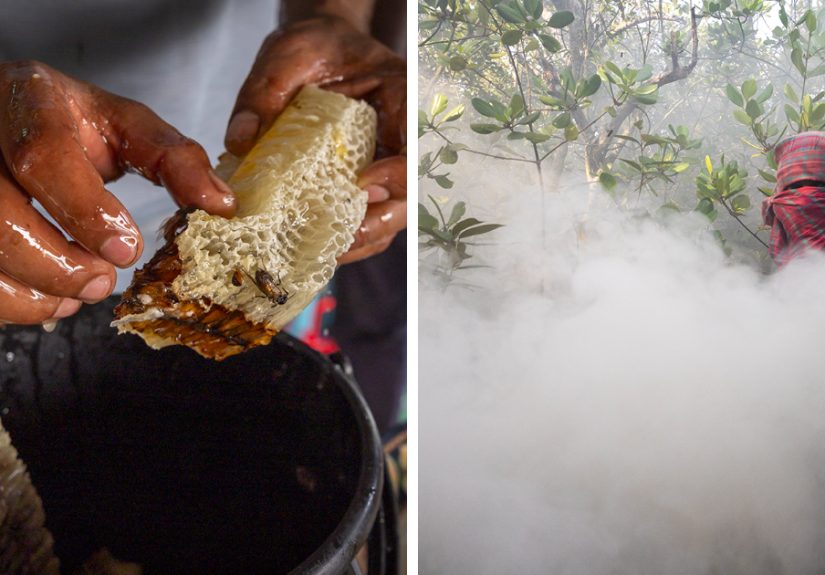
Two men climbed the tree barefoot, hugging the trunk like they’d been born
there. Another prepared the smoker: a bundle of straw set on fire, then tamped
down to smolder. Thick white smoke billowed upward, calming and driving away
the bees just long enough for the climbers to slash chunks of honeycomb into
a metal bucket.
It looked dangerously simple. One slip, and they’d be impaled on a root,
swarmed by angry bees, orif the timing was truly unluckysurprised by something
large and striped padding quietly through the undergrowth.
The Constant, Unseen Presence Of Tigers
Tiger attacks in the Sundarbans are not a rare freak occurrence; they’re a
regular part of life near the forest. Over recent decades, researchers and
local organizations have estimated that on average, dozens of people
are killed by tigers every year in this region, with thousands of deaths
recorded over the last several decades.
Honey collectors, crab catchers, and woodcutters are at particular risk.
One study tracking human–tiger conflict in the area recorded hundreds of deaths
and injuries over a few decades, with a strikingly high death-to-injury ratio.
That’s a grim way of saying: if a tiger attacks you here, you probably don’t
walk away from it.
On the boat, people spoke about tigers the way you might talk about an
unpredictable neighbor. One Mowal described how his cousin never came back
from a honey trip. Another told me he no longer lets his teenage son join
the crews, even though the extra income would help.
“The tiger is also hungry,” one man shrugged. “We come into his house.
Sometimes he is angry. What can we do?”
Risk, Poverty, And The Harsh Math Of Survival
It’s easy, from a safe distance, to wonder why anyone would keep doing a job
this dangerous. Up close, the answer is stark: they don’t have many
alternatives.
Coastal communities near the Sundarbans have been hit by multiple pressures:
cyclones, soil salinity, shrinking farmland, and declining fish stocks. Rising
sea levels and stronger storms are eroding villages and damaging crops. For many
families, the forest is the last safety neta place where you can still gather
something of value if you’re strong enough, skilled enough, and willing to risk
it.
Honey offers quick cash. A successful season can mean enough money to repair a
house, pay off loans, or send kids back to school. The men I met talked about
each hive in almost financial terms: the weight of honey, the price per kilo,
how many hives they needed to hit their target earnings before the permits
expired and the forest closed again.
When your choice is “risk the tiger” or “go hungry,” the forest starts to look
less like a horror movie and more like a very dangerous marketplace.
The Forest Is ChangingAnd So Is The Honey
The Sundarbans is on the frontline of climate change. Scientific studies show
that sea level rise, reduced freshwater flow, and increasingly intense cyclones
are reshaping the mangrove ecosystem. Some of the most biodiverse areas are
projected to shrink dramatically by the end of the century if trends continue.
For honey collectors, these changes show up in very practical ways:
- Bee colonies destroyed by high winds and storm surge
- Flowering patterns shifting, which affects how much nectar is available
- Salty water creeping further inland, stressing trees that support bee hives
Several Mowals told me that the honey “doesn’t come like before”there are
fewer hives, and sometimes the quality or taste seems different. When you
depend on a seasonal natural resource, climate change isn’t an abstract concept;
it’s a missing hive and an empty basket.
Safer Honey, Safer Lives?
Conservation groups and local cooperatives are trying to make honey collection
less deadly. Some initiatives have helped relocate beekeeping closer to villages,
where domesticated or semi-wild bee colonies can be tended in safer areas like
fields or homestead gardens. In a few communities, collectors are training to
harvest honey away from deep tiger habitat, shortening the time they spend in
the most dangerous zones.
There are also experiments with better protective gear, communication devices,
and stronger enforcement of no-go areas known to be tiger hotspots. But none of
this fully replaces the lure of the wild forest honey, marketed as pure, raw,
medicinal, and almost mystical in its origin.
For buyers, Sundarbans honey is a trendy “superfood.” For the people who collect
it, it’s a calculated gamble with their lives.
Documenting The Work: Behind The Camera In Tiger Land
My own role in all of this was awkwardly simple: I was there to document.
Camera batteries charged, lenses wrapped in plastic against the salty air, I
followed the Mowals as closely as I could without getting in their wayor in
the tiger’s way.
Photographing honey collection in the Sundarbans is a strange balance of
adrenaline and patience. Hours of quiet drifting are punctuated by short,
intense bursts of activity when a hive is found. One minute you’re staring at
a mudflat wondering if your socks will ever be dry again; the next you’re
watching a man dangling from a branch with a bucket of honey in one hand and
a machete in the other, bees swirling around him like an angry halo.
I tried to capture more than just the “hero shot” of men holding dripping
combs to the camera. I wanted readers to see the cramped boat where everyone
sleeps shoulder to shoulder, the calloused hands that handle oars and ropes
all day, the tiny shrine to Bon Bibi lit by a single candle, the nervous glances
at the treeline when the forest goes unnaturally quiet.
Because behind every glossy jar of “wild forest honey” on a store shelf,
there’s a story that looks nothing like wellness influencers drizzling it on
avocado toast.
Moments That Stayed With Me
The Night The Forest Roared Back
One night, anchored near the edge of a creek, we heard it: a low, distant roar
that instantly silenced everyone on the boat. No one needed me to translate.
For a few seconds, all I heard was my own heartbeat.
Then someone cracked a joke about the tiger complaining that we hadn’t left him
any honey, and the tension broke into nervous laughter. But for the rest of the
night, at least two men stayed awake, watching the dark line of trees with
flashlights ready.
The Widow’s Story
In a village on the forest’s edge, I met a woman whose husband never returned
from a honey trip. In the local language, women widowed by tigers are sometimes
called “tiger widows”a term that sounds poetic until you see the exhausted,
practical grief behind it.
Her husband’s friends brought back his shirt and the story of what happened.
That was all. No insurance payout. No pension. Just one less breadwinner and
a family trying to recalibrate their life without him.
When I asked if she would let her sons become Mowals, she shook her head so
quickly her earrings flashed.
“I’d rather be poor,” she said, “than lose another one to the forest.”
Why Their Story Matters
It’s easy to romanticize wild honey and tiger forests from far away, to enjoy
the aesthetic of “untouched nature” without thinking about the people who
live with that nature every day. The Mowals of the Sundarbans don’t have
that luxury. For them, conservation, climate change, and human–wildlife conflict
aren’t hashtags or headlinesthey’re the background conditions of daily survival.
If we care about protecting tigers and mangrove forests (and we should), we
also have to care about the communities whose lives are most entangled with
those ecosystems. Safer livelihoods, fairer prices for honey, climate adaptation,
and smarter conflict-mitigation strategies are all part of the same story.
Otherwise, we’re just cheering for the forest while the people who keep it
going pay the bill with their blood.
What I Learned Walking With Honey Collectors
Spending time with the Mowals didn’t make me brave. It made me observant.
You quickly learn that fear in the Sundarbans isn’t a dramatic movie-style
panic; it’s a quiet, constant companion. The men joked, gossiped, shared food,
and teased each otherbut they also moved with a level of situational awareness
that would put many professional athletes to shame.
I noticed how often they scanned the shoreline, how they adjusted their route
when they saw fresh footprints, how they chose trees with an eye not only for
honey but also for escape routes. Even the way they sleptlightly, with someone
always half-awakesaid a lot about the mental adaptation required to work in
tiger territory.
One afternoon, when the sun was high and the air felt like hot soup, we stopped
near a mudflat to cook a quick meal. The stove was just a metal frame balanced
on bricks, smoke curling lazily up as rice boiled. I drifted toward the water’s
edge, camera in hand, thinking how beautiful the twisted roots looked reflected
in the tide.
“Not so far,” one of the men called out, not unkindly. “If the tiger comes,
you will be the easiest first choice.”
I laughed, took two steps back, and realized he wasn’t joking. To them,
a distracted stranger at the water’s edge was not a photographer getting an
artsy shot; it was a liability, a soft target in a place where mistakes are
expensive.
Another moment that stuck with me happened when we found a hive that was
clearly damagedmaybe by wind, maybe by a previous team. The Mowals debated
whether to take what was left. In the end, they decided to leave part of the
comb behind so the colony could recover.
“If we are greedy,” Rahim said, tapping the trunk of the tree lightly,
“the forest will be greedy with us later.”
That sentence carried more ecological wisdom than a stack of policy reports.
Their relationship with the forest is transactional, yes, but also deeply
reciprocal. They understand that if they strip every hive, cut every tree,
or ignore every warning, the system that feeds them will collapseand might
take them down with it.
I also learned that danger doesn’t cancel out humor. On the last evening of
our trip, as we headed back toward the village with buckets of honey and
smoke-stained clothes, someone asked me how much Sundarbans honey would sell
for in my home country. When I converted the prices, there was a stunned
silence, followed by an explosion of laughter and a round of sarcastic
comments about who really benefits from “premium forest products.”
One Mowal grinned and raised his eyebrows.
“Next time,” he said, “you carry the honey on your head, and we will take
the dollars.”
Fair point.
When I left, I carried with me hundreds of photographs, a notebook full of
quotes, and a lingering combination of awe and discomfort. Awe at the courage,
skill, and resilience of the honey collectors; discomfort at knowing that
the sweetness of wild honey is built on a level of risk most of us would
never accept.
So if you ever see a jar labeled “Sundarbans forest honey,” remember this:
behind that label is a maze of muddy creeks, the shadow of a tiger, the hum
of a million bees, and a small group of men balancing survival, tradition,
and danger on a very thin line.