Table of Contents >> Show >> Hide
- What Makes Magical Realism Different From Fantasy or Surrealism?
- The Ultra-Real Illumination: Why These Paintings Seem to Glow
- Order, Composition, and the Feeling of a Private Cosmos
- Animals as Symbols, Not Decorations
- Why Sharpness Can Feel Hallucinatory
- The Emotional Tone: Peaceful, Strange, and Slightly Dangerous
- Why Magical Realism Still Feels Fresh Today
- Looking at the 30 Pictures as a Visual Journey
- The Craft Behind the Enchantment
- Experience: What It Feels Like to Enter a Magical Realist Painting
- Conclusion: The Shimmer Between Reality and Wonder
- SEO Tags
Some paintings ask politely to be admired. Others kick open the door, rearrange the furniture in your imagination, and leave a moonlit owl staring at you from the hallway. That is the strange charm of magical realism paintings: they look familiar enough to trust, yet mysterious enough to make you wonder whether reality has been keeping secrets from you.
In the work of Belgrade-based painter Saša Montiljo, magical realism is not a decorative label tossed on top like glitter. It is the engine of the image. His scenes are orderly, precise, and almost impossibly clear, yet they glow with an ultra-real illumination that pushes them beyond ordinary realism. The viewer recognizes animals, forests, objects, light, and spacebut the arrangement feels cosmic, symbolic, and slightly enchanted, as if nature has just remembered an ancient language.
This is why the phrase “magical realism” fits so well. These are not fantasy paintings in the usual sense. They do not depend on dragons, castles, or heroic wizards waving sticks like overworked orchestra conductors. Instead, they transform the everyday world by sharpening it. The magic comes from clarity, composition, atmosphere, and the feeling that every creature, shadow, branch, and glowing horizon has been placed exactly where it belongs.
What Makes Magical Realism Different From Fantasy or Surrealism?
Magical realism in painting lives in a fascinating middle zone. It does not fully abandon the real world, but it refuses to behave like a simple mirror. A magical realist image may show a recognizable landscape, a room, a figure, or an animal, yet the scene carries an uncanny charge. Something is too still, too luminous, too symbolic, or too perfectly arranged. Reality is presentbut it has been tuned to a frequency most people only hear in dreams.
The term “magic realism” has deep roots in modern art history. It was used in the early 20th century to describe art that retained precise representation while introducing strangeness, mystery, or dreamlike intensity. In American art, the idea became especially visible through exhibitions and artists who painted the improbable as if it were physically possible. That is the key: magical realism does not scream, “Look, I am impossible!” It whispers, “Of course this could happen. Why are you acting surprised?”
Surrealism often disrupts logic through shocking juxtapositions. Fantasy builds alternate worlds with their own rules. Hyperrealism pushes technical accuracy to dazzling extremes. Magical realism borrows a little from all three but belongs entirely to none. It is quieter, more patient, and often more haunting. Its power lies in the moment when the ordinary becomes charged with meaning.
The Ultra-Real Illumination: Why These Paintings Seem to Glow
One of the most striking qualities in Montiljo’s paintings is the sensation of light that feels more intense than natural light. The scenes do not merely appear lit; they seem illuminated from within. This is not the casual glow of a sunny afternoon. It is the kind of glow that makes leaves look like stained glass, fur like soft fire, and the space between objects feel spiritually loaded.
That “ultra-real illumination” is central to the emotional experience of the work. The eye first notices technical control: crisp forms, careful detail, and clean composition. But the longer you look, the more the image slips away from ordinary realism. The precision becomes strange. The calm becomes intense. The painting starts to feel less like a window and more like a threshold.
Light in magical realism often behaves like a storyteller. It does not simply reveal the subject; it gives the subject importance. A bird is not just a bird. A wolf is not just wildlife. A tree is not merely standing there minding its leafy business. Each element appears chosen, almost ceremonially staged, as if the painting is presenting evidence from a world where animals, landscapes, and symbols still communicate with humans.
Order, Composition, and the Feeling of a Private Cosmos
Montiljo’s paintings often feel carefully arranged, and that order matters. In magical realism, composition is not just a design decision; it is a form of meaning. When a scene feels balanced, deliberate, and free of visual chaos, the viewer senses that the painting is governed by hidden laws. The result is a peaceful yet intense cosmogonya small universe where nothing appears accidental.
This is one reason the works reward slow looking. At first glance, the viewer may admire the color, detail, or atmosphere. Then the structure begins to reveal itself. The placement of animals, the direction of light, the openness of a clearing, the shape of branches, and the rhythm of shadows all seem to participate in a larger visual order. The painting becomes a puzzle, but not the frustrating kind that makes you regret owning a coffee table. It is more like a myth whose meaning grows richer each time you revisit it.
In many magical realism paintings, the artist uses recognizable forms to produce psychological depth. George Tooker, Paul Cadmus, Jared French, Peter Blume, and other 20th-century artists explored similar territory in different ways. Some used urban spaces, social tension, or classical figure arrangements. Montiljo’s world leans more toward nature, animals, stillness, and symbolic atmosphere. Yet the shared impulse remains: make the unreal believable by painting it with conviction.
Animals as Symbols, Not Decorations
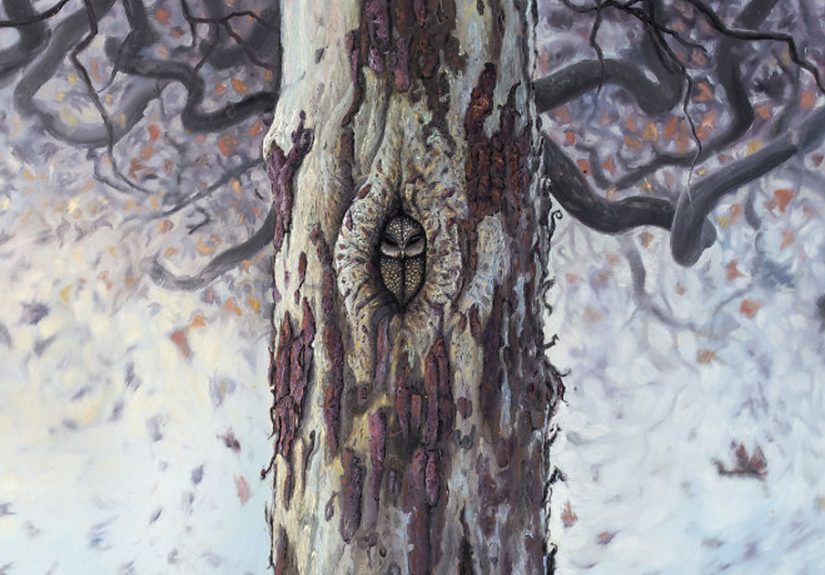
Animals often carry a special charge in magical realism. In ordinary wildlife art, an owl may represent beauty, anatomy, or habitat. In magical realism, the owl may feel like a witness. A fox may become a messenger. A wolf may seem less like a predator and more like a guardian of some forest law humans forgot to read.
This symbolic quality does not require heavy-handed explanation. In fact, magical realism works best when it leaves some doors closed. The viewer senses that the animal means something, but the painting does not pin that meaning down like a butterfly in a display case. Instead, the image invites interpretation. Is the creature a memory? A spirit? A warning? A companion? A slightly judgmental forest accountant? The ambiguity is part of the pleasure.
Montiljo’s animals often appear calm, alert, and deeply present. They are not cartoonish or sentimental. Their stillness gives them authority. They seem to belong to the scene in a way humans rarely do. That feeling is important because magical realism frequently reverses the usual hierarchy. Nature is not background. Nature is the intelligence of the painting.
Why Sharpness Can Feel Hallucinatory
Most people associate dreams with blur, fog, and soft edges. Magical realism often does the opposite. It makes dreams feel sharp. This crispness can create a hallucinatory effect because the viewer expects mystery to arrive through distortion, but instead it arrives through precision.
When every detail is clear, the mind stops blaming uncertainty on technical vagueness. The strange thing is not unclear because it was painted loosely. It is strange because it is deliberately, beautifully, confidently there. That is why magical realism can feel more unsettling than obvious fantasy. The artist does not ask the viewer to suspend disbelief; the artist calmly removes disbelief from the room and offers it a chair outside.
In Montiljo’s paintings, meticulous detail helps produce the feeling of “more real than real.” The viewer can study surfaces, forms, and relationships, yet the atmosphere remains elusive. This combination of visible clarity and hidden meaning is what gives the work its shimmer. It is realism with a secret pulse.
The Emotional Tone: Peaceful, Strange, and Slightly Dangerous
The best magical realism paintings rarely settle into one mood. They often feel beautiful and unsettling at the same time. Montiljo’s scenes can appear peaceful, but not empty. They have the hush of a place where something has just happenedor is about to happenbut no one has decided whether to tell you.
This emotional complexity is one of the reasons viewers are drawn to the style. Purely pleasant images can be enjoyable, but they do not always stay with us. Images that contain tension, silence, and mystery tend to linger. They behave like songs you cannot stop humming, except the song is a glowing fox under a cosmic sky and now your brain has questions.
Magical realism respects the viewer’s intelligence. It does not explain every symbol or flatten every mood into a slogan. Instead, it allows contradictory feelings to coexist: wonder and unease, beauty and loneliness, precision and mystery, nature and myth. That mixture is what makes the paintings feel alive.
Why Magical Realism Still Feels Fresh Today
In a digital culture flooded with quick images, magical realism offers a slower kind of visual pleasure. It asks viewers to pause, look again, and accept uncertainty. That alone makes it feel almost rebellious. The internet wants instant reactions; magical realism wants attention.
The style also speaks to a modern hunger for meaning. Many people feel surrounded by information but starved for wonder. Magical realism does not deny reality; it deepens it. It suggests that the ordinary world may still contain symbolic power, if we learn how to see it. A forest can be more than a forest. A night sky can be more than weather. A painting can be more than decoration over a couch, although the couch is probably honored to be involved.
For contemporary viewers, Montiljo’s work offers a visual antidote to chaos. The careful order of the scenes, the luminous atmosphere, and the symbolic presence of animals create a space where imagination feels structured rather than random. The paintings do not escape the world; they reorganize it into something contemplative, mysterious, and strangely reassuring.
Looking at the 30 Pictures as a Visual Journey
A collection of 30 magical realism paintings works best when experienced as a journey rather than a simple gallery scroll. Each picture may stand on its own, but together they create a rhythm. One image introduces stillness. Another deepens the mystery. Another offers a creature, a glowing scene, or a strange visual harmony that feels like a clue.
The repetition of certain qualitiesclarity, order, symbolic animals, luminous landscapesbuilds a recognizable artistic language. Viewers begin to understand the rules of the world. They learn to expect quiet intensity, not spectacle. They begin to notice how space is arranged, how light behaves, and how the smallest detail can tilt a scene from realistic into magical.
This is also where the “30 pics” format becomes surprisingly effective. Online image collections can sometimes feel disposable, but a strong magical realism series benefits from accumulation. The more images viewers see, the more they sense the artist’s private mythology. The paintings become chapters in a visual book, and the book seems to have been written in moonlight with an unusually disciplined pen.
The Craft Behind the Enchantment
Magical realism depends on craft. Without strong drawing, composition, color control, and surface treatment, the magic can collapse into decoration. The viewer must believe in the world before being invited to question it. That is why technical discipline is so important.
Montiljo’s work demonstrates how realism can serve imagination instead of limiting it. The careful rendering of forms gives the viewer something solid to hold onto. Once that trust is established, the painting can introduce symbolic tension, unusual atmosphere, and dreamlike relationships. The result is not a random fantasy but a believable mystery.
This balance is difficult. Too much realism, and the image may become merely descriptive. Too much fantasy, and it may lose its quiet credibility. Magical realism succeeds when the two forces are held in elegant suspension. The painting says, “This is real,” while another voice beneath it says, “But not in the way you think.”
Experience: What It Feels Like to Enter a Magical Realist Painting
Looking at magical realism for a long time changes the way you look at everything else. After spending time with paintings like these, a walk through a park can start to feel suspiciously meaningful. A blackbird on a fence seems less like a bird and more like an editorial comment. A patch of sunlight on the floor suddenly appears staged by an invisible curator with excellent taste.
That is the real experience of this kind of art: it trains attention. It encourages viewers to slow down and notice relationships between things. The branch leaning toward a window, the glow behind a cloud, the animal pausing at the edge of visionthese details begin to feel like parts of a larger composition. Magical realism does not only live inside the frame. It spills outward and teaches the eye to find shimmer in ordinary places.
There is also a personal kind of silence in these paintings. They do not shout for attention, even when they are visually striking. Instead, they create a calm pressure. You feel invited, but not fully admitted. The scene opens itself just enough to make you curious, then keeps its deepest meaning protected. That restraint is refreshing. In a world where every image seems eager to explain itself, magical realism preserves the dignity of mystery.
The emotional experience can be unexpectedly intimate. A viewer may not know exactly why a glowing animal or carefully ordered landscape feels moving, yet the feeling arrives anyway. Perhaps it is because the paintings suggest that the world is not as spiritually flat as daily routines make it seem. Perhaps it is because they restore symbolic weight to nature. Or perhaps it is because humans secretly enjoy being confused by beautiful things. We are complicated creatures; give us a luminous owl and we will build a philosophy around it by lunchtime.
For artists, the lesson is equally powerful. Magical realism shows that imagination does not require abandoning discipline. In fact, the more carefully the world is built, the more convincing the magic becomes. The painter’s patience becomes part of the enchantment. Every edge, color shift, and compositional decision helps persuade the viewer that the impossible has simply been waiting for the right lighting.
For collectors and casual art lovers, these paintings offer something rare: images that can remain interesting after the first look. Many artworks impress quickly and fade quickly. Magical realism tends to deepen. A painting that seemed beautiful on day one may feel symbolic on day ten, unsettling on day thirty, and oddly comforting months later. It changes because the viewer changes. The work becomes a companion rather than a visual snack.
That lasting quality is why Montiljo’s magical realism resonates. His paintings do not merely display skill; they create atmosphere. They suggest a world where order still matters, where animals may be guardians of meaning, and where light can transform a scene into a revelation. The experience is not loud, but it is memorable. It leaves the viewer with the delicious suspicion that reality may be better lit, better arranged, and far stranger than we normally allow ourselves to believe.
Conclusion: The Shimmer Between Reality and Wonder
“Magical Realism”: The Scenes In My Paintings Shimmer With A Certain Ultra-Real Illumination (30 Pics) is more than a beautiful title. It describes a precise visual experience: the moment when realism becomes luminous enough to feel supernatural. Saša Montiljo’s paintings invite viewers into scenes where order replaces chaos, animals become symbolic presences, and light seems to reveal hidden laws of nature.
The appeal of these works lies in their balance. They are clear but mysterious, peaceful but charged, realistic but not limited by realism. They remind us that art does not always need to invent an entirely separate universe. Sometimes it only needs to look at this one with enough intensity to make it shimmer.
Magical realism endures because it honors both the eye and the imagination. It gives us recognizable forms while leaving room for wonder. And in a noisy age, that quiet glow may be its greatest magic of all.