Table of Contents >> Show >> Hide
- The Big Idea: A Garden That Keeps Working After Bloom Time
- Gathering: The Art of Looking at the Garden Differently
- Weaving: When Stems Become Structure
- Making: Preserving the Season in Useful, Beautiful Ways
- Why the Gardenista Mood Resonates So Strongly
- How to Bring “Gathering, Weaving, Making” Home
- Conclusion: The Garden Is Not Finished, It Has Simply Changed Jobs
- A Longer Reflection on the Experience of Gathering, Weaving, and Making
Some garden stories are about peak bloom, heroic tomatoes, or hydrangeas so fluffy they look like they’ve unionized. This is not one of those stories. This is about the moment after the applause, when the garden gets quieter, scruffier, a little more philosophicaland, somehow, even more useful.
Meanwhile, On Gardenista: Gathering, Weaving, Making captures a mood that has become increasingly irresistible in modern garden culture: the idea that the garden is not just a place to admire, but a place to gather from, shape with, and live alongside. In other words, the garden is not merely scenery. It is pantry, studio, supply closet, inspiration board, and occasional therapist.
That sensibility feels especially right now. As more gardeners lean toward seasonal living, sustainable decorating, slower hobbies, and less wasteful entertaining, the old divide between “gardening” and “making” starts to disappear. Suddenly, a basket is not just a basket. It is a record of stems, hands, weather, and time. A bunch of clippings is not yard debris. It is tomorrow’s centerpiece. A fading patch of herbs is not the end of anything. It is the beginning of drying, storing, brewing, tying, and tucking away.
The beauty of the Gardenista approach is that it refuses to treat the late-season garden like an overcooked side dish. Instead, it asks a better question: what else can this place become once the flowers stop showing off?
The Big Idea: A Garden That Keeps Working After Bloom Time
At its heart, “gathering, weaving, making” is about seeing value where many people see leftovers. Once you start looking through that lens, the garden changes completely. Twigs become structure. Drying leaves become texture. Seed heads become ornament. Cut branches become support, sculpture, or centerpiece. Even plants that are past their prime can have a highly glamorous second actless red carpet, more beautiful old linen apron.
This way of gardening also has a practical side. It encourages reusing what is already on hand, cutting down on impulse buys, and developing a closer relationship with the rhythms of a place. You notice which stems bend without snapping, which herbs dry well, which branches still hold their leaves, and which containers actually make life easier when you are hauling cuttings back to the porch. That kind of knowledge is small-scale, but it adds up. It turns garden work into fluency.
And unlike some aspirational garden trends that require a stone folly, three acres, and a trust fund, this one can begin with a modest backyard, a side yard, a few pots, or even a walk around the blockwith permission and common sense, of course.
Gathering: The Art of Looking at the Garden Differently
Gathering is the first skill, and it is more imaginative than it sounds. It means learning to stop hunting only for perfect flowers and start noticing texture, line, shape, and usefulness. The branch with a crooked elbow? Suddenly interesting. The dried hydrangea head? Excellent. The rosemary that has gone woody but still fragrant? Dinner party material. The dogwood stem with color? Straight to the vase.
That is part of what makes this mindset so appealing: it democratizes beauty. A formal florist’s bouquet is lovely, but there is something more intimate about arrangements made from what the season is already offering. The results are usually looser, moodier, and more specific to a place. They feel found rather than ordered, which is often the entire charm.
Gathering also changes the tools you value. A harvest basket, trug, or hod is not just a cute prop for a photo you caption “accidentally rustic.” It is genuinely useful. The best gathering containers are light enough to carry, sturdy enough to hold clippings, and open enough to let you sort materials as you collect them. Gardeners have long relied on baskets and trugs because they are efficient, but they also reinforce something deeper: harvesting is part of daily garden life, not a special-effects event.
Still, good gathering has rules. It should be ethical, observant, and restrained. If you are clipping beyond your own property, permission matters. Protected areas are not your free craft aisle. Invasive species may sometimes be useful to remove, but they also need careful handling and disposal. Thoughtful makers do not treat nature like a clearance bin. They work with it respectfully.
What Belongs in a Gathering Basket?
The answer depends on the season, but a few categories show up again and again: bendable stems, seed heads, herbs, branches with color, grasses, cones, berries, faded flower heads, and anything with an interesting silhouette. The key is variety. A good gathered collection usually includes something airy, something structural, something soft, and something odd enough to keep it from looking too polished.
That last part matters. Perfection is not the point here. Personality is.
Weaving: When Stems Become Structure
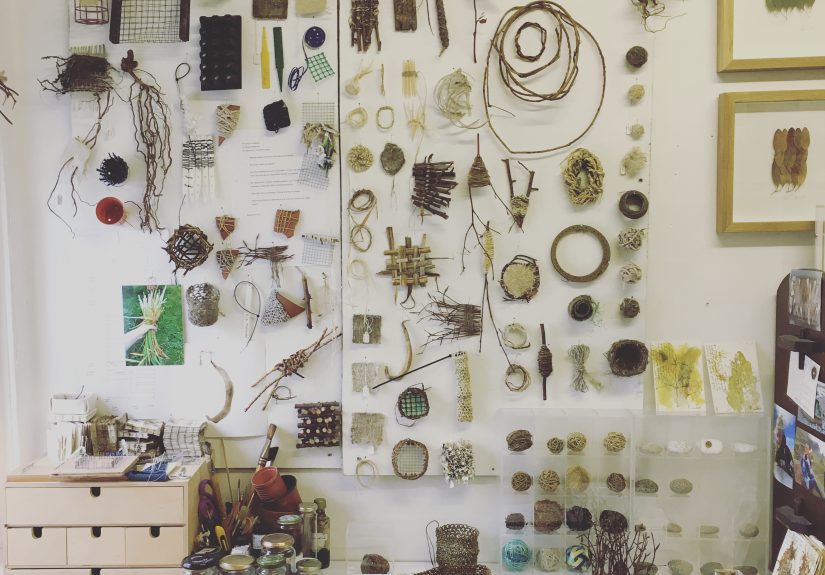
Weaving may sound like a specialized craft best left to people with saintly patience and a studio full of labeled bundles, but the Gardenista worldview makes it feel far more approachable. Weaving can be as ambitious as basketry or as simple as bending pliable stems into a wreath base, wrapping branches around a pot, or constructing a rustic garden support in place.
This is where the late-season garden gets almost magical. Materials that look spent still hold tremendous design potential. Willow, dogwood, hazel-like branches, and other flexible stems can be coaxed into circles, supports, and woven forms. Even a loose, imperfect result has beauty, because natural materials bring their own line, texture, and irregularity. Frankly, a slightly lopsided handmade wreath often has more soul than anything that arrived shrink-wrapped with artificial berries and a faint smell of warehouse despair.
Weaving also appeals because it combines utility and decoration. A woven branch support can hold up vines or floppy stems. A handmade basket can carry produce, flowers, or kindling. An onion basket can hang in the kitchen and be both storage and sculpture. This is not fussy crafting for crafting’s sake. It is making that earns its keep.
There is also a compelling sustainability angle. Instead of buying every decorative object new, gardeners are rediscovering how much can be made from prunings, clippings, and natural fibers. That shift aligns neatly with the broader rise of nature-forward, reusable, and compostable décor. In a culture tired of disposable everything, a hand-shaped object made from gathered materials feels refreshingly grounded.
Why Woven Things Feel So Right Right Now
Part of the answer is texture. Modern spaces often need more of it. Woven pieces soften hard surfaces, add warmth, and bridge the gap between indoors and out. Part of the answer is emotional. Weaving is repetitive, tactile, and slow in a way that many people now crave. And part of the answer is aesthetic: handmade objects, especially imperfect ones, look less staged and more alive.
That “perfectly imperfect” quality is what makes the whole movement feel modern rather than quaint. It is not reenactment. It is not pretending everyone suddenly lives in a 19th-century cottage with geese. It is contemporary design with dirt under its fingernails.
Making: Preserving the Season in Useful, Beautiful Ways
Once gathering and weaving enter the picture, making becomes the natural third act. This is where the garden’s leftovers become future pleasures. Herbs are dried for winter use. Tubers are lifted and stored. Clippings turn into centerpieces. Fallen sticks become labels, collages, miniature structures, or wreath materials. The season gets edited, not discarded.
One of the smartest lessons in this approach is that making does not have to be monumental. It can be small and domestic. Dry a handful of aromatic herbs. Tie a bundle with twine. Tuck branches into a tall vessel on the table. Save interesting stems for a mantel display. Make a loose wreath one weekend. Store dahlia tubers so next year’s garden begins with something you already tended. These are humble acts, but they create continuity between seasons.
They also make a home feel more connected to the garden. A branch arrangement on the dining table, a basket of onions in the kitchen, a simple wreath on the back gate, or dried herbs hanging by the pantry all signal the same thing: this household notices the season it is living in.
And that, increasingly, is what people want. Not maximal decoration for the sake of decoration, but meaningful seasonal detail. Better entertaining, too, is moving in that directiontoward garden-picked greenery, foraged accents, fruit, herbs, and layered natural textures. The effect is warmer, less rigid, and more personal than a one-click matching set ever could be.
Why the Gardenista Mood Resonates So Strongly
Gardenista has long understood that good garden style is not only about plants; it is about living well around plants. The phrase “gathering, weaving, making” resonates because it turns gardening into a cultural practice, not just a maintenance routine. It invites creativity without demanding high drama. It values old skills without becoming precious. It allows beauty, usefulness, and seasonality to occupy the same basketsometimes literally.
It also offers a subtle rebuke to consumer overload. The message is not “buy nothing,” but rather “notice more.” Before ordering another object, take a look at the branch pile. Before tossing faded stems, consider their shape. Before writing off November, see what can still be dried, stored, woven, or arranged. This is not deprivation. It is attentiveness.
There is humor in that shift, too. The same gardener who mourns the end of summer in September may be out in November cooing over seed heads like they are rare jewels. But that is how seasonal fluency works. Your taste matures. Your eye gets sharper. Your standards become stranger, and honestly, better.
How to Bring “Gathering, Weaving, Making” Home
You do not need a grand plan to start. In fact, the best version of this approach usually begins with one practical project and a little curiosity.
- Make a gathered centerpiece: Clip branches, herbs, seed heads, and a few faded blooms from your yard and arrange them loosely in a crock, pitcher, or basket.
- Try a simple wreath base: Use flexible stems to form a rough circle, then tuck in berries, grasses, or evergreen snippets.
- Create a drying station: Bundle herbs or interesting stems and hang them in a pantry, shed, or kitchen corner.
- Use prunings decoratively: Wrap branches around planters, use sticks as plant labels, or save beautiful twigs for winter arrangements.
- Store with intention: Lift and label tender bulbs or tubers, and treat that task as part of next year’s design work rather than garden bureaucracy.
The goal is not to become instantly expert. The goal is to build the habit of seeing your garden as a creative partner. Once that happens, the projects tend to multiply on their own.
Conclusion: The Garden Is Not Finished, It Has Simply Changed Jobs
Meanwhile, On Gardenista: Gathering, Weaving, Making speaks to one of the most satisfying truths in gardening: the season does not end when the flowers do. It changes register. It asks for slower attention, steadier hands, and a more resourceful eye. What remains may be quieter, but it is hardly empty.
In that quieter season, gardens offer some of their most interesting gifts. Not the flashy gifts, perhaps. Not the “look at me” gifts. But the useful, soulful, textural, deeply livable ones. A basket full of clippings. A hand-shaped wreath. A dried herb bundle. A carefully stored tuber. A table that smells faintly of rosemary and branches. A room that feels like the garden kept talking after you came indoors.
That is the real appeal here. Gathering, weaving, and making are not just activities. They are a way of extending the life of the gardenand maybe our own attention spans, too. And in a world that loves speed, that may be the most radical garden project of all.
A Longer Reflection on the Experience of Gathering, Weaving, and Making
There is a particular pleasure in stepping outside when the garden looks, at first glance, like it has already said everything it had to say. The flowers are fewer. The leaves are not trying nearly as hard. The whole place has traded sparkle for character. And then, once you begin to gather, the garden reveals that it was never done at all. It was simply waiting for you to notice different things.
That experience is what makes this way of gardening feel so intimate. You stop moving through the space like a spectator and start moving through it like an editor. You look for line, curve, scent, flexibility, color, storage potential. You notice the branch that can become a centerpiece, the herb that should be dried before the next cold snap, the stems that might be woven before they turn brittle. Even the act of carrying a basket changes your mindset. You are no longer just “checking on the garden.” You are in conversation with it.
Weaving, especially, has a way of slowing everything down. It asks for enough patience to make you forget your phone exists for a while, which is no small miracle. You bend one stem, then another. You make a shape, then adjust it, then laugh because it looks slightly ridiculous, then keep going until it becomes unexpectedly lovely. That is the charm of handmade work with natural materials: it rarely obeys at first, but it often rewards persistence. And when you finish, the result feels earned in a way store-bought décor rarely does.
Making with gathered materials also creates a memory trail. The wreath on the door is no longer just decoration; it is the afternoon you clipped dogwood after lunch. The dried herb bundle in the pantry is the smell of that one bright autumn day when everything seemed briefly manageable. The basket on the kitchen shelf is not just storage; it is proof that the garden can continue to participate in daily life long after the bloom parade has moved on.
What stays with people, I think, is the feeling of sufficiency. Not abundance in the flashy sense, but the calmer realization that there is already quite a lot here. Enough to arrange. Enough to store. Enough to weave. Enough to make a room feel seasonal and alive. Enough to keep your hands busy in a satisfying way. Enough to turn the end of the season into its own kind of beginning.
And perhaps that is why this theme lands so well. It gives late-season gardening a dignity that many people miss. It says the brown stems matter. The seed heads matter. The fallen branches matter. The half-wild corners matter. The making matters. Instead of treating the garden as a performance that closes after summer, it treats it as a relationship that deepens in quieter months. That is a far richer way to gardenand, frankly, a far more interesting way to live with one.