Table of Contents >> Show >> Hide
- What Exactly Is a “Mini Origami Robot”?
- The Self-Folding Trick: Heat, Smart Layers, and a Crease Pattern with an Attitude
- How It Moves: The Magnet Is the Motor (Sort Of)
- What It Can Do: A Tiny Robot with a Big Resume
- Dissolves Into Nothing: The “End-of-Life” Feature That Changes the Whole Conversation
- So… What Would You Use It For?
- The Tradeoffs: The Robot Isn’t a Wizard, It’s an Engineer’s Compromise
- How This Fits Into the Bigger Story of Origami Robotics
- What’s Next: Smarter, Safer, More Autonomous (and Less Stage Equipment)
- Takeaway
- Experience Add-On: What It Feels Like to Watch a Robot Live a Whole “Life Cycle”
Imagine ordering a robot the way you order takeout: it arrives flat, “cooks” itself into shape in seconds, does the job, and then politely disappearsno
messy cleanup, no awkward “where do I store this thing,” no robot cluttering up your junk drawer next to the stray hex keys.
That’s basically the premise behind a centimeter-scale origami robot demonstrated by researchers who asked a delightfully unhinged question:
What if a robot could have a whole life cycle? Birth (it self-folds), life (it moves across land and water and does tasks), and retirement (it dissolves).
The result is a tiny, magnetically controlled machine that’s part origami, part materials science, part “hold on, it can do what?”
In this deep dive, we’ll unpack how a mini origami robot can self-fold, walk, swim, dig, carry loads, climb, and then degradeplus why anyone would want a
disappearing robot in the first place (spoiler: it’s not just because it looks cool on video, though it absolutely does).
What Exactly Is a “Mini Origami Robot”?
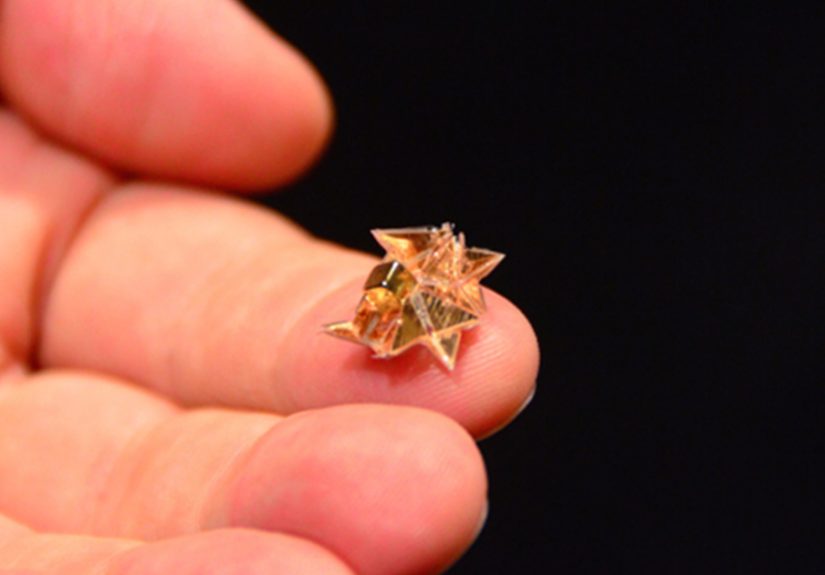
At its core, this robot starts as a flat sheetroughly a 1.7 cm squarethat contains a carefully designed crease pattern. When heated, one layer of the
sheet contracts, forcing the structure to fold itself into a three-dimensional body. The only “hard” component it needs to become a functioning robot is a
small permanent magnet, which ends up acting like the engine when external magnetic fields are applied.
Once folded, the robot becomes an untethered mobile device (no wires, no onboard motors in the usual sense) that can zip around on a tabletop, traverse
rougher surfaces, and even move through shallow water. And when it’s done? Depending on the materials used for the outer layers, the robot’s body can
dissolve in a liquidleaving behind little more than the magnet. In other words: a robot you can “deploy,” “use,” and “erase.”
The Self-Folding Trick: Heat, Smart Layers, and a Crease Pattern with an Attitude
If you’ve ever folded a paper crane, you already understand the vibe: folds are instructions. But instead of you doing the folding, the robot’s sheet uses
material behavior to do it automatically.
Layered materials that behave like a built-in muscle
The self-folding sheet is a sandwich of layers. The middle layer is a heat-sensitive plastic (commonly described as polyvinyl chloride, PVC) that contracts
when warmed. The outer layers provide structure and “tell” the sheet where to bend.
Here’s the clever part: laser-cut slits in the outer layers guide the folding direction. Make one slit wider than the one opposite it, and when the middle
layer contracts, the sheet bends the “right” way. Multiply that idea across dozens of fold lines, and you get a flat pattern that snaps into a functional
3D robot body when heat is applied.
Folding that’s fast enough to feel like a magic trick
In demonstrations, the sheet begins folding at around 150°F (about 65°C). That’s warm enough to activate the material but not “lava hot.” The folding can
start within seconds on a heating element, producing a ready-to-drive robot quicklymore “pop-up tent” than “ship in a bottle.”
This is often described as a “4D printing” mindset: the object isn’t just manufactured; it changes shape over time when exposed to a stimulus (here, heat).
The “time” dimension is the folding itself.
How It Moves: The Magnet Is the Motor (Sort Of)
Once the robot folds, it becomes something like a tiny mechanical creature built around a magnet. But it doesn’t carry a battery and a motor the way
larger robots do. Instead, it “outsources” its energy and control to an external magnetic field generated by electromagnets under the surface.
Walking mode: friction, flexing, and a tiny mechanical hustle
Walking happens because the robot’s body flexes when the magnet is torqued by an applied magnetic field. The robot’s feet and body geometry are designed so
that, during part of the cycle, the front legs grip while the back shifts, and then the roles swapcreating net forward motion.
Think of it like a controlled shimmy: the magnetic field oscillates, the robot flexes, friction does the rest, and forward movement emerges from a
repeating sequence of tiny “stick-slip” steps. It’s physics doing choreography.
Swimming mode: steering a tiny body through water
In water, the robot uses different magnetic control strategiesmore about applying forces (and sometimes gradients) to create directional movement.
Because the folded body can be boat-like, it can float and move across shallow water with surprisingly decent control for something that started life as a
flat plastic square.
Reported speeds land around “nearly four body lengths per second” in some setups. Put that in perspective: if you scaled that to human size, you’d be
sprinting like you just heard the ice cream truck musicfaintlythree blocks away.
What It Can Do: A Tiny Robot with a Big Resume
The headline abilities sound like someone mashed every action verb into a single sentence. But the point of the demo wasn’t just “look, it moves.” It was
“look, it moves and performs tasks you’d actually care about if the robot were inside a tight space.”
Walks across different surfaces
Because its locomotion is baked into its mechanical design, the robot can traverse flat surfaces and handle some rougher terrain, as long as the magnetic
actuation system can deliver the right oscillations and the surface friction sits in the sweet spot (too slippery and it slides; too grippy and it sticks).
Climbs an incline
The ability to climb matters because real environments aren’t billiard tables. Demonstrations show the robot can climb slopesagain relying on careful
control of torque and the relationship between body flex, foot contact, and friction.
Swims (and sometimes floats)
Swimming isn’t just a party trick. If you imagine medical or industrial environmentsfluid-filled spaces, wet pipelines, flooded cavitiesbeing able to
operate in water becomes a big deal. The folded geometry can provide buoyancy, and magnetic control provides direction.
Carries loads (up to about twice its weight)
One of the more eyebrow-raising capabilities is load carrying. The robot itself weighs roughly a third of a gram, yet demonstrations show it can carry
objects about twice its weight. On the tiny scale, that’s like a toy forklift discovering it has a gym membership.
Digs and pushes through materials
“Digging” at this scale often means pushing through small obstaclesthink granular materials or small pilesrather than excavating a trench like a
construction vehicle. Still, the fact that a self-folded, magnet-driven micro-machine can burrow or push through a resistive environment hints at
applications in cluttered or confined spaces.
Dissolves Into Nothing: The “End-of-Life” Feature That Changes the Whole Conversation
The dissolving part is the twist that turns this from “tiny robot demo” into “wait, this could actually matter.” Most robots leave footprintssometimes
literal ones, always logistical ones: retrieval, disposal, contamination, and storage.
Why build a robot that disappears?
Because retrieval can be the hardest part. If your robot is inside a narrow pipe, behind rubble, or (in a future medical vision) inside the human body,
getting it back might be risky, expensive, or impossible. So instead of designing for retrieval, you design for controlled degradation.
How dissolving works (without making this a chemistry lecture)
The robot’s body can be made from materials that dissolve in certain liquids. One prototype uses polystyrene outer layers that dissolve in acetone, while
another approach uses layers that are soluble in water. In the acetone case, the robot’s body can essentially vanish in the liquidleaving behind the
permanent magnet (the one part that doesn’t dissolve in that setup).
This is not the same as “teleportation,” unfortunately. It’s material science: choose structural layers that break down under specific conditions. But it
creates an important design knob: the robot can be temporary by design.
So… What Would You Use It For?
The most attention-grabbing vision is medical: tiny sheets introduced into the body that fold into robots, travel to a target, do a job, and then degrade.
That’s still research territory, but it’s not random science fiction. The logic is practical:
small robots can reach places bulky tools can’t, and if they don’t need a tether, they may be easier to maneuver in tight anatomy.
Medical and clinical inspiration (the “fantastic voyage” that isn’t ridiculous)
Later origami-robot research from related teams explored ingestible devices designed to unfold in the stomach and be steered by external magnetic fields to
retrieve swallowed objects (like button batteries) or deliver a patch to a wound site. The key theme is the same: untethered control + safe materials +
purposeful disappearance once the job is done.
Search, rescue, and inspection
Outside medicine, temporary robots could be useful in places where retrieval is tough:
collapsed structures, narrow voids, messy industrial interiors, or disaster zones where you want cheap, small, disposable scouts that can move and sense.
If a robot can be deployed quickly, do simple tasks, and not become permanent debris, that changes the deployment calculus.
Environmental sensing (and leaving no long-term trash)
A dissolvable robot is also an interesting answer to the “we should put sensors everywhere” dream. Ubiquitous sensors are greatuntil you remember someone
has to pick them up later. A temporary platform that can carry a sensor, collect readings, and then degrade reduces cleanup and potential contamination.
The Tradeoffs: The Robot Isn’t a Wizard, It’s an Engineer’s Compromise
It’s tempting to see a dissolving, self-folding robot and assume we’ve basically solved robotics. We have not. What we have is a brilliant combination of
materials and mechanics that makes certain tasks possibleand makes other tasks tricky.
External magnetic control is powerful, but it’s infrastructure
The robot can be tiny partly because the “muscles” (electromagnets and power supply) live outside it. That’s a feature and a limitation. It means the robot
doesn’t need a battery, but it also means you need a magnetic actuation setup around the workspace.
Precision gets harder in complex environments
Tabletop demos are controlled environments. Real-world environments introduce variable friction, turbulence, obstacles, and unpredictable contact surfaces.
Mini robots can be sensitive to those factors. That’s not a dealbreaker; it’s a reminder that scaling from lab success to practical deployment often
requires more sensing, more robustness, and smarter control.
Dissolving is only “clean” if the materials are chosen responsibly
The whole point of a disappearing robot is to avoid leaving problematic debris. So the material choices matter: in many future use cases, researchers aim
for biocompatible and biodegradable materials, not just “soluble in a convenient lab liquid.” The concept is powerful, but the details determine whether it
becomes a medical tool, an environmental helper, or just an entertaining science video.
How This Fits Into the Bigger Story of Origami Robotics
This mini robot isn’t a one-off oddity. It sits in a growing field where origami-inspired design helps engineers build structures that are compact, quick to
assemble, and mechanically clever.
Origami as engineering, not just art
The same folding principles that turn a flat sheet into a crane can turn flat materials into 3D mechanisms. Research on self-folding machines has shown how
embedded hinges and shape-memory composites can transform a flat template into a functional robot that crawls away after foldinghighlighting how “folding”
can be a manufacturing strategy, not merely a shape change.
Why “printable” and “flat-pack” robots are a big deal
Traditional robots often require complex assembly, precise alignment, and lots of separate parts. Flat-pack fabrication suggests a different future:
laser-cut layers, embedded circuits, and automated folding that can make robots cheaper and faster to build. For scenarios where you need many devices
(or you expect to lose some), that changes the economics.
What’s Next: Smarter, Safer, More Autonomous (and Less Stage Equipment)
If you want to predict the next chapter, watch for three themes:
- Better materials that are biocompatible and truly biodegradable in realistic environments.
- More onboard function (sensing, simple computation, or passive mechanical “logic”) without losing the tiny form factor.
- More practical control so magnetic actuation systems become smaller, more portable, and more adaptable to real spaces.
The long-term dream isn’t “a cute robot that dissolves.” It’s “a deployable tool that can go where other tools can’t, do something useful, and then stop
being your problem.” In robotics, that’s practically a love language.
Takeaway
A mini origami robot that self-folds, walks, swims, digs, carries loads, climbs, and dissolves is more than a viral headline. It’s a demonstration that
mechanical design + smart materials can replace bulky components, and that “end-of-life” can be engineered as intentionally as “power” and
“mobility.”
Whether the future brings ingestible repair bots, disposable search-and-rescue scouts, or temporary environmental sensors, the underlying lesson is the
same: sometimes the most useful robot isn’t the one that lasts foreverit’s the one that shows up, does the job, and leaves gracefully.
Experience Add-On: What It Feels Like to Watch a Robot Live a Whole “Life Cycle”
Even if you’ve seen the videos, the experience of mentally walking through the robot’s “birth-to-disappearance” story is where the idea really
lands. It’s not just the movementit’s the fact that the movement is the middle act of a three-part performance: flat sheet, functional creature, gone.
The first moment is the weirdest: the robot doesn’t look like a robot at all. It looks like a tiny craft project you’d lose on a cluttered deskflat,
square, and suspiciously harmless. Then it meets heat, and you get that split-second of disbelief where your brain tries to categorize what’s happening.
Is it warping? Curling? Failing? And thennoit’s folding on purpose. The creases happen where they’re supposed to happen. The body pops into a shape that
suddenly has “front” and “back,” and you realize you’re watching a manufacturing step and an animation at the same time.
The second moment is when it starts moving. There’s something almost comedic about how fast “this is a science experiment” becomes “why is it scuttling like
it has somewhere to be?” Because it’s so small, the motion reads as livelytiny steps, quick turns, a little burst forward. You can practically imagine it
wearing a hard hat. When it carries something, the effect is even stronger. On a human scale, it’s like watching a moving company where the entire crew is
one determined beetle made of plastic and ambition.
The swimming is the moment people usually lean in. Water adds drama: reflections, ripples, and the sense that the robot is operating in a different physics
regime. The fact that it can be steered makes it feel less like a wind-up toy and more like a controlled tool. You start thinking about tight spaces:
flooded pipes, slick surfaces, and the kinds of environments where wheels and legs don’t automatically win.
But the most memorable partthe part that sticksis the ending. Engineers don’t usually get an “exit scene” for hardware. Most machines end their lives
slowly: a cracked gear, a dead battery, a retirement into a drawer. This one ends with intention. The dissolving concept flips your expectations. Instead of
“how do we make it tougher,” you start asking “how do we make it temporary in exactly the right way?” That’s a different kind of design mindset.
And it sparks a surprisingly practical emotional response: relief. If you’ve ever dealt with a broken gadget, you know the feeling of owning a problem you
didn’t mean to adopt. A disappearing robot suggests a tool that doesn’t overstay its welcome. It makes you picture future kits where deploying a robot is
normallike using a test strip, a disposable sensor, or a single-use medical deviceexcept this disposable thing can move, carry, and act.
That’s the real “experience” of this topic: watching a robot do tricks is fun, but watching a robot be designed for a whole lifecycle is what makes
you realize you’re not just seeing a novelty. You’re seeing a different philosophy of roboticsone that treats assembly, mobility, and disappearance as one
continuous story.