Table of Contents >> Show >> Hide
- Why This Tiny Fridge Became a Big Deal
- First Rule: Read the Chip Quik Label Before You Buy Anything
- What a Peltier Mini-Fridge Actually Is
- So, Can a Peltier Mini-Fridge Preserve Chip Quik?
- Why It Also Preserves a Marriage
- How to Make the Setup Actually Work
- Mistakes That Ruin Paste and Mood
- Conclusion
- Extended Experience: The Tiny Fridge That Ended the Yogurt Negotiations
- SEO Tags
There are few domestic moments more awkward than opening the family refrigerator and finding butter, berries, and a suspicious little syringe of solder paste sharing shelf space like they all went to high school together. That is how many electronics hobbyists discover a truth that should probably be embroidered on a workshop pillow: just because something can live in the kitchen fridge does not mean it should. Enter the Peltier mini-fridge, the tiny thermoelectric box that promises quiet cooling, workshop convenience, and perhaps most importantly, fewer conversations that begin with, “Why is there flux next to the yogurt?”
This article is about more than gadget lust. It is about storing Chip Quik products correctly, understanding what a thermoelectric mini-fridge can actually do, and figuring out whether a small dedicated cooler is a clever shop upgrade or just a glowing cube of false hope. The short version is this: a Peltier mini-fridge can absolutely help preserve certain Chip Quik products, but only if you understand the product label, the room temperature, and the limits of thermoelectric cooling. Done right, it preserves solder paste. Done even more right, it preserves household peace.
Why This Tiny Fridge Became a Big Deal
Electronics people love tools, but the real luxury item is not a new iron or microscope. It is friction reduction. A dedicated mini-fridge in the workshop reduces friction in at least three ways. First, it keeps temperature-sensitive materials close to the bench instead of lost behind salsa jars in the kitchen. Second, it creates a place for organized storage, date labels, and a proper thermometer. Third, it stops innocent family members from discovering that “Chip Quik” is not, in fact, a new brand of hummus.
That last point is funnier than it is trivial. Shop materials tend to spread. One syringe becomes three. A jar of paste turns into extra flux, spare tips, thermal tape, and a mystery bag of components that nobody remembers buying. A dedicated cooling space draws a hard line between household food storage and workshop consumables. Even if no one in your home ever says a word, the relief is visible. The fridge shelves look less like a confused science fair, and your electronics supplies stop living a double life between pickles and leftovers.
First Rule: Read the Chip Quik Label Before You Buy Anything
Not every Chip Quik product wants the same storage conditions
This is where many hobbyists go slightly off the rails. They hear “solder paste likes refrigeration” and convert that into “everything from the solder aisle belongs in the cold.” Not so fast. Some common Chip Quik solder pastes are designed to be refrigerated, while some fluxes can be stored refrigerated or at room temperature, and some thermally stable solder pastes are made specifically for room-temperature storage. In other words, your storage strategy should follow the data sheet, not your workshop superstition.
For many standard Chip Quik solder pastes, the target storage range is refrigerator territory. That makes cold storage practical and often beneficial for shelf life and consistency. But some Chip Quik liquid flux products are comfortable in a wider range and do not demand a dedicated cold box. Meanwhile, some thermally stable pastes are happiest at normal room temperature. So before you crown your mini-fridge the hero of your bench, make sure your specific material actually wants to be there.
Cold storage is about consistency, not drama
The point of refrigeration is not to make solder paste feel fancy. It is to help maintain workable properties over time. Across the solder industry, manufacturers regularly recommend refrigeration for paste because it helps preserve viscosity, performance, and shelf life. That does not mean all paste becomes useless the moment it spends a few hours out of the fridge. It means consistent storage gives you a better chance of predictable printing, dispensing, and reflow behavior. And predictable behavior, as anyone who has reworked a board at midnight knows, is worth its weight in gold-plated headers.
There is also an important practical detail: cold paste should be allowed to warm to room temperature before opening and use. That warm-up step is boring, but skipping it is a great way to invite condensation and a cranky process. In other words, the mini-fridge is not a teleportation device from storage to stencil. It is one step in a careful routine.
What a Peltier Mini-Fridge Actually Is
The technology sounds futuristic because it kind of is
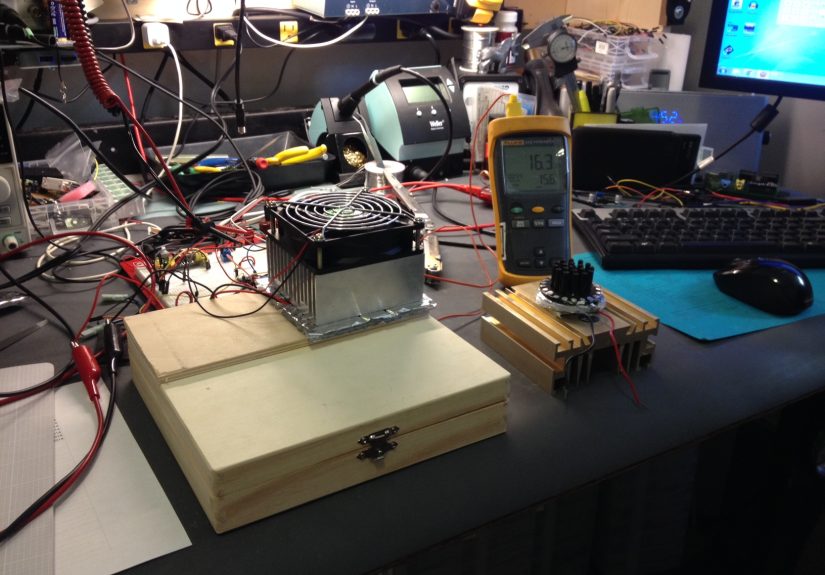
A Peltier mini-fridge uses thermoelectric cooling rather than a compressor. Instead of pumping refrigerant, it uses a solid-state module that moves heat from one side to the other when current passes through it. One side gets cold. The other side gets hot. That means the system can be compact, quiet, and mechanically simple. For a workshop, those are attractive qualities. Nobody dreams of a bench accessory that growls like a tired hotel air conditioner.
Thermoelectric cooling also works well in small spaces, which is exactly why little desktop coolers exist in the first place. If your goal is storing one or two syringes of paste, a jar of flux, and maybe a small bag of temperature-sensitive odds and ends, the size is a feature, not a flaw. You do not need a full-size refrigerator to chill something roughly the size of a fat marker.
But a Peltier cooler is not a tiny miracle compressor
This is the catch, and it is a big one. Thermoelectric coolers are highly dependent on ambient temperature. They do not bully the room into submission the way compressor refrigerators do. They work by creating a temperature difference, so if the room gets hotter, the cold side usually gets less impressive. That is why the same mini-fridge that behaves reasonably well in an air-conditioned office can become a decorative disappointment in a garage during summer.
That limitation matters because many people assume a mini-fridge with a digital display is automatically delivering “real refrigerator” performance. Not always. Some thermoelectric coolers tested by consumer reviewers failed to stay below 40 degrees Fahrenheit, which is the standard benchmark for safe food refrigeration. For electronics materials, the exact requirement depends on the product label, but the broader lesson is the same: never assume. Measure.
So, Can a Peltier Mini-Fridge Preserve Chip Quik?
Yes, it can. But “can” is not the same as “guaranteed,” and that distinction is where many workshop romances go to die.
If your specific Chip Quik paste wants storage in the high-30s to mid-40s Fahrenheit, a good Peltier mini-fridge may be perfectly adequate if all of the following are true: the room is not excessively hot, the unit has decent airflow around the hot side, the door is not being opened every twelve minutes, the contents are modest, and you use an internal thermometer to verify the actual temperature. In that scenario, the mini-fridge is doing honest work. It is not pretending to be a laboratory instrument. It is simply maintaining a controlled little environment for a small volume of workshop materials.
Where things go sideways is when users buy the cutest possible mini-fridge, place it in a hot room, stuff it full, trust the front panel blindly, and assume their paste is living the good life. If the unit drifts warm, your carefully stored materials may not actually be stored according to spec. That is why the thermometer matters more than the marketing copy. The mini-fridge does not get points for having mood lighting.
There is another subtle advantage to a dedicated cold box: organization. Once you have a specific place for paste and flux, it becomes much easier to label open dates, rotate old stock first, and avoid buying duplicates because you forgot what was hiding in the back of the main refrigerator. This matters because shelf-life-dependent items are rarely ruined by one dramatic event. More often, they die a slow death from casual neglect, poor tracking, and the famous household storage method known as “somewhere in there, probably.”
Why It Also Preserves a Marriage
The word “marriage” in the title is a joke, but it is also not entirely a joke. Shared spaces create shared tensions, and the family refrigerator is sacred territory. Food belongs there. Drinks belong there. Condiments of uncertain age definitely belong there, apparently forever. A syringe of solder paste? That is where opinions begin to form.
A Peltier mini-fridge solves a domestic problem with delightful efficiency. It removes workshop materials from the kitchen. It prevents those moments when someone reaches for cheese and instead learns more than they ever wanted to know about no-clean flux. It makes it easier to say, with complete confidence, “No, the electronics stuff is not in the food fridge.” That sentence has saved many hobbyists from having to explain themselves with the intensity of a courtroom witness.
Dedicated storage also reduces mental clutter. When supplies have a home, nobody has to renegotiate boundaries every week. The bench stays the bench. The kitchen stays the kitchen. That separation is healthy for relationships, roommates, and anyone who prefers their snacks not to feel like they were curated by a repair lab.
How to Make the Setup Actually Work
Use a thermometer, not optimism
The number one upgrade is laughably cheap: put an appliance thermometer inside the mini-fridge. Do not rely only on the dial, the blue light, or your spiritual sense that the interior feels “pretty chilly.” If your product requires a storage range, verify that range. This one habit separates a useful setup from a decorative one.
Keep the fridge in a cool room
A thermoelectric mini-fridge placed in an air-conditioned office, hobby room, or basement has a fighting chance. The same unit placed in a blazing garage in August is entering the ring with one oven mitt tied behind its back. Ambient temperature affects performance, so location matters more than many buyers realize.
Give the hot side room to breathe
Peltier systems move heat; they do not erase it. That heat must go somewhere. If the back or sides of the fridge are pressed against a wall, buried in clutter, or wrapped in the workshop equivalent of a hug, performance suffers. Leave ventilation space so the unit can dump heat efficiently.
Store only what belongs there
Keep the contents focused. Solder paste, appropriate fluxes, and clearly labeled shop materials are reasonable candidates. A random collection of snacks, batteries, mystery adhesives, and one energy drink from last month is not a storage system. It is a cry for help. The more disciplined the contents, the easier it is to monitor temperature and manage shelf life.
Warm materials properly before use
Once you remove refrigerated paste or flux, let it come to operating temperature before opening or using it, according to the product instructions. This is not glamorous advice, but it is one of those small habits that separates “Why does this process feel inconsistent?” from “Oh, right, I did the boring part correctly.”
Label dates like a responsible adult with a soldering iron
Write the purchase date, open date, and any manufacturer expiration information on the package. Use older material first. This first-in, first-out approach sounds like warehouse manager behavior, but it is exactly what prevents waste. It also reduces the temptation to perform the classic hobbyist test of holding a mystery syringe to the light and whispering, “I think it still looks okay.”
Mistakes That Ruin Paste and Mood
- Buying a mini-fridge without checking whether your specific Chip Quik product even needs refrigeration.
- Putting the unit in a hot garage and expecting office performance.
- Trusting the control panel without using an internal thermometer.
- Skipping warm-up time and opening cold material immediately.
- Overstuffing the fridge so air cannot circulate well.
- Using the same fridge for food and workshop supplies, then acting surprised when someone objects.
- Ignoring labels and shelf-life dates because “it was expensive, so it must still be fine.”
One more thing deserves mention: some solder pastes contain lead or other materials that should be handled with care. That is another excellent reason to keep workshop consumables sealed, labeled, and out of shared food spaces. Good storage is not just about chemistry. It is about common sense.
Conclusion
A Peltier mini-fridge is not a universal answer, but it can be a smart and charmingly civilized one. If your Chip Quik product calls for refrigeration, if your room is reasonably cool, and if you verify the actual temperature with a thermometer, a thermoelectric mini-fridge can absolutely serve as a practical storage solution. It keeps solder materials close to the bench, helps preserve shelf-life-sensitive products, and prevents the kitchen refrigerator from becoming an accidental extension of your workshop.
And that is where the title earns its grin. The little fridge is not just preserving Chip Quik. It is preserving boundaries, reducing clutter, and quietly preventing the sort of domestic debates that start with electronics and end with somebody reorganizing the entire refrigerator out of principle. In a world full of overpriced gadgets with questionable value, that is honestly a pretty heroic little box.
Extended Experience: The Tiny Fridge That Ended the Yogurt Negotiations
The funniest part about owning a Peltier mini-fridge is that it rarely begins as a grand engineering decision. It usually begins with embarrassment. In one very familiar household scenario, a hobbyist buys a syringe of Chip Quik paste, reads that it should be refrigerated, and does the logical thing: puts it in the kitchen fridge. At first, this feels efficient. The syringe sits in the back behind a carton of eggs, looking almost respectable. Then one evening someone goes hunting for a snack, sees a labeled tube that sounds vaguely edible, and suddenly the entire household is holding a summit on why electronics supplies are socializing with dairy products.
That was the turning point. The dedicated mini-fridge arrived not as a toy, but as a peace treaty with a power cord. It sat on a side table in the workshop humming so quietly it was almost smug. A thermometer went inside. The solder paste went in next. Then came the small luxuries nobody expects: the bench felt more organized, the kitchen felt less invaded, and there was no longer a need to explain that no, the weird syringe next to the jam was not part of a new recipe trend.
Over time, the fridge changed behavior as much as storage. Materials were finally labeled. Open dates were written down. Duplicate purchases dropped because supplies were not scattered like breadcrumbs across the house. It became obvious that the value of the mini-fridge was not just cooling; it was discipline. The tiny box encouraged the kind of habits people swear they will start “eventually,” usually right after finishing three more projects and misplacing two more tools.
There were lessons, of course. In a cool room, the setup worked beautifully. In warmer weather, the thermometer became the boss of the whole arrangement. Some days the fridge held the desired range nicely. Other days it reminded everyone that thermoelectric cooling has limits and that ambient temperature is not a suggestion. That experience turned out to be valuable rather than disappointing, because it replaced wishful thinking with real monitoring. The mini-fridge was no longer judged by how futuristic it looked. It was judged by what the thermometer said, which is how all grown-up workshop decisions should be made.
The domestic improvement was the sneaky bonus. Nobody had to navigate around shop supplies in the main refrigerator. Nobody had to wonder whether a food container was actually food. Nobody had to pretend they were completely comfortable with a tube labeled like a chemistry exam sitting next to the strawberries. The kitchen became normal again. The workshop became more self-contained. The relationship between the electronics enthusiast and everyone else in the home improved by one tiny, glowing appliance and several fewer conversations that began with the phrase, “Can you please explain this?”
That is why the joke works. A Peltier mini-fridge really can preserve Chip Quik, but the bigger win is that it preserves order. It creates a clean boundary between making things and eating things. It reduces clutter, waste, and weirdness. It lets hobbyists feel slightly more professional and lets everyone else keep their sandwich ingredients free from accidental encounters with solder supplies. For such a small appliance, that is a surprisingly elegant accomplishment. Sometimes the best workshop upgrade is not the one that makes your projects faster. It is the one that makes your whole house a little less ridiculous.