Table of Contents >> Show >> Hide
- Why This Headline Works (Even If Your Roomba Can’t Bench-Press a Sofa)
- How a Roomba Actually “Finds” Anything
- From Predator Vision to PrecisionVision
- What Would “Hunting” Even Mean for a Robot Vacuum?
- The Real Superpower: Knowing Your Home
- Robot Vacuum Privacy: The Not-So-Funny Part of the Joke
- The Business Plot Twist: When the Roomba Maker Became the Headline
- Smart Home Integration: Your Roomba’s Social Life
- So… Should You Be Worried About a Roomba “Hunting” You?
- Experiences: Life With a “Hunting” Roomba (500+ Words of Realistic, Relatable Chaos)
- Conclusion: The Roomba Isn’t a TerminatorIt’s a Mirror
If you read the headline “Roomba Now Able To Hunt Arnold Schwarzenegger” and immediately pictured a hockey-puck vacuum
rolling down a hallway whispering, “I’ll be back… for that dust bunny,” you’re in the right place.
The joke lands because robot vacuums already feel a little too alive: they map our homes, dodge our messes, and
occasionally nudge a toe like they’re asking for tips.
But can a Roomba actually “hunt” anyonemuch less a cinematic symbol of unstoppable machines?
Not in the action-movie sense. Still, the headline is a sneaky gateway into something genuinely interesting:
how modern robot vacuums see, navigate, learn, anddepending on your settingscollect data about the most private
museum you own: your living room.
Why This Headline Works (Even If Your Roomba Can’t Bench-Press a Sofa)
The phrase “hunt Arnold Schwarzenegger” presses two big cultural buttons at once:
(1) we’ve been trained by decades of sci-fi to assume every robot is one firmware update away from becoming dramatic,
and (2) Arnold’s film legacy is basically a public service announcement about what happens when machines get ideas.
Your Roomba, however, mostly gets one idea: “That corner looks suspiciously like crumbs.”
Still, the best satire has a kernel of truth. A Roomba doesn’t need laser eyes to feel like it’s pursuing you.
If it starts a scheduled clean the moment you sit down, it can appear to be tracking your emotional weak spots.
(The human brain is excellent at pattern recognition, especially when the pattern is “I am being judged by a disc.”)
How a Roomba Actually “Finds” Anything
Robot vacuums don’t wander aimlessly anymoreat least, not the good ones. Today’s machines blend sensors, mapping,
and route planning so they can clean in neat rows, return to their dock, and remember where they’ve been.
Under the hood, there are a few core pieces that make them seem intelligent:
1) Sensors: The Roomba’s Basic Survival Instincts
- Bump and wall sensors help it understand boundaries and follow edges.
- Cliff sensors help it avoid stairsbecause gravity is undefeated.
- Gyros and wheel sensors help estimate movement and orientation.
These sensors are why even older models can roam a room without instantly falling into a dramatic spiral staircase
situation. It’s not “hunting,” but it is autonomous enough to make you mutter, “How did you end up under there?”
2) Mapping: From “Random Bounce” to “I Know Where Your Kitchen Is”
Roomba’s evolution mirrors the evolution of consumer robotics itself: early models were “bump-and-roll” cleaners
that eventually covered a space by brute persistence. Newer models use mapping to clean efficiently and let you
target specific rooms. If that sounds like a small upgrade, try living with one for a week and you’ll realize
mapping is the difference between “robot pet” and “robot coworker.”
Some Roombas use camera-based navigation (often discussed as visual SLAM, where the robot uses visual features
to localize itself and build a map). Othersespecially newer industry competitors and, more recently, iRobot’s
refreshed lineupuse lidar, which measures distance to build maps with laser scanning.
The result is the same user experience: a robot that seems to understand your floor plan as if it pays rent.
3) Planning: The Part That Feels Like “Pursuit”
Once the robot has a map, it can plan routes: clean high-traffic rooms first, avoid no-go zones, and estimate
how long a job might take. In iRobot’s ecosystem, this is often framed as a broader “OS” layer that coordinates
behaviorwhere, when, and how cleaning happens. When it works well, you stop thinking about cleaning entirely.
When it works badly, you start thinking about moving to a studio apartment with one chair and a single plate.
From Predator Vision to PrecisionVision
The “hunt Arnold” joke gets extra punch because it riffs on a real, very nerdy phenomenon:
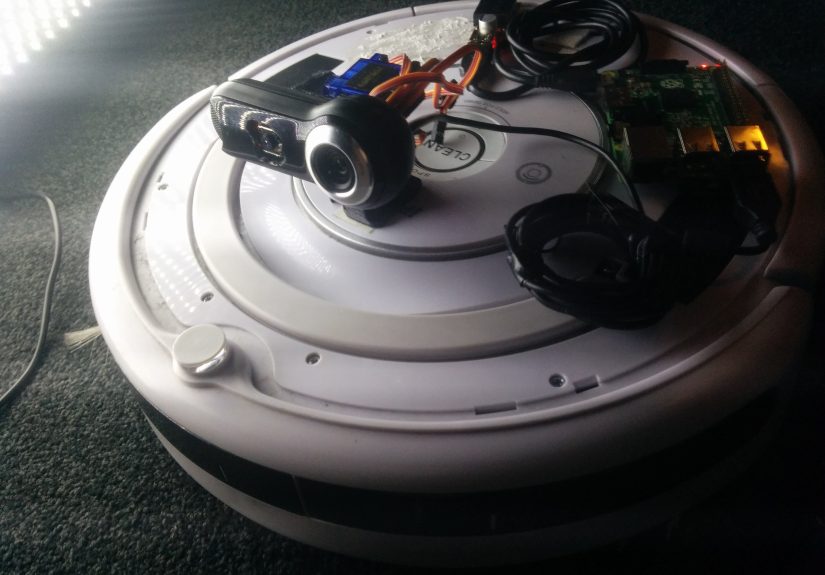
people love turning Roombas into platforms for experiments. One famous example involved building a Roomba with
“heat vision” using an infrared camera, plus a Raspberry Pi for wireless connectivity and motor control, along
with a webcam for streamingessentially transforming a vacuum into a rolling robotics testbed.
The vibe wasn’t “housekeeping,” it was “low-budget Predator reboot (starring dust).”
Meanwhile, mainstream Roombas have been moving toward their own kind of “vision,” just without the movie trailer.
iRobot’s newer models promote camera-based object recognitionused to identify and avoid obstacles like cords,
shoes, and (famously) pet waste. In other words, the consumer version of “I see you” is:
“I see your sock, and I’m choosing peace.”
What Would “Hunting” Even Mean for a Robot Vacuum?
In action movies, “hunting” implies intent, target identification, tracking, and pursuit. For a robot vacuum,
the closest real-world equivalents would be:
- Target identification: recognizing a specific person or object using a camera or other sensors.
- Tracking: following that target across rooms while maintaining localization.
- Path planning: continuously adjusting route to intercept or follow the target.
- Persistence: keeping the “mission” across time, not just one cleaning run.
Most consumer robot vacuums do not do person-specific tracking in a “follow that human” way.
They are designed to avoid you, not pursue you. If anything, the safest Roomba is a polite one:
it navigates around your feet and refuses to weaponize your living room clutter against you.
So Why Does It Sometimes Feel Like It’s Following You?
Three reasons:
(1) Scheduling coincidenceyou notice it most when it interrupts you;
(2) high-traffic prioritizationit cleans where humans are messy (rude but accurate);
and (3) your brainwe anthropomorphize anything that moves with purpose,
especially if we’ve given it a name like “Sir Sucks-a-Lot.”
The Real Superpower: Knowing Your Home
The most valuable “intelligence” a robot vacuum has isn’t suction or speedit’s context.
A good robovac knows:
where the rug begins, where the kitchen ends, where the chair legs form a tiny metal forest, and where it usually
finds crumbs (the couch, always the couch).
That context is why home mapping became such a big dealand also why privacy questions followed.
A map of your home can be surprisingly sensitive. It can suggest room layout, patterns of use, and daily routines.
And as robot vacuums gained cameras for obstacle avoidance, people naturally asked: what does the robot “see,” and
where does that information go?
Robot Vacuum Privacy: The Not-So-Funny Part of the Joke
Let’s keep this practical. Many robovacs collect some combination of mapping data, usage data, and app/account data.
Some models can capture images for obstacle recognition features, and companies may offer options to share certain
data (or not) through app settings.
iRobot, for example, describes user controls that can limit data transmissionsuch as choosing not to transmit map data
and, for some features, choosing whether to share obstacle images. Their privacy policy also notes that some devices
can be used without Wi-Fi or Bluetooth data transmission by not connecting (or disconnecting) connectivitythough
that may limit app-based features.
A Real-World Cautionary Tale: Test Units and Leaked Images
The robovac privacy conversation intensified after reporting that sensitive images captured by certain Roomba test units
(not typical consumer retail units) ended up leaked online. The headline value was obvious, but the broader takeaway
was more important: whenever cameras and cloud workflows enter the picture, so do risksespecially in beta or data
labeling pipelines.
Consumer advocates and product testers have advised shoppers to treat robot vacuums like any other connected device:
review privacy settings, understand what data is shared, and decide whether convenience is worth the trade-off.
The Business Plot Twist: When the Roomba Maker Became the Headline
For a while, it looked like iRobot might become part of Amazonan acquisition that sparked debate about competition
and the value of home-mapping data. But regulators pushed back, and the companies ultimately terminated the deal,
citing a lack of path to approval in the European Union.
More recently, iRobot’s own story got even more dramatic. Reports described iRobot filing for Chapter 11 bankruptcy
protection as part of a restructuring plan, with an acquisition by its primary contract manufacturer (Picea) through
a court-supervised process. iRobot said it expected to keep operations and customer support running during the process.
If you want irony, here it is: the company that popularized home robots became a case study in how brutally competitive
the home-robot market has become.
Smart Home Integration: Your Roomba’s Social Life
If a Roomba can’t hunt Arnold, it can at least take voice commands.
Modern robot vacuums commonly integrate with voice assistants and can be triggered by routines:
“clean the kitchen after breakfast” is the most wholesome form of automation.
There’s also a bigger compatibility trend: standards like Matter aim to make smart-home devices work together more
smoothly across ecosystems. iRobot has signaled Matter support in newer products, whichat least in theoryreduces
the “my vacuum only talks to my toaster on alternate Tuesdays” problem.
So… Should You Be Worried About a Roomba “Hunting” You?
In a word: no. In two words: absolutely not.
A robot vacuum is a specialized appliance with a narrow mission: floor cleaning. It does not have the autonomy,
power, or design intent to be a roaming action villain. Your biggest risks are far more ordinary:
it might get stuck, it might smear something unpleasant, or it might reveal that your “I’ll pick that up later”
strategy is not a strategy.
The more realistic conversation is about data and trust. As robot vacuums become smarterespecially with cameras and
detailed home mapsprivacy and security choices matter more. The good news is: many companies now offer clearer
settings and disclosures than they did a decade ago. The better news is: your Roomba is still more likely to
“hunt” a stray Cheerio than a former governor of California.
Experiences: Life With a “Hunting” Roomba (500+ Words of Realistic, Relatable Chaos)
The funniest part of robot vacuums is that they don’t need sci-fi features to create sci-fi moments. Plenty of owners
have stories that sound like a machine uprisinguntil you realize the “uprising” was a robot politely bumping the same
chair leg for nine minutes because it believes persistence is a personality.
One common experience is the “midnight patrol.” Even if you schedule your Roomba for daytime, someone eventually
triggers it at the wrong timemaybe you hit “clean” while half-asleep, maybe a routine runs early, maybe your smart
home decided to be “helpful.” A quiet house plus a little motor whir can feel like suspense music. People describe
stepping into the hallway and catching a glimpse of the robot’s silhouette, like a tiny UFO searching for evidence of
snack activity. It’s not hunting you; it’s hunting the crumbs you promised yourself you didn’t eat.
Then there’s the obstacle dramaan entire genre. Socks. Charging cords. Shoelaces. A single LEGO piece that becomes a
wheel-chocking villain. The best obstacle-avoidance models can recognize and dodge a lot of clutter, which is
genuinely impressive. But owners still talk about that one day the robot decides a phone cable looks like a delicious
spaghetti noodle and tries to redecorate the living room. In those moments, “Roomba hunting Arnold” feels less like a
joke and more like a documentary called Machines: Doing Their Best.
Pet households create their own folklore. Some people swear their dog thinks the Roomba is a rival.
Others report cats treating it like a moving throne, riding it with the calm confidence of tiny royalty.
And yes, there’s the infamous pet-waste scenarioso notorious that it became a selling point for advanced vision and
avoidance. Many owners don’t even want to say the story out loud, as if speaking it might summon the mess.
The “P.O.O.P. Promise” and similar features exist because people lived the nightmare once and collectively said,
“Never again.”
Another relatable experience: learning what your home actually looks like to a robot. A Roomba will expose your
floor’s secret personalitiesrugs with tassels that behave like trapdoors, thresholds that are one millimeter too
tall, chairs that form an obstacle maze, and low-clearance furniture that turns the robot into a stubborn little
explorer wedged under a couch like it’s searching for Atlantis. Owners often end up making tiny, practical changes:
lifting a curtain hem, moving a lightweight stool, or setting a no-go zone around that one spot where the robot always
gets ambitious.
And finally: the emotional experience of naming the thing. The moment you name it, it becomes a character.
It’s no longer “the vacuum”it’s “Broom Willis,” “Dusty Springfield,” or “Termi-Nator.” You start talking to it like a
roommate: “Buddy, not that corner again.” You may even thank it when the floors look goodproof that humanity will
anthropomorphize literally anything with wheels and a schedule. In that sense, the Roomba doesn’t need to hunt Arnold.
It already hunted something bigger: your dignity, right in front of your guests.
Conclusion: The Roomba Isn’t a TerminatorIt’s a Mirror
“Roomba Now Able To Hunt Arnold Schwarzenegger” is funny because it flips a mundane appliance into an action hero.
The reality is more interesting: robot vacuums are becoming sophisticated home robots, using mapping, sensors, and
(in some cases) camera-based object recognition to clean more intelligently and get stuck less.
The tech is real. The convenience is real. And the privacy conversation is real, toobecause the smarter a device is
about your home, the more important it is to understand what it knows and what it shares.
If your Roomba ever feels like it’s hunting you, relax: it’s probably just cleaning the room you’re sitting in,
because that’s where the snacks happen.