Table of Contents >> Show >> Hide
- What Was Luna-25 Trying to Do?
- Quick Timeline: From Launch to Loss
- The Critical Moment: The Orbit-Lowering Burn That Went Wrong
- So Why Didn’t the Engine Shut Off When It Was Supposed To?
- What NASA Saw After the Crash: A New Crater
- Why the Lunar South Pole Is So Hard (Even When Nothing Goes Wrong)
- Was This a Rare Fluke or a Common Type of Failure?
- How the Crash Fit Into the 2023 “Moon Rush”
- What Happens After a Spacecraft Crashes?
- What’s Next for Russia’s Lunar Program?
- Key Takeaways: The Plain-English Answer to “What Happened?”
- Experience: When a Moon Mission Goes Quiet (and What You Learn From It)
- SEO Tags
Luna-25 was supposed to be Russia’s big lunar comeback: a robotic lander headed for the Moon’s south polar region to sniff around for science goodies like
water ice and to prove Russia could still “stick the landing” after decades away from the lunar surface. Instead, the mission ended the way no one puts in
the press kit: with a high-speed meeting between spacecraft and Moon.
If you’re wondering how a probe can go from “in orbit” to “sudden new crater,” you’re in the right place. Let’s walk through what Luna-25 was trying to do,
what went wrong during the most delicate part of the plan, and why this kind of failure is both painfully common and genuinely informative in spaceflight.
(The Moon is not a forgiving place. It doesn’t do second chances. It barely does first chances.)
What Was Luna-25 Trying to Do?
Luna-25 was designed as a robotic lander aimed at the Moon’s south polar areaone of the hottest destinations in modern space exploration.
Not because it has beaches (it absolutely does not), but because permanently shadowed craters near the poles may hold water ice locked into the soil.
Water matters because it’s science gold and future exploration fuel: it can potentially be turned into drinking water, breathable oxygen,
and even rocket propellant components.
The plan was straightforward on paper and brutal in reality:
- Launch from Earth and cruise to the Moon.
- Enter lunar orbit and spend days adjusting that orbit to the right shape and altitude.
- Drop into a pre-landing orbita lower, more “landing-friendly” path.
- Begin descent, slow down at exactly the right times, and touch down gently enough to survive.
Luna-25 made it through the earlier steps. The trouble arrived right when the mission was transitioning into the “no-room-for-drama” phase.
Unfortunately, space loves drama.
Quick Timeline: From Launch to Loss
1) Launch and lunar orbit insertion
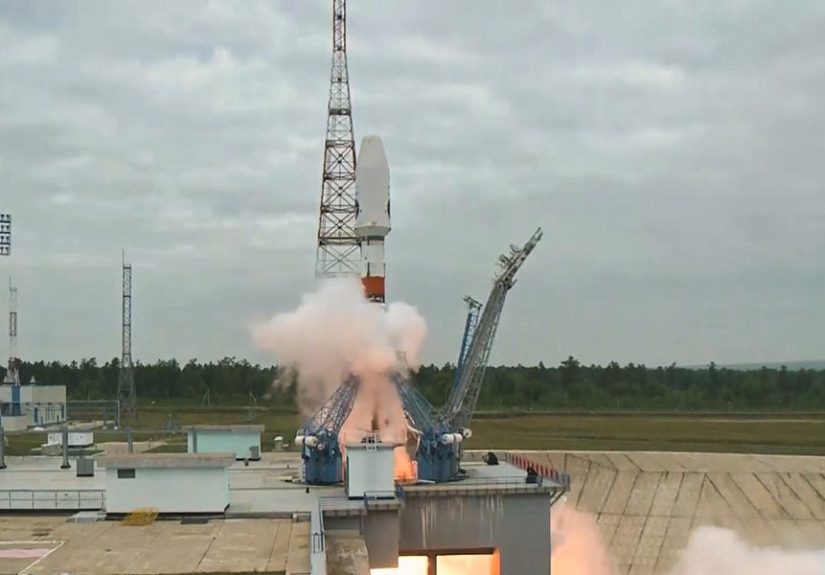
Luna-25 launched in August 2023 and successfully reached lunar orbit a few days later. Getting into orbit is a major milestone: it means your navigation,
propulsion, communications, and power systems all worked long enough to arrive at the target and slow down properly.
2) Preparations for landing
After orbit insertion, the spacecraft needed a series of maneuvers to set up landing. Think of it like arriving at an airport: you don’t just show up in the
sky and drop straight onto the runway. You get sequenced into a pattern at the right altitude, speed, and direction. A lunar lander does something similar,
but without air traffic control, without air, and with gravity that’s eager to turn a small mistake into a crater.
3) The “abnormal situation”
On August 19, Roscosmos reported an abnormal situation during a maneuver intended to shift Luna-25 into a pre-landing orbit. Soon after, contact was lost.
Later, Roscosmos confirmed the spacecraft had crashed into the lunar surface.
The Critical Moment: The Orbit-Lowering Burn That Went Wrong
The key failure happened during a thruster burn meant to lower and reshape Luna-25’s orbit in preparation for landing. This maneuver is a big deal because it’s
the bridge between “stable orbit” and “committed to landing.”
Here’s the basic idea: a spacecraft in lunar orbit is moving fastthousands of miles per hour. To land, it has to very carefully reduce its energy and
lower its orbit so that it can start a controlled descent over the intended landing zone. That means firing the engine for a precise duration to change the craft’s
velocity by a specific amount.
In Luna-25’s case, the engine burn ran longer than planned. That extra push changed the orbit too much. Instead of ending up in a safe elliptical pre-landing orbit,
the spacecraft shifted onto a path that intersected the Moon.
In everyday terms: it didn’t “miss the stop” by a block. It blew past the stop, took the off-ramp at highway speed, and discovered that the Moon does not have guardrails.
So Why Didn’t the Engine Shut Off When It Was Supposed To?
Early explanations focused on the immediate symptom: the thrusters fired longer than intended. Later, a more detailed cause emergedone that sounds nerdy, but is exactly
the kind of “tiny-but-deadly” problem that haunts spacecraft.
The short version
The onboard control system did not receive the motion data it needed (from an accelerometer system) to determine when the spacecraft had achieved the required velocity
change. Without that feedback, the engine did not shut down at the correct time and instead stopped based on a timed settingtoo late to avoid disaster.
The slightly longer (but still human) version
Spacecraft burns aren’t just “turn engine on, count to 84, turn engine off.” They are often controlled by a mix of timing and sensor feedback.
Accelerometers and related navigation sensors help the spacecraft measure how its velocity is changing during the burn. When the spacecraft hits the target parameters,
the control system can command shutdown.
Roscosmos later described a scenario where the accelerometer unit wasn’t turned on as expected due to a command-handling issueessentially a conflict in command priorities.
The result: the control system didn’t get the signals it needed to recognize “we’ve reached the right speed change,” so the burn ended the wrong way, at the wrong time.
This is a classic spaceflight heartbreak: hardware and software can each be “fine” in isolation, but the interface between themtiming, sequencing, priority rules,
and redundancy logiccan be where missions live or die.
What NASA Saw After the Crash: A New Crater
Once Luna-25 was presumed lost, the obvious question became: Where did it hit? Enter NASA’s Lunar Reconnaissance Orbiter (LRO), which has been mapping the Moon
in high detail for years.
Using location estimates released after the incident, the LRO Camera team targeted the suspected area and compared “before” and “after” images. The result: a fresh crater
that wasn’t there in earlier imagery.
NASA reported the crater was roughly 10 meters (about 33 feet) wide and located on the inner rim of Pontécoulant G crater, on steep terrain. In other words, Luna-25 didn’t just
crashit hit in a place that would have been a nightmare to land on even on a good day.
Why the Lunar South Pole Is So Hard (Even When Nothing Goes Wrong)
Landing on the Moon is difficult in general. Landing near the south pole is “difficult” with extra bold formatting.
Lighting is weird
Near the poles, the Sun sits low on the horizon. Shadows can stretch dramatically, which makes terrain look deceptively flat or dangerously jagged.
Navigation cameras can struggle when everything is either washed out or pitch-black.
Terrain is unforgiving
Polar regions include cratered, sloped landscapes with boulders and sharp variations in elevation. A lander needs excellent hazard detection and the ability to divert during descent.
If your mission can’t “see” hazards or can’t steer away quickly, the surface will teach you a lesson at impact speed.
Navigation margins are thin
By the time a lander begins serious descent operations, the margin for error is tiny. A small extra velocity change, a misread sensor, or a software edge case can push a spacecraft
into an unrecoverable trajectory. Spacecraft don’t “pull over and reboot.” They continue obeying physics until physics wins.
Was This a Rare Fluke or a Common Type of Failure?
It’s not “common” in the sense that every mission crashes (thankfully), but the category of failurean error during a critical orbit change or descent eventis a well-known hazard.
Lunar landings combine high-speed orbital mechanics with split-second engine control, sensor fusion, and autonomy. There are many points where one bad assumption can cascade.
If anything, Luna-25’s story rhymes with a recurring theme in spaceflight:
- Most of the mission is routine… until suddenly it isn’t.
- The failure happens fast, often in minutes or seconds.
- The root cause often sounds small (a sensor feed, a command sequence, a timing edge case), but the outcome is huge.
How the Crash Fit Into the 2023 “Moon Rush”
Luna-25 wasn’t operating in a vacuum (except, well, yes, it wasjust not politically or programmatically). 2023 saw an intense global push toward lunar exploration,
especially around the south pole. The region is strategically and scientifically valuable, and multiple countries want early experience there.
In the same time window, India’s Chandrayaan-3 was also heading toward a south polar landing attemptand successfully soft-landed days after Luna-25’s crash.
That success underlined a modern truth of lunar exploration: it’s not about one perfect step; it’s about building capability through repeated missions, testing,
and institutional learning.
The broader landscape includes NASA’s Artemis-era plans, commercial landers developed in the United States, and China’s ongoing lunar exploration. In that context,
Luna-25’s failure wasn’t just one mission’s disappointmentit was a data point about how hard it is to maintain deep-space engineering expertise across long gaps.
What Happens After a Spacecraft Crashes?
The public sees “mission failed” and imagines the lights go off and everyone sadly walks away. Real life is less cinematic and more spreadsheet-heavy:
1) Telemetry triage
Teams gather every bit of downlinked data: sensor readings, command logs, timing marks, and any hints from communications performance.
If contact was lost mid-burn, those last packets can be priceless.
2) Fault tree analysis
Investigators map out possible chains of events: what could cause an over-burn, what could block shutdown logic, what modes could be triggered by missing sensor input,
and what safeguards should have caught the problem.
3) Recommendations, redesigns, and rules
The practical output is not just “the cause.” It’s a set of changes: new test procedures, new redundancy checks, new command-sequencing safeguards, and software updates
designed to make sure the same failure mode can’t happen again.
That last part matters because a failure is only wasted if you don’t learn from it. Spaceflight has an unromantic motto: “Flight failures are expensive training.”
The goal is to make sure you only pay tuition once.
What’s Next for Russia’s Lunar Program?
Even after a crash, space agencies rarely abandon long-term lunar plans. Instead, they rework schedules, review designs, and decide whether the next missions need extra
testing, different architecture, or more conservative profiles.
For Russia, Luna-25 was meant to be a stepping stone into a series of future lunar missions. The crash means future missions will face heavier scrutinyespecially around
sensor redundancy, command sequencing, and the autonomy logic that governs engine burns.
The biggest “next step” is proving reliability again. In space, credibility is cumulative: each successful mission builds confidence, and each failure resets the conversation
back to fundamentals.
Key Takeaways: The Plain-English Answer to “What Happened?”
- Luna-25 successfully reached lunar orbit and began preparations for landing near the Moon’s south polar region.
- During a crucial orbit-lowering maneuver, its thrusters fired longer than intended.
- Later reporting indicated the onboard control system lacked needed accelerometer data to trigger engine shutdown at the right moment.
- The spacecraft entered an unsafe trajectory and impacted the lunar surface.
- NASA’s Lunar Reconnaissance Orbiter later imaged a new crater consistent with the crash site.
Experience: When a Moon Mission Goes Quiet (and What You Learn From It)
If you’ve ever watched a rocket launch livestream, you know the vibe: nerves, excitement, and a running commentary that sounds like a mix of poetry and accounting.
But the real emotional cliff happens laterwhen a spacecraft is already out there, and something small goes sideways in a way that can’t be fixed with a wrench.
Missions like Luna-25 are often designed around “events,” and the pre-landing maneuver was one of the biggest. In mission operations, these moments are rehearsed obsessively.
Teams run simulations where everything is perfect, and then they run simulations where everything is terrible. They practice losing a sensor, losing a thruster, losing attitude control,
losing communicationsbecause once you’re at the Moon, “practice” is the only place you get to do it twice.
When an anomaly hits, the experience can be oddly quiet. Telemetry might still be streaming, but it becomes a puzzle in motion. Engineers start triage: which data is trustworthy,
which sensor might be lying, and whether the spacecraft is following commands or stuck in an autonomous protection mode. If you’re lucky, the spacecraft announces its problem clearly.
If you’re not, it just goes off-script in the most literal way: the numbers stop making sense, the predicted orbit doesn’t match reality, and your tracking plots drift toward a bad outcome.
There’s also the “clock pressure” experience. A burn is time-bounded; you don’t get hours to debate. Decisions are made through pre-agreed rules: if A happens, do B; if B fails, do C.
This is why command sequencing and sensor feedback are so important. Spacecraft autonomy is powerful, but it’s also ruthless: it will keep executing a plan even when the environment has changed,
unless the software is designed to recognize that change and respond correctly.
After a loss, the experience shifts from adrenaline to forensic patience. Teams reconstruct the last minutes like detectives: command logs, timing, sensor readings, and failure modes.
This is where “boring” engineering shines. A root-cause report might read like a software bug ticketpriority conflicts, missing data, an instrument not powered onbut those details are the difference
between a successful landing and a crater with your mission’s name on it.
For space fans, there’s a different kind of experience: the slow realization that space exploration isn’t a straight-line story. It’s iterative. It’s messy. It advances through wins, yes, but also through
faceplants that teach hard lessons. Luna-25’s crash was painfulbut it also reinforced a truth every lunar program learns eventually: the Moon rewards caution, redundancy, and relentless testing.
And it punishes assumptionsespecially the assumption that “it worked last time” means “it will work this time.”