Table of Contents >> Show >> Hide
- Quick picks: which griddle fits your life?
- What makes an outdoor griddle “the best”?
- The best outdoor griddles by category
- Best Overall: 36-inch 4-burner steel-top griddle (the backyard workhorse)
- Best Premium Upgrade: Rust-resistant griddle with wind guards and accessory ecosystem
- Best Splurge for Multi-Zone Cooking: Recessed, U-shaped burner design for strong zone separation
- Best Value: A mid-size griddle that’s easy to control and easy to live with
- Best for Families Who Want Maximum Flexibility: A griddle that can “do it all” (and keep up)
- Best Portable for Tailgates and Camping: Tabletop griddles that travel well
- Best Compact Patio Option: 2-burner griddles that still feel legit
- How to choose the right size (without guessing)
- Meals that prove outdoor griddles aren’t one-trick ponies
- Must-have accessories (and a few “nice-to-haves”)
- Seasoning and maintenance: the simple routine that saves your cooktop
- Safety and setup tips that prevent “oops” moments
- Outdoor griddle FAQs
- Real-world experiences: what cooking on a griddle is actually like (the good, the messy, and the delicious)
- Conclusion
Outdoor griddles are what happens when a grill and a diner flat-top fall in love and decide to host your next backyard party.
They’re fast, versatile, and oddly addictive: one weekend you’re “just making smash burgers,” and the next you’re running a
full brunch service for your neighbors like you’ve got a reservation system and a secret handshake.
This guide breaks down the best outdoor griddles for different cooking styles and budgets, what actually matters when you’re
shopping, and how to keep that cooktop slick and happy so it doesn’t turn into a rusty guilt pancake.
Quick picks: which griddle fits your life?
- Best overall for most backyards: a 36-inch, 4-burner steel-top griddle (classic “feed-a-crowd” size).
- Best premium upgrade: a rust-resistant, wind-managed griddle built for steadier edge-to-edge heat.
- Best for smaller patios: a compact 2-burner model that still gives you real two-zone cooking.
- Best for tailgates and camping: a portable 17–22-inch tabletop with sturdy legs and quick cleanup.
- Best value: a mid-size 28-inch griddle with solid heat control and a simple grease system.
- Best for “I cook everything outside now” energy: a multi-zone griddle with a lid/hood plus accessory rails.
What makes an outdoor griddle “the best”?
1) Heat control you can actually trust
The best outdoor griddles don’t just get hotthey get usefully hot. You want burners that respond predictably, plus enough
separation to run zones: sear steaks on one side, warm tortillas on the other, and keep veggies in the “don’t burn, please” lane.
If you’ve ever tried to cook pancakes and bacon at the same temperature, you already understand diplomacy.
2) A cooktop that holds heat and plays nice with metal tools
Most popular outdoor models use carbon steel or rolled steel cooktops that you season (like cast iron). That seasoning becomes
your nonstick layer and your rust protection. It also means you can scrape, flip, and smash with metal spatulasthe way griddle
cooking is meant to be done.
3) Grease management that doesn’t ruin the vibe
Grease systems vary a lot. Some push drippings to the rear; others funnel them through a front trough.
What you’re looking for is simple: drippings should leave the cook surface easily, land in a container that’s easy to remove,
and not require yoga to access while you’re holding a spatula in each hand.
4) Wind and weather defenses
Wind is the underrated villain of outdoor cooking. A griddle with wind guards, a recessed cooktop, or a well-designed burner layout
tends to hold temperature better when the weather decides to “help.” If you live somewhere breezy, put wind management high on your list.
5) Build quality that matches your cooking plans
A lightweight frame can be fine for occasional burgers and breakfast. But if you’re planning weekly taco nights, family brunch,
and hibachi-style dinners, sturdier carts, better casters, and thicker materials start to matterespecially once you’re rolling it
across a patio with one hand while holding a tray of buns with the other.
The best outdoor griddles by category
Best Overall: 36-inch 4-burner steel-top griddle (the backyard workhorse)
If you want one griddle that can do breakfast for six, smash burgers for eight, and a full fajita bar for “who invited the entire neighborhood,”
the classic 36-inch, 4-burner format is the sweet spot. This is the size that turns outdoor cooking into a production linein a good way.
Why it wins: lots of space, true multi-zone control, easy crowd cooking, and enough heat output to sear while keeping a gentler warming area.
Many top-tested models in this category also nail cleanup with efficient grease routing and a cooktop that holds heat well once preheated.
- Ideal for: families, entertaining, meal prep, “let’s do breakfast outside” people
- Watch for: storage/covers, side shelves that actually feel sturdy, and a grease cup you can access without removing half the universe
Best Premium Upgrade: Rust-resistant griddle with wind guards and accessory ecosystem
Premium griddles earn their keep in the details: steadier heat across the surface, design touches that reduce flare-ups and blowouts,
and accessory rails/tables that make prep easier. A rust-resistant cooktop is a big plus if you cook often, live in humid climates,
or simply don’t want to treat your cover like a sacred artifact.
This is the category for people who want the “nice kitchen range” feeling outdoorsorganized tools, room for trays, and a lid that’s more than décor.
If you like cooking multiple items at once, the premium experience is less about bragging rights and more about fewer annoyances.
- Ideal for: frequent cooks, windy patios, “I want this to last” buyers
- Watch for: true accessory compatibility (rails, bins, prep inserts), lid hinge quality, and how the unit handles wind
Best Splurge for Multi-Zone Cooking: Recessed, U-shaped burner design for strong zone separation
Some higher-end griddles use design choices that help heat consistencylike U-shaped burners under the cooktop and a recessed griddle surface
that’s less exposed to wind. The benefit is control: you can sear hard on one zone and keep another zone calmer without fighting hot spots as much.
Splurge models also tend to include sturdier carts, better storage, and more thoughtful grease handling. The tradeoff is usually price and assembly time.
(Translation: don’t schedule “quick setup” right before guests arrive unless your guests enjoy watching you read instructions in a new language.)
- Ideal for: serious outdoor cooks, two-zone/three-zone meal planning, hibachi-style dinners
- Watch for: how easy it is to re-season/maintain, and whether the cooktop is protected well during shipping
Best Value: A mid-size griddle that’s easy to control and easy to live with
Value isn’t “cheap”it’s “I’m happy every time I use it.” A strong value pick typically gives you reliable burners, a cooktop that seasons nicely,
and a grease system that doesn’t make cleanup feel like a penalty.
Mid-size models (often around 28 inches) are especially good for couples, small families, and patios where a full 36-inch setup feels like adopting
a small vehicle.
- Ideal for: smaller households, new griddle owners, budget-conscious shoppers who still want real performance
- Watch for: side shelf stability, lid/hood quality, and whether replacement parts/accessories are easy to find
Best for Families Who Want Maximum Flexibility: A griddle that can “do it all” (and keep up)
Some outdoor setups shine because they’re built around real family cooking: lots of surface area, sturdy shelves, and features designed for
back-to-back mealsbreakfast, lunch, dinner, repeat. If you’re feeding kids, friends, and that one neighbor who always “just happened to be walking by,”
prioritize surface area and grease management over fancy extras.
Best Portable for Tailgates and Camping: Tabletop griddles that travel well
A portable outdoor griddle is the hero of parking lots, campsites, and “we rented a cabin and now we’re responsible for breakfast.”
The best portable picks heat up quickly, stabilize on a table or fold-out legs, and clean up without requiring a full sink installation.
Look for dual burners if you want real zone cooking on the road. Also, don’t underestimate windportable setups benefit hugely from wind guards
or a design that keeps burners from getting bullied by a cross-breeze.
- Ideal for: tailgates, RV life, camping, small balconies (where allowed), lake-house weekends
- Watch for: carry handles/cases, regulator compatibility, grease cup access, and overall stability
Best Compact Patio Option: 2-burner griddles that still feel legit
If you don’t need a stadium-sized cooktop, a compact 2-burner griddle can be the perfect daily driver. You still get zone cooking,
you still get a great sear, and you’re less likely to store it “temporarily” in the middle of the yard for three months.
How to choose the right size (without guessing)
- 1–2 people: 17–22 inch tabletop or compact 2-burner is usually plenty.
- 3–5 people: mid-size (around 28 inches) gives breathing room for full meals.
- 6+ people or frequent entertaining: 36-inch 4-burner is the classic crowd solution.
A practical trick: think in “zones,” not inches. If you frequently cook protein + veg + bread/tortillas at the same time, you’ll appreciate more surface
and more independent burnersbecause juggling temperatures is half the game on a griddle.
Meals that prove outdoor griddles aren’t one-trick ponies
Breakfast that feeds a crowd
Pancakes, bacon, eggs, hash browns, breakfast burritos, French toastgriddles do breakfast like they were born for it.
You can run a cooler zone for eggs while crisping potatoes on the hot side. Bonus: the kitchen stays cleaner, and your smoke detector doesn’t get a vote.
Smash burgers and diner sandwiches
A griddle’s flat surface gives you maximum contact and maximum crust. Smash burgers, patty melts, grilled cheese, chopped cheesethis is the “tasty meals”
category where outdoor griddles become a lifestyle.
Fajitas, stir-fries, and “hibachi night”
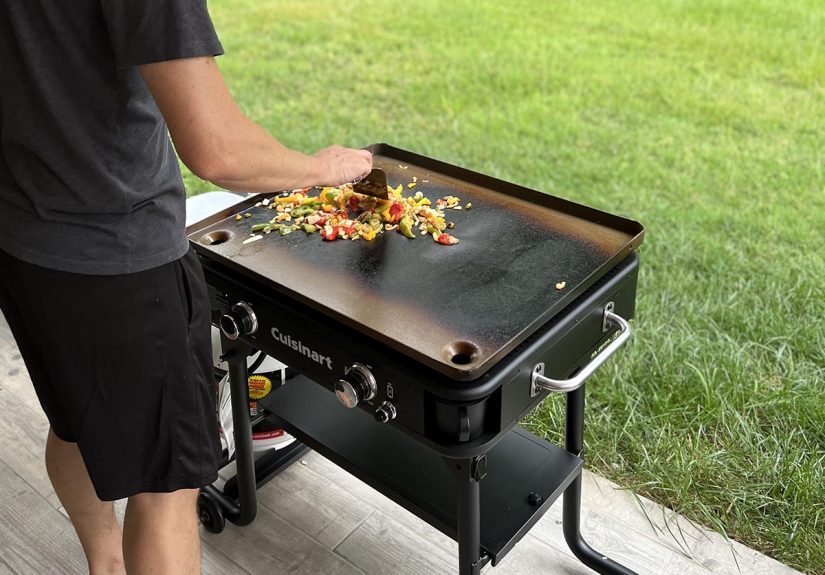
High heat plus a wide surface makes it easy to sear steak or chicken, soften onions and peppers, and warm tortillas at the same time.
Add a squirt bottle of water for quick steam, and you’ve basically opened a restaurant that accepts payment in compliments.
Seafood without the fear
Shrimp, scallops, salmon, flaky fishon a griddle, delicate seafood doesn’t fall through grates, and you can control the heat more gently.
Use a light oil, keep the surface seasoned, and let the food release when it’s ready.
Vegetables that actually taste like something
Sear broccoli, char green beans, caramelize onions, blister peppers, toast buns, roast mushroomsthen hit everything with a squeeze of lemon or a sauce.
This is where griddles quietly outperform a lot of grills, especially for smaller chopped foods.
Must-have accessories (and a few “nice-to-haves”)
- Two metal spatulas: one wide for flipping, one stiff for scraping and chopping.
- Bench scraper or griddle scraper: for cleanup and moving chopped ingredients.
- Burger press: for smash burgers and faster contact cooking.
- Melting dome: for cheeseburgers, steaming veggies, and quick “cover it and it’s done” wins.
- Oil bottles: one for oil, one for water (steam), one for sauce if you’re feeling ambitious.
- Instant-read thermometer: so chicken is safe and steak is exactly how you like it.
- Cover: because weather doesn’t care about your seasoning.
Seasoning and maintenance: the simple routine that saves your cooktop
Most outdoor griddles need seasoningthin layers of high-smoke-point oil heated until they polymerize into a durable, dark coating.
The key word is thin. Thick oil layers lead to sticky spots, uneven patches, or flaking later.
- Heat the griddle until it’s hot and dry.
- Wipe on a very thin layer of oil (avocado, canola, grapeseed, etc.).
- Let it smoke off until the surface looks dry again.
- Repeat several thin coats for a new cooktop; do quick maintenance coats as needed.
After cooking: scrape debris, wipe with a small amount of oil, and store it covered. If you see rust, don’t panicscrub it off, re-season, move on.
Rust happens when moisture sits on a bare spot; seasoning is your shield.
Safety and setup tips that prevent “oops” moments
- Cook outside in a well-ventilated area. Griddles are for open air, not garages or enclosed patios.
- Level the griddle. Grease systems work best when the unit is flatthis also improves heat behavior.
- Do a quick leak check. If you smell gas, stop and troubleshoot before lighting.
- Preheat with intention. Give it time to stabilize before judging heat.
- Keep water handy (in a squeeze bottle). Not for firesmostly for steam and quick deglazing of sticky spots.
Outdoor griddle FAQs
Is an outdoor griddle the same as a grill?
Not quite. A grill cooks with open grates and more direct flame exposure; a griddle cooks on a solid flat surface. Griddles are better for
small foods, smash burgers, breakfast, and anything you’d cook on a skillet. Grills are better for big smoky char, drip-through cooking,
and classic grill marks. Plenty of people own bothand sleep just fine at night.
Do I need a lid?
A lid/hood helps with protection and some heat control (especially melting cheese and light steaming). It’s not mandatory, but it’s very convenient
particularly if you cook often and want faster “set it, cover it, finish it” moves.
How hard is cleanup?
Usually easier than you think: scrape, push grease into the tray, wipe, oil lightly. The best outdoor griddles make this process straightforward.
The worst ones make you feel like you’re doing chores for a cooktop that refuses to say thank you.
Real-world experiences: what cooking on a griddle is actually like (the good, the messy, and the delicious)
If you’re new to griddles, the first experience most people have is a mix of excitement and “wow, this is hotter than I expected.”
The surface behaves differently than a grill grate or an indoor pan because you’re managing a large steel plate that stores heat.
The upside is consistency: once the cooktop is preheated, it stays ready for batch cookingpancakes in waves, burgers in rounds, fajitas in a full assembly line.
The learning curve is mostly about controlling when you add food and where you place it.
The second big experience is discovering zones. On a typical cook night, you’ll end up with a “sear zone” for proteins, a “sauté zone” for onions and peppers,
and a “hold zone” where buns toast gently or tortillas stay warm. That’s when an outdoor griddle starts to feel like a short-order station,
even if you’re wearing flip-flops and your spatula skills are still “enthusiastic beginner.” Many new owners also notice that griddle cooking rewards prep:
once the surface is hot, you don’t want to run inside every two minutes for the next ingredient. A small tray system (or even sheet pans) suddenly feels genius.
Cleanup is usually the surprise hit. The first time you scrape the surface, push the drippings to the grease cup, and wipe everything down in under five minutes,
it feels like you’ve hacked outdoor cooking. The trick is timing: a quick scrape while the cooktop is still warm is dramatically easier than waiting until it’s cold
and crusty. Another common “aha” is steam-cleaning: a small squirt of water on hot steel loosens stuck bits, and you can scrape them away without going full elbow-grease.
Just don’t flood the surfacethink “light mist,” not “backyard monsoon.”
Seasoning creates the most opinions. Some cooks love the ritual (thin oil, heat, repeat), while others just want to cook and move on with life.
In reality, it’s closer to maintaining a cast-iron skillet than doing a science experiment. A new griddle may need a handful of thin seasoning passes to build a good base,
and then it becomes maintenance: cook, clean, wipe with a whisper of oil, cover. The most common mistake is applying too much oil, which can leave sticky patches.
If that happens, it’s fixable: heat it up, scrape, wipe, and do a thinner coat next time.
Finally, there’s the “I didn’t know I could cook that on this” phase. People start with breakfast and burgers, then graduate to stir-fries,
quesadillas, fried rice, toasted hoagies, seared veggies, and seafood that would’ve been risky on grill grates. Hosting gets easier, too:
you can cook in front of guests without disappearing into the kitchen, and you can feed a crowd in stages without feeling behind.
The best outdoor griddles don’t just make tasty mealsthey make outdoor cooking feel more social, more flexible, and a lot more fun.
Conclusion
The best outdoor griddle is the one that matches how you actually cook: big 36-inch workhorses for crowd meals, compact 2-burners for smaller patios,
and portable tabletop models for camping and tailgates. Prioritize steady heat control, a cooktop you can season and maintain easily, and grease management
that makes cleanup simple. Do that, and you’ll have a backyard tool that can crank out breakfast, dinner, and everything in betweenwithout turning your kitchen into a smoky sauna.