Table of Contents >> Show >> Hide
- Why This Atari 2600 Laser Blaster Hack Is So Appealing
- The Original Problem: Classic Atari Games Were Not Meant To Be Shot At
- How Machine Vision Makes The Laser Blaster Work
- Why Atlantis Is Such A Good Showcase
- Why This Works Better Than Traditional Light Guns On Modern Displays
- What The Project Says About Retro Gaming Today
- Challenges, Trade-Offs, And The Not-So-Magical Bits
- The Bigger Lesson Behind Adding A Laser Blaster To Classic Atari 2600 Games With Machine Vision
- Hands-On Experience: What This Kind Of Atari Laser Blaster Setup Feels Like
- Conclusion
Some retro gaming projects politely restore history. This one grabs history by the joystick, straps a laser pointer to a toy blaster, and asks a very serious question: what if the Atari 2600 had been allowed to live just a little longer in the future?
That is the charm of adding a laser blaster to classic Atari 2600 games with machine vision. It is not just a nostalgia stunt, and it is definitely not a normal controller mod. It is a clever collision between one of the most influential home consoles ever made and a stack of modern tools that did not exist when disco was still a tactical decision. Instead of hacking a cartridge or rewriting the original hardware, the concept uses emulation, a camera, computer vision, and simulated inputs to make old games react as if they were designed for a whole new kind of play.
At a glance, the idea sounds absurd in the best possible way. The Atari 2600 became legendary because it helped normalize cartridge-based home gaming and turned the living room into a place where arcade-style play could thrive. But the system itself was built for brutally simple input: joysticks, paddles, and a single fire button. Asking it to understand a laser blaster is like asking a rotary phone to run a group chat. And yet, with the right machine vision pipeline, that impossible-seeming request becomes not only possible, but surprisingly elegant.
Why This Atari 2600 Laser Blaster Hack Is So Appealing
Retro gaming fans love authenticity, but they also love seeing old systems pushed into weird, wonderful territory. That tension is exactly what makes this project memorable. It respects the look, feel, and logic of classic Atari 2600 games while changing the way players interact with them. The result is part preservation, part playful rebellion.
There is also something deeply funny and deeply satisfying about solving a 1970s design limitation with 2020s computer vision. The original console was never built around a native, mainstream light-gun ecosystem. Yes, the Atari universe eventually brushed up against light-gun hardware in later years, and the 2600 itself got a very limited taste of that world late in its life. But that was the exception, not the rule. For most people, the Atari 2600 experience meant one stick, one red button, and a lot of imagination. This hack takes that familiar control language and translates aiming on a wall into the same old directional and button actions the game already understands.
The Original Problem: Classic Atari Games Were Not Meant To Be Shot At
Simple games, simple inputs, severe limitations
The genius of the Atari 2600 was never brute force. It was creative restraint. Developers worked with tiny budgets in memory, lean hardware, and extremely direct control schemes. Games were designed around what the console could read quickly and reliably. That usually meant left, right, maybe up or down, and fire. Elegant? Yes. Flexible? Not exactly.
That is why a machine-vision approach makes so much sense. Instead of demanding that the original game understand a brand-new controller, the software watches what the player is doing and converts that into the old language the game already speaks. In other words, the player aims freely, but the console still hears something familiar: a directional choice and a trigger press.
A light-gun footnote, not a core identity
It is worth noting that the Atari 2600 was not entirely untouched by light-gun history. Late in the platform’s long life, the XE Light Gun and games like Sentinel demonstrated that gun-style play was not completely impossible in the broader Atari ecosystem. But that support was rare, late, and niche. It never defined the console in the way the NES Zapper became culturally glued to Nintendo in the public imagination.
That distinction matters. This project is not reviving a standard feature people forgot about. It is creating a new interaction model for games that were mostly built without one. That makes the hack feel less like restoration and more like alternate history: the Atari 2600 you might have gotten in a slightly stranger timeline.
How Machine Vision Makes The Laser Blaster Work
Step 1: Use emulation as the bridge
One of the smartest choices in the whole setup is avoiding invasive surgery on original hardware. Rather than modifying a real console, the project runs an Atari 2600 game through the Stella emulator. That matters because emulation provides a clean interface between old software behavior and modern computing tools. It lets the system observe the game, process a live camera feed, and inject inputs without needing to redesign the game itself.
That also makes the project more flexible. Once the logic exists outside the original cartridge, experimentation becomes much easier. You can refine hit zones, adjust tracking, swap display sizes, or test different games without pulling apart a forty-something-year-old machine and praying to the gods of brittle plastic.
Step 2: Project the game and watch the playfield
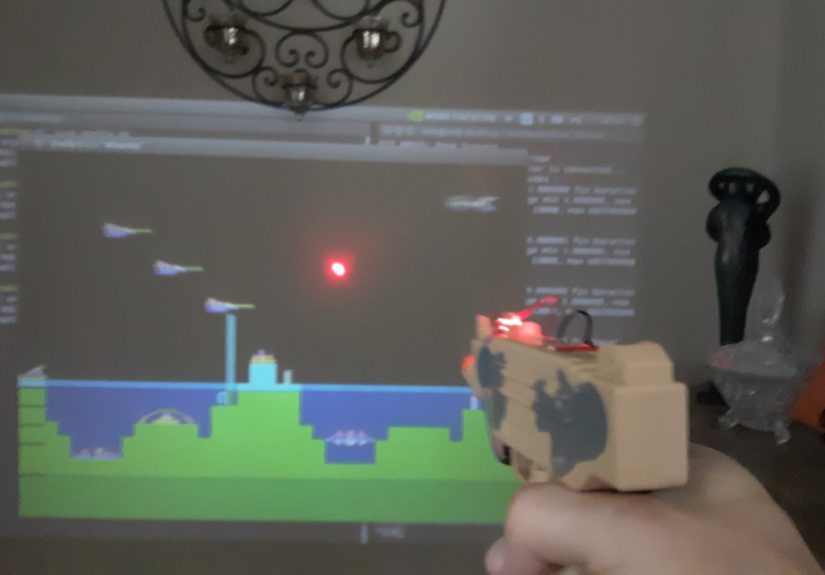
In the featured build, the game is projected onto a wall while a camera continuously observes the image. This is a crucial design choice. The system is not trying to interpret controller motion in the air. It is tracking where the laser dot lands in relation to the visible game field. That means the wall effectively becomes a giant targeting surface.
There is something gloriously theatrical about this. A tiny old game becomes a room-sized battlefield. The Atari 2600, once confined to a living room television, suddenly behaves like a retro arcade installation built by someone who looked at a projector and said, “You know what this needs? More lasers.”
Step 3: Let OpenCV find the red dot
This is where machine vision does the heavy lifting. A red laser dot is an ideal target for image segmentation because it stands out sharply from much of the scene. With OpenCV, the software can threshold the image or isolate a specific color range, detect the bright red point, and estimate its coordinates on the projected display. From there, the system only needs to decide what that position means in game terms.
That sounds simple on paper, but it is quietly brilliant in practice. The software does not need to understand “Atlantis,” “enemy ship,” or “retro shooter” in a human sense. It only needs to know that when the laser appears inside a defined region, a corresponding input should be fired. Machine vision does not need to become a game historian. It just needs good aim and decent lighting.
Step 4: Convert aim into retro controls
Once the laser position is found, Python code maps those coordinates to gameplay actions. The build then simulates key presses using pynput, which lets software press and release keyboard controls programmatically. This is the crucial translation layer. The blaster is not directly controlling Atari hardware. It is telling the emulator, “Pretend the player just pressed this.”
That small detail is what makes the whole system feel so clean. The hack does not demand that the game become something else. It just gives the existing game a new interpreter.
Why Atlantis Is Such A Good Showcase
The demo choice is not random. Atlantis is an excellent fit because the game already divides defense into distinct firing positions. In the original design, the player controls the left sentry, right sentry, and center command post using joystick direction plus the fire button. That means the machine-vision system does not need full analog precision. It only needs to decide which firing zone the player is targeting and then trigger the appropriate shot.
That is a beautiful match between old design and new technology. Aim left side of the wall, fire left battery. Aim center, fire center defense. Aim right, fire right battery. The game still behaves like Atlantis. The player experience, though, suddenly feels more physical, more dramatic, and a little more arcade-like.
Just as important, the visuals are readable. Classic Atari games often use large, bold shapes and clearly separated play zones. That simplicity can be a gift for machine-vision-driven interaction. Modern photorealistic games would introduce clutter, overlapping effects, and visual ambiguity. The 2600’s chunky visual language, born from limitation, becomes an accidental advantage for computer vision.
Why This Works Better Than Traditional Light Guns On Modern Displays
Classic light guns were built around CRT behavior. They typically used a photodiode to detect light from the television while the game and display timing worked together to infer where the gun was pointed. That trick depended on the way CRTs scanned the screen line by line. It was clever, fast, and deeply tied to the physics of older displays.
Modern flat panels and projectors do not behave the same way, which is why so many vintage light-gun experiences fall apart outside the CRT era. Machine vision sidesteps that problem entirely. Instead of relying on the display’s scan timing, it treats the screen as a visual scene and analyzes it with a camera. That makes the whole setup far more adaptable to present-day hardware.
In plain English: old light-gun logic needed the television to cooperate. Machine vision only needs the camera to see the laser. That is a massive difference, and it is the reason this hack feels modern instead of merely retro.
What The Project Says About Retro Gaming Today
This build is a reminder that retro gaming is no longer just about preservation. It is also about reinterpretation. The best modern retro hacks do not merely keep old machines alive; they ask new questions about them. What happens when embedded AI hardware meets a cartridge-era design philosophy? What happens when projection turns a simple shooter into a wall-scale experience? What happens when computer vision becomes a translator between eras?
Those questions matter because they show how durable old game design really is. The Atari 2600 is not relevant because it can compete with modern hardware. It is relevant because its ideas remain legible, remixable, and fun. Give modern makers an emulator, a camera, and an afternoon full of bad ideas, and the 2600 becomes fresh again.
Challenges, Trade-Offs, And The Not-So-Magical Bits
Of course, this kind of system is not perfect. Lighting conditions matter. A red laser dot must remain visible against the projected image. Camera placement matters. Calibration matters. Latency matters. If the camera feed lags or the hit zones are sloppy, the whole illusion starts to wobble.
There is also a philosophical trade-off. This is not authentic light-gun play in the historical sense. It is closer to a machine-vision overlay that puppeteers original game logic. Purists may grumble. Then again, retro gaming has survived decades precisely because people keep doing gloriously unnecessary things with it.
And there is one more subtle issue: feedback. A visible laser dot gives the player aiming information that classic light guns often did not. That can make some shots easier, and it changes the feel of play. But honestly, that is part of the fun. This project is not pretending to be museum-grade reconstruction. It is openly a creative hack, and it wears that identity well.
The Bigger Lesson Behind Adding A Laser Blaster To Classic Atari 2600 Games With Machine Vision
The real story here is not just “someone made the Atari 2600 work with a laser gun.” The deeper point is that machine vision can act as a compatibility layer for experiences that never officially existed. It can observe a player’s intent in the physical world and translate that intent into a form that old software understands. That is a powerful idea, and it stretches far beyond retro gaming.
For makers, it is a blueprint. For game historians, it is a fascinating “what if.” For players, it is a blast. And for the Atari 2600, it is one more reminder that limitations age, but great ideas do not.
Hands-On Experience: What This Kind Of Atari Laser Blaster Setup Feels Like
The most interesting part of a project like this is not the spec sheet. It is the experience of standing in front of a wall-sized Atari game and realizing that your brain needs a second to catch up. You know you are looking at a classic console game. The graphics are unmistakably old-school: bold shapes, simple motion, no wasted detail, and a kind of visual honesty that modern games often polish right out of existence. But then you raise a toy blaster, squeeze the trigger, and the game reacts. That moment is weird in the best way. It feels like retro gaming wandered into a science fair and came back cooler.
The first sensation is surprise. Even if you understand the technical idea, your reflexes still expect an Atari 2600 game to be operated with a stick and a button. A laser blaster changes your posture, your rhythm, and your sense of distance from the game. Instead of hunching over a controller, you stand back, aim, and commit. The play becomes more physical. You are no longer simply issuing commands. You are pointing at the screen like you have a personal grudge against pixelated invaders.
Then comes the delight of scale. Projecting the game onto a wall transforms the entire mood. Atari graphics, which were designed for comparatively small displays, suddenly become giant and theatrical. Enemy movement is easier to read. Firing lanes feel more dramatic. The room itself starts to feel like part of the cabinet. It is the same game logic, but the emotional texture changes because your whole body is now part of the control loop.
There is also a very specific kind of satisfaction in realizing that the machine vision layer is doing just enough and not too much. It is not trying to outsmart the player or reinvent the game from scratch. It is simply translating. That makes the interaction feel oddly respectful. The project does not smother the Atari identity under modern effects. It leaves the game recognizable while giving you a new way to inhabit it.
Of course, the experience also has a tinkerer’s charm. You can feel the calibration behind the curtain. If the room is too bright, if the camera angle is slightly off, or if the laser dot blooms too much on the wall, the illusion gets a little messy. But honestly, that is part of the appeal. This is not sterile consumer electronics. It is a living hack. It invites adjustment, experimentation, and the kind of muttered troubleshooting that somehow makes the eventual success more satisfying.
And once it works, it becomes the sort of project that makes bystanders grin immediately. You do not need a ten-minute explanation. “It is an Atari game controlled by a laser blaster and machine vision” is enough to get people interested. In a hobby full of subtle improvements and quiet restorations, this one is gloriously obvious. It has showmanship. It has personality. It has the energy of a late-night build that should not work, except it absolutely does.
That is why the experience lingers. It is not merely a control hack. It is a reminder that old games can still surprise us when they are paired with new tools and a playful mindset. You walk away thinking less about nostalgia and more about possibility. If a humble Atari 2600 game can be reimagined through a projector, a camera, OpenCV, and a toy blaster, then retro computing is not a graveyard of finished ideas. It is a workshop full of unfinished conversations.
Conclusion
Adding a laser blaster to classic Atari 2600 games with machine vision is the kind of project that captures everything people love about retro tech culture. It respects the past without being trapped by it. It uses modern tools like OpenCV, emulation, and input simulation not to erase old design, but to illuminate it from a new angle. The Atari 2600 remains what it always was: simple, iconic, and surprisingly flexible in the hands of imaginative people.
More than anything, this hack proves that the best retro gaming experiments do not ask whether old systems can compete with new ones. They ask whether old systems can still inspire new play. In this case, the answer arrives with a bright red dot on the wall and a very enthusiastic yes.